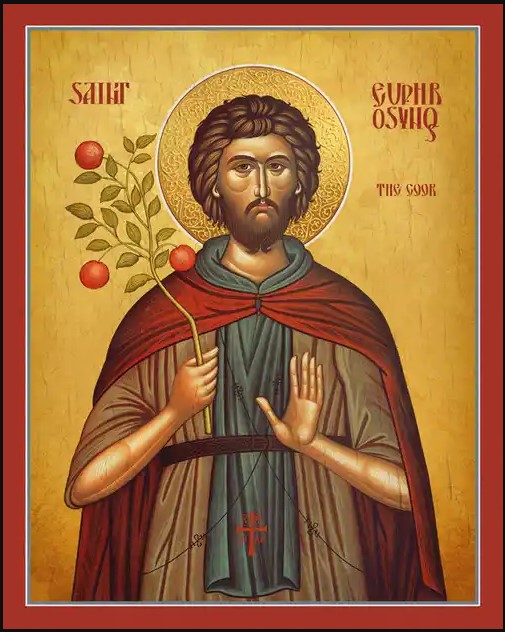
One of the saints commemorated today is a rather popular saint, St. Euphrosynos the Cook. You’ll find his icon in lots of Greek kitchens, and for good reason. He is a wonderful saint.
If you have prepared meals for large groups of people, or even for just your own family, then you know how difficult it is to please everyone. The larger the group, the more likely it is that someone will find the meal distasteful enough to tell the cook of his dissatisfaction. So imagine poor Euphrosynos, cooking for an entire monastery of monks who are constantly fasting, eating less than they should of mostly vegetables, sometimes fish, and you can understand how the poor man often suffered abuse from his hangry brothers. This abuse rests on top of the fact that cooks are always in the kitchen. Meals are served several times each day of the week, and if folks are grouchy even when they’re being fed, you certainly don’t want anyone missing meals. In spite of all this, Euphrosynos’ spirit was in keeping with his name, which means “gladness,” or—more literally—“good on the inside.” In recognition of his long-suffering patience in the kitchen, he has become the patron of cooks.
But there’s more to his story than his patience. One evening, one of the priests of the monastery asked God to give him a vision of paradise, and when he laid down to sleep had a dream. He dreamt of an indescribably beautiful garden, filled with lush vegetation and lovely flowering and fruit-bearing plants. As he explored he came upon the disheveled monk that had served him dinner—Euphrosynos. “How did you get here?” the bewildered priest asked the monk. The saintly cook replied, “I am in paradise through the great mercy of God.”
“Can you give me something from the garden?”
“Whatever you wish.”
Indicating three apples on the nearby tree the priest said, “Those look luscious.”
So Euphrosynos picked three of them, wrapped them in a napkin, and handed them to the priest.
The priest awoke early the next morning, amazed at the dream he’d just had and how real it had seemed, even the awkward encounter with the monastery cook. As he prepared himself for morning prayers he glanced at the table in his cell, and there, wrapped in the same cloth, were the three apples that Euphrosynos had given him in paradise.
Saint Euphrosynos had not just been patient and obedient to his service of the monastery kitchen, he also had devoted himself secretly to prayer and to developing a constant awareness of God. He had made his life—his work in the kitchen—into prayer itself. Prayer that transformed him, and gave him access to paradise. Not a distant, posthumous paradise either, but one present and real to him during his life—even his daily life in the kitchen. A paradise discovered only when a priest was given a vision of heaven.
When the excited priest told his brethren about the encounter and the apples, all were so moved to have such a holy man in their midst that they sought him out to pay their respects, to apologize, and to honor the saint in their midst. However, St. Euphrosynos—who having been there himself, knew of the priest’s vision—anticipated this response and absented himself from the monastery. His humility could not sustain the adulation of his fellow ascetics, and he was never again seen outside of paradise. The apples were kept reverently at the monastery, where small portions were distributed for blessing and healing.
On this Sunday before we celebrate the Elevation of the Holy Cross, Euphrosynos’ story is a perfect reflection. It reminds us that the kind of prayer that makes saints is available even to those of us who are “too busy” to pray. His ascesis, his struggle, in the monastery was the same kind of daily grind that all of us endure in our more mundane lives. He became a saint by doing something familiar to all of us, but doing it in a godly way, possessing what the rock band Rush described as heroic: the “pride of purpose in [an] unrewarding job.” And the daily grind of our lives often seems unrewarding, but St Ephraim of Katounakia offers us hope when he said that “if [he reads] a hundred prayers in the silence of Mt. Athos a day, and [we], in the noise of the city, with work and family responsibilities, read three prayers, then we are in the same position.” We drift from God only if in our daily grind we forget about God, if we forget our purpose, which is to love God and to love each other in everything we do. “This is how you pray continually,” says St. Basil the Great, “not by offering prayer in words but by joining yourself to God through your whole way of life, so that your life becomes one continuous and uninterrupted prayer.” Just as St. Euphrosynos transformed his life into continual prayer in his service to others, so can we.
The Apostle Paul tells the Galatians in this Sunday’s Epistle, “far be it from me to glory except in the cross of our Lord Jesus Christ, by which the world has been crucified to me, and I to the world.” If, in our mundane work—our particular cross—we glory in the opportunity to reflect the love of our Lord, God, and Savior Jesus Christ, who suffered crucifixion on the Holy Cross for us; if we take up the cross of our daily grind remembering God constantly in prayer, then we—like Euphrosynos—can find ourselves in paradise, each and every day. And you’re gonna like them apples.
 An Orthodox Priest Abroad