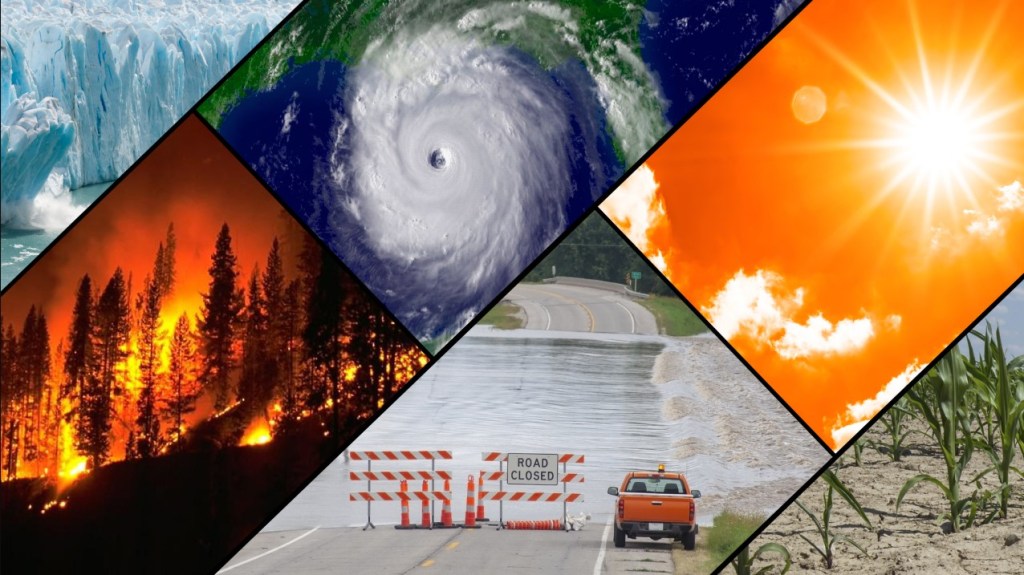
Looking for indicators of what they call a “climate crisis,” advocates for governmental action on climate change often claim that in recent decades natural storms and disasters have increased frequency and severity. Such talk always gets me thinking about the hurricanes and storms I have lived through. It occurred to me that natural disasters of every sort—not just hurricanes, but also tornados, floods, droughts, fires, blizzards, and earthquakes—have occurred throughout recorded history, and some of them have been pretty bad.
It’s difficult to compare the various disasters’ severity, given the scant historical meteorological data, so we’re left to infer such information from ancillary effects. For example, if we look at the financial costs associated with natural disasters, we find that the financial losses associated with natural disasters in 1980 was about $25 billion, which is considerably less than the more than $300 billion they cost in 2011.[1] On the other hand, if we look at fatalities associated with natural disasters we find that mankind was far safer in 2010, when 45,260 unfortunate souls were victims of natural disasters, than we were in 1920 when more than half a million perished.[2] So, in spite of more people living in more places subject to the whims of natural disasters—making it more expensive—we have gotten better at mitigating whatever the effects of climate change might be, and are far safer. Rather mixed results.
I think it more likely, however, that, rather than storms actually being worse, we tend to have a short memory about such things and thus think each current calamity worse than the last, sometimes the worst that’s ever been. We just forget how bad things were before.
When I was a boy, my family moved to western Pennsylvania not long after a flood in Johnstown killed 41 people and did incalculable damage to its economy by essentially ending the steel industry there. That was bad enough, but far better than the flood in the same town in 1889 that killed more than 2200 people, 10% of its population at the time, but from which the city eventually rebuilt. The 1889 Johnstown flood was the largest single-event death toll in America until surpassed by the 1900 Galveston hurricane that killed 8000, which is still the deadliest natural disaster in U.S. history.
Not only has the U.S. suffered floods and hurricanes, but drought and famine in the Plains states, remembered as the Dust Bowl of the 1930s, killed around 5000 Americans[3] and left another half million homeless. My Grandpa nearly starved. It also prompted the largest migration in U.S. history when more than three million farmers abandoned their land.
It’s difficult, then, to say whether or not natural disasters are any worse now, but it is true that death tolls are not nearly as severe as they used to be. Thanks to better predictive models; sturdier construction of better designed buildings; and prompt, well-equipped, and well-trained response and rescue personnel, Americans are far safer nowadays than we were just a few decades ago when I was a child. Yet we seem to feel less safe, and when disaster strikes we proclaim our doom and cast about for someone to blame, as if such things could be prevented. We do this because we have become so well accustomed to a life unencumbered by suffering.
Garrison Keillor once explained the hardiness of Midwesterners by reminding his audience that every year in winter “Mother Nature makes a serious attempt to try and kill us.” Nature is dangerous. But our urbanized, industrial society looks out from our climate-controlled offices and is dumbfounded whenever reality rears its head and reminds us of our fragility and powerlessness in the face of natural forces. The past two years of dealing with the COVID-19 virus has shown just how uncomfortable we are with the idea that we are bound to suffer and how now, more than ever, we don’t like being confronted with our own mortality.
Feeling powerless and helpless led ancient tribal civilizations to try to influence those powerful, uncontrollable forces through religious rites and sacrifices. We are told in our “enlightened” age that science has demystified the universe to the point of making such things silly and unnecessary, mere irrational superstitions. But has it really? Simply explaining the mechanics of weather or how the world functions doesn’t offer us any more control over the forces themselves. We can build dikes to mitigate flooding, but we can’t stop the rains from coming or the river from rising.
As Christians we cannot escape the truth that suffering is part of life and that our highest efforts are not necessarily reserved for saving our own lives. In fact, Jesus tells us in this morning’s gospel that “whoever would save his life will lose it.” BUT we can take courage from Christ’s promise that “whoever loses his life for [Jesus’s] sake and the gospel’s will save it.” This means, I think, that we’re bound to experience persecution because of our faith in Christ, but also that on account of the Gospel we no longer need to have any fear of death, let alone the suffering that attends it. Rather than attempting to stave off the inevitable, we should make use of it, make our suffering redemptive. This is the real benefit of our rites and of our prayers: they bring well-ordered life out of the chaos of death.
Johnny Cash tells a story in his song “Five Feet High and Rising” about a natural disaster he suffered as a boy on his family farm in Dyess, Arkansas. Once when introducing a performance of the song he talked about the way Christians should look at natural disasters. He said, “My mama always taught me that good things come from adversity if we put our faith in the Lord. We couldn’t see much good in the flood waters when they were causing us to have to leave home, but when the water went down, we found that it had washed a load of rich black bottom dirt across our land. The following year we had the best cotton crop we’d ever had.”
Cash’s family had the benefit of a prompt positive event following their disaster, yet it still came only after suffering much loss. When we suffer any kind of trial, we do well to remember Jesus’s promises that such things would happen. Then he told His disciples, “These things I have spoken unto you, that in me you might have peace. In the world you shall have tribulation: but be of good cheer; I have overcome the world.” And if we join ourselves to Christ, then we, too, will overcome the world.
Psychological studies have demonstrated that the human psyche has a remarkable capacity to endure much suffering in this life without falling into despair. Dr. Jonathan Haidt writes in The Happiness Hypothesis that “if you can find a way to make sense of adversity and draw constructive lessons from it, you can benefit [from adversity].” The key is to see the end in our suffering, both the temporal end (knowing that the flood waters will eventually recede) and the meaning of it (its telos or end). Haidt says what should be obvious to us, the Church, that “religious practice can aid growth [after trauma], both by direct fostering of sense making … and by increasing social support.” Communion is the medicine that heals suffering.
Through Holy Communion in the Divine Liturgy, our suffering is placed in the proper context of eternity and we realize the temporal nature of all suffering: that there is an end in sight. Moreover, we discover the redemptive nature of suffering as it exists now. In the words of St. Isaac the Syrian, “If you would be victorious, taste the suffering of Christ in your person, that you may be chosen to taste His glory. For if we suffer with Him, we shall also be glorified with Him. Blessed are you if you suffer for righteousness’ sake. Behold, for years and generations the way of God has been made smooth through the Cross and by death. The way of God is a daily Cross. The Cross is the gate of mysteries.” The Cross is the gateway to Holy Communion with Jesus and with each other. In His Holy Resurrection, Christ not only shows us an end to suffering, but has made even death a mere trifling to be suffered for only a time. Now, even death has an end in sight.
In this festal period of the Exaltation of the Holy Cross we remember that even in the bleakest of circumstances, the darkest of storms, the deepest of waters, we have hope. Because of Christ’s triumph, one in which by grace we all participate, now after death comes Resurrection. If we can join the Apostle Paul in saying, “I have been crucified with Christ” with all of my suffering, and “the life I now live in the flesh I live by faith in the Son of God,” then, after all the trials, after all the suffering, after the cross will come our resurrection. No matter how violent the storm or how high the waters rise, when our focus is on the victory the race can’t beat us.
[1] OECD Disaster Charts (businessinsider.com)
 An Orthodox Priest Abroad