In the mid-third century, in the Thebais region deep in the southern part of Egypt along the Red Sea, lived a monk by the name of Makarius. Even though he was a young man, his devotion to study and prayer gave Makarius a level of wisdom and piety that eventually began to draw people from all around the Mediterranean seeking his guidance and counsel. To avoid the growing crowds, Makarius was forced to move deeper and deeper into the Egyptian desert to concentrate on his studies and prayer.
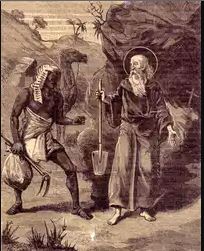
So it was that in the wilderness a camel-mounted stranger happened upon Makarius’ humble hermitage. Makarius was not there at the time, and seeing no one there the stranger dismounted and began loading the monk’s belongings onto his camel. When Makarius returned to find his belongings being pilfered, he rushed in … and began helping the thief load the rest until all of his meager possessions were packed onto the camel’s back. The thief then tried to leave, but the camel refused to rise, so Makarius returned to his cell and brought a small hoe. Saying that the camel must want the hoe also, the monk loaded it on, and kicked the camel telling it to get up. The camel obeyed Makarius’ command, but soon lay down again, and would not move until everything had been returned to Makarius.
I suspect that had it been me who was being robbed, I would have tried a different approach with the hoe than adding it to the pile of my stolen possessions. But Saint Makarius knew better than I that attachment to one’s possessions is a habit fraught with much difficulty. It is such a big problem that nearly all of the world’s religious traditions warn against it, because attachments to things make it far too easy to value our stuff more than we value other people. And if you need proof of this fact, think of the difference between how we react when someone says something denigrating about our favorite sportsball team and how we feel when someone steals or even just damages our officially licensed team jersey.
If we find it easier within ourselves to tolerate someone insulting our neighbor than to suffer someone dinging our car door in the parking lot, then we have something to learn from ABBA Makarius, who would rather lose all of his stuff than offend even the thief in the process of stealing it. We can cultivate the Saint’s attitude in ourselves if we develop a habit of giving things away. Jesus says as much in Luke chapter 12, where he tells a parable about a rich fool before imploring us to “Sell [our] possessions and give to the poor,” so that thereby we can “provide purses for [our]selves that will not wear out, a treasure in heaven that will never fail, where no thief comes near and no moth destroys. For where your treasure is, there your heart will be also.”
St Basil didn’t want us to miss Jesus’ point, so he makes it crystal clear: “The bread which you hold back belongs to the hungry; the coat, which you guard in your locked storage-chests, belongs to the naked; the footwear moldering in your closet belongs to those without shoes. The silver that you keep hidden in a safe place belongs to the one in need. Thus, however many are those whom you could have provided for, so many are those whom you wrong.”
So practice giving things away. It isn’t like you can take them with us anyway, and it’s less stuff to pack for your next move. And, ultimately, it will help us love our neighbor better.
LET US PRAY
Merciful God, we thank you that you do not deal with us as we deserve, but because of your love for mankind you treat us with infinite mercy and compassion. Help us to treat each other the same way, forgiving each other and valuing people more than possessions because all of us are created in your image and bear your likeness. Continue to keep us safe in our daily journeys by your providence and through our mutual concern for each other. Help us to grow less attached to our things and more attached to each other, for You are the God of love and communion, and it is in Your name we pray.
AMEN
 An Orthodox Priest Abroad