Another poem and another opportunity to share with Sailors things and ideas for which, perhaps, they haven’t had much time or opportunity. It tickles me that I was allowed to broadcast poetry on the public address system on a warship. I don’t know how many young people read Robert Frost’s poems in school anymore, but, as I mention in this prayer, most people know the last couple of lines of this one. I remember this prayer also prompting conversations with Sailors the next day, one of whom congratuated me for correctly understanding the poem. I am pleased I got it right. Or did I?
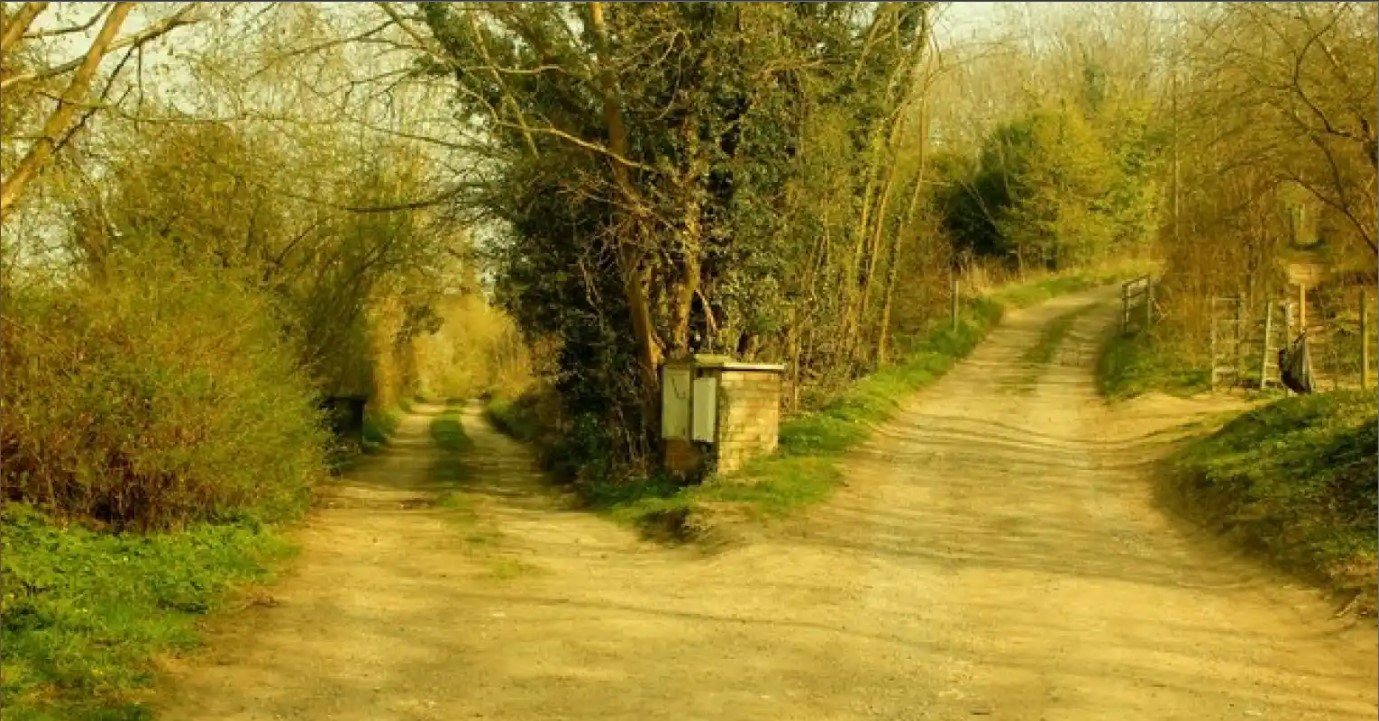
When you come to a fork in the road, take it.
I’d like to share with you another of my favorite poems. This one is a poem by Robert Frost and the title is important, so don’t forget it. It’s called
The Road Not Taken
Two roads diverged in a yellow wood,
And sorry I could not travel both
And be one traveler, long I stood
And looked down one as far as I could
To where it bent in the undergrowth;
Then took the other, as just as fair,
And having perhaps the better claim,
Because it was grassy and wanted wear;
Though as for that the passing there
Had worn them really about the same,
And both that morning equally lay
In leaves no step had trodden black.
Oh, I kept the first for another day!
Yet knowing how way leads on to way,
I doubted if I should ever come back.
I shall be telling this with a sigh
Somewhere ages and ages hence:
Two roads diverged in a wood, and I—
I took the one less traveled by,
And that has made all the difference.
One of the principle difficulties that affects all of us are unexpected course corrections, changes in our plans made necessary by circumstances beyond our control. Whenever something unexpected happens we are confronted with choices that have to be made. Sometimes they’re big choices, sometimes they’re small choices, but like the traveler in Frost’s poem we look down each choice as far as we can and then have to decide which road to take, which choice to make.
Most people remember the final couplet of this poem and think that the poet was encouraging the use of unique, less-travelled paths, that we should all blaze our own trail. But the choice is actually between two already existing roads, and the poet’s description of them makes them rather indistinguishable. There’s no clear clue as to which really is the less-travelled path.
Much like in Navy planning meetings, and in our everyday life choices, the poem’s traveler must choose between uncertain alternatives. He—and we—can only look down the path a little way before it becomes obscured.
What makes all the difference is that we choose a path and move forward, and not get stuck where we are, or think we must go back from whence we came. It matters less which road we take, than the road not taken at all.
LET US PRAY
Lord give us this evening an angel of peace to be a faithful guide and a guardian for our souls and bodies. Help us to be active in the choices we make for our lives and not passive or regressive. You, O Lord, direct our ways, and we don’t always understand our paths, but we know that You are faithful and good and will lead us down the correct path if we trust in you and seek always to do what is good and noble and true, for you are the God of Truth and understanding and it is in your name that we pray.
AMEN
 An Orthodox Priest Abroad