The Boatswains Mate (BM) is one of the oldest ratings in the Navy, predating steam—and even the United States. It is one of the hardest working rates in the Navy, as boatswains mates are responsible for the care of all the ships lines (what most of us call ropes) and for the preservation of the ship’s hull and deck surfaces. Additionally, BM’s have to do nearly all of this work while exposed to the elements. The BMs in Deck Division often feel forgotten about, left to do work no one wants to do without enough hands to do it all, so I enjoyed telling the story of one of their heroes. I found out later that the gang in Deck Division appreciated it, but to me all of them are heroes too.
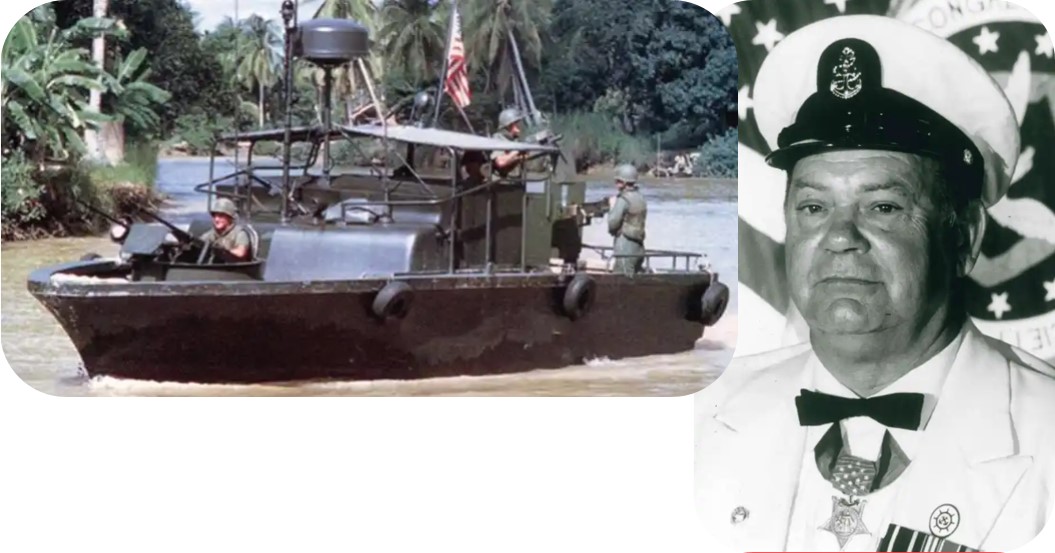
Well, we had another RAS this morning, but it wasn’t just our ship. While we were alongside the oiler’s port side, to her starboard was the USS James E. Williams (DDG-95). Whenever I see a name I don’t immediately recognize adorning a ship or structure, I want to know the story behind the man or woman for whom it’s named, and James E. Williams has to have a good story if the ship’s call-sign is “Mekong Warrior.”
We learned this morning that the USS Osmand Ingram was the first ship named for an enlisted sailor, but she wasn’t the last. James E. Williams was also an enlisted sailor. A Cherokee born in South Carolina, he enlisted when he was 16 and retired 20 years later as a Boatswains Mate First Class after having served in both the Korean and Viet Nam wars. It was in the latter that he distinguished himself as a warrior. BM1 James E. Williams is the most decorated enlisted sailor in U.S. Navy history, having earned the Congressional Medal of Honor, the Navy Cross, two Silver Stars, a Legion of Merit with combat “V,” three Bronze Stars with combat “V,” and three Purple Hearts, just to name the first two rows. He died in 1994, but his widow, Elaine, was alive in 2004 when the ship that bears his name was commissioned.
I think it worthwhile to read this hero’s Medal of Honor Citation this evening:
Attention to Award:
“For conspicuous gallantry and intrepidity at the risk of his life above and beyond the call of duty. PO1c. Williams was serving as boat captain and patrol officer aboard River Patrol Boat (PBR) 105 accompanied by another patrol boat when the patrol was suddenly taken under fire by two enemy sampans. PO1c. Williams immediately ordered the fire returned, killing the crew of one enemy boat and causing the other sampan to take refuge in a nearby river inlet. Pursuing the fleeing sampan, the U.S. patrol encountered a heavy volume of small-arms fire from enemy forces, at close-range, occupying well-concealed positions along the river bank. Maneuvering through this fire, the patrol confronted a numerically superior enemy force aboard two enemy junks and eight sampans augmented by heavy automatic-weapons fire from ashore. In the savage battle that ensued, PO1c. Williams, with utter disregard for his safety, exposed himself to the withering hail of enemy fire to direct counterfire and inspire the actions of his patrol. Recognizing the overwhelming strength of the enemy force, PO1c. Williams deployed his patrol to await the arrival of armed helicopters. In the course of his movement he discovered an even larger concentration of enemy boats. Not waiting for the arrival of the armed helicopters, he displayed great initiative and boldly led the patrol through the intense enemy fire and damaged or destroyed 50 enemy sampans and seven junks. This phase of the action completed, and with the arrival of the armed helicopters, PO1c. Williams directed the attack on the remaining enemy force. Now virtually dark, and although PO1c. Williams was aware that his boats would become even better targets, he ordered the patrol boats’ search lights turned on to better illuminate the area and moved the patrol perilously close to shore to press the attack. Despite a waning supply of ammunition, the patrol successfully engaged the enemy ashore and completed the rout of the enemy force. Under the leadership of PO1c. Williams who demonstrated unusual professional skill and indomitable courage throughout the three-hour battle, the patrol accounted for the destruction or loss of 65 enemy boats and inflicted numerous casualties on the enemy personnel. His extraordinary heroism and exemplary fighting spirit in the face of grave risks inspired the efforts of his men to defeat a larger enemy force and are in keeping with the finest traditions of the U.S. Naval Service.”
Signed PRES. LYNDON B. JOHNSON
As we approach more treacherous water ourselves, it is good to reflect on the example of our forebears. As U.S. Navy Sailors, we stand on some pretty strong shoulders, but, as the XO likes to point out, it only takes one weak link for a chain to part. May the heroes of our history continue to inspire us to keep the finest traditions of the U.S. Naval Service and thereby keep the chain strong.
LET US PRAY
Heavenly Father, We thank You for your providence that gives us heroes to inspire us and traditions that teach us. As we begin to take our turn at the tip of the spear, I pray that you will inspire each of us to do our duty, giving us the strength and the courage to live up to the expectations and examples of our forebears. Continue to grant us your peace and protection, and may our very presence deter those who might otherwise act viciously. Watch over our loved ones at home and grant them also your mercy and peace, for You, Heavenly King, are the Comforter, who is present in all places, filling all things, and to You we give glory, honor, and worship now and forever, and to the ages of ages
AMEN
 An Orthodox Priest Abroad