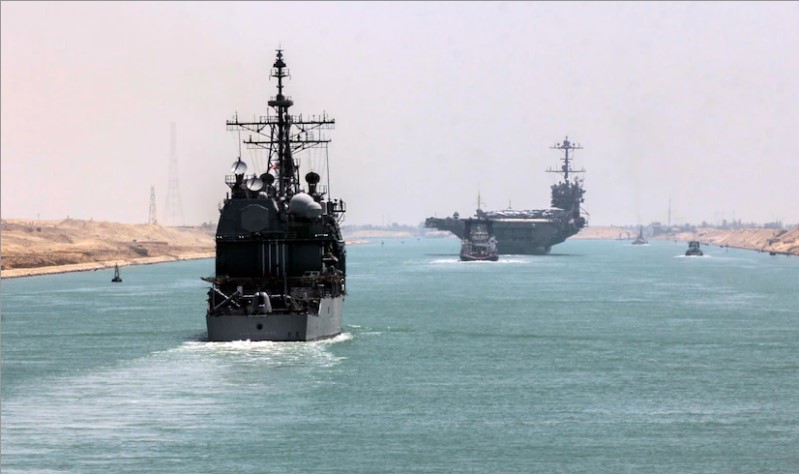
Most of our Navy ships that deploy from the eastern coast of the U.S. will pass through the Suez Canal. It is a long transit in restricted waters that presents a host of difficulties, not the least of which is that the ships are close enough to land to be hit by a thrown rock, let alone more heavily armed assailants. It makes commanders nervous, and when they get nervous so does the crew. It is the first time on most deployments that everyone must confront the fact of the dangerous nature of their business. I am constantly in awe at how well such young men and women stand to their posts with the easy confidence that they can handle whatever is coming that day, and then execute a difficult evolution easily as a matter of course. I try to hold up my end of the bargain with these daily prayers, some of which—like this one—are simply a history lesson to contextualize what it is we’re doing followed by a prayer. Not all of these stories are moral tales, but every prayer is sincere.
The Order of the Ditch
Well, as I’m sure you are all aware by now, tonight—or rather in the wee hours of the morning—we will begin our transit through the Suez Canal, the means by which we can sail from the Mediterranean into the Red Sea. The canal cuts through a narrow portion of land that has been crossed, re-crossed, and fought over for time out of memory.
Efforts to build a canal through it began very early in history. In fact, there is evidence that canals were dug here as early as the 19th century BC. Napoleon’s engineers discovered evidence of such prehistoric efforts when the French emperor began exploring the possibility of digging his own canal to expand his empire in the 19th century AD. Bonaparte gave up, however, because his surveyors erroneously believed that the Red Sea was 28ft higher than the Mediterranean and would thus require locks, making the project cost-prohibitive. The actual difference, it turns out, is <1ft.
Another Frenchman, a diplomat named Ferdinand de Lesseps, convinced the ruler of Egypt to allow him to create a company to construct and operate a canal. After 10 years of digging, the canal opened to much fanfare on 17 November 1869. During the celebrated initial transit, the French ship Péluse ran aground, blocking the recently completed canal until it could be hauled clear the next day. Initial hiccups aside, the canal—combined with the first American transcontinental railroad completed earlier that same year—made it possible to circle the globe faster than it had ever been possible before.
The canal was operated by a privately held company until the British withdrew from the region in 1956, after which Egyptian President Nasser nationalized the company and transferred control to the Suez Canal Authority, with whom it remains to this day. By 1955, two thirds of Europe’s oil passed through the Suez. In 2008, 8% of the world’s seaborne trade transited the canal, which amounted to 21,415 vessels at an average cost of about $251,000 each.
As we cross the threshold of Egypt in the Suez and enter into the various contested waters of 5th Fleet (the waters surrounding the Arabian peninsula), let’s remember that our mission is to keep these waters safe for anyone to transit them, and to keep the fight on this side of the globe, keep the danger here and off of our own shores. The job is not an easy one, but it is ours. May we all have the strength and the courage to stand to our duty.
LET US PRAY
Lord God, as we begin to stand our watch on the wall between the ones we love and those who would do them harm, remind us of your abiding presence even in the midst of chaos. Continue to give us the strength and courage we need to live up to our responsibilities and to fulfill our duties. Keep us safe at sea and our loved ones safe at home, for You are a God of peace and hope, and it is in Your name we pray
AMEN
 An Orthodox Priest Abroad