The nice thing about poetry is that a good one can offer a good moral lesson for which I might otherwise turn to scripture, but which I avoid for fear of alienating my listeners. It’s also good for them to hear language used beautifully. In current popular music, the various kinds I hear when the crew—or my kids—are playing it, there seems to be an absence of any poetic voice. Even in the thoughtful and otherwise good music, there seems to me a rather limited and shallow use of metaphor and a lack in depth of expression. All this indicates to me that young people aren’t reading enough poetry. If I can inspire just a few to begin exploring the possibilities of beauty in language, then I’ve accomplished part of my mission as their chaplain.
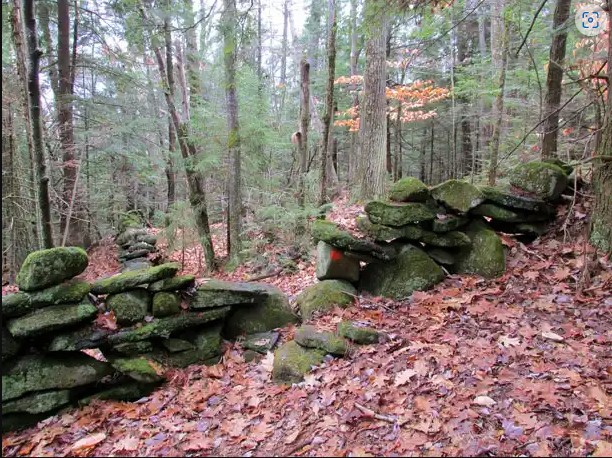
Meet me at the boundaries.
I’m going back to the poetry well tonight, and again to Robert Frost, but he is a particular favorite of mine, and his relatively short poems are typically packed with layered meaning. This one’s called
Mending Wall
Something there is that doesn’t love a wall,
That sends the frozen-ground-swell under it,
And spills the upper boulders in the sun;
And makes gaps even two can pass abreast.
The work of hunters is another thing:
I have come after them and made repair
Where they have left not one stone on a stone,
But they would have the rabbit out of hiding,
To please the yelping dogs. The gaps I mean,
No one has seen them made or heard them made,
But at spring mending-time we find them there.
I let my neighbor know beyond the hill;
And on a day we meet to walk the line
And set the wall between us once again.
We keep the wall between us as we go.
To each the boulders that have fallen to each.
And some are loaves and some so nearly balls
We have to use a spell to make them balance:
‘Stay where you are until our backs are turned!’
We wear our fingers rough with handling them.
Oh, just another kind of out-door game,
One on a side. It comes to little more:
There where it is we do not need the wall:
He is all pine and I am apple orchard.
My apple trees will never get across
And eat the cones under his pines, I tell him.
He only says, ‘Good fences make good neighbors.’
Spring is the mischief in me, and I wonder
If I could put a notion in his head:
‘Why do they make good neighbors? Isn’t it
Where there are cows? But here there are no cows.
Before I built a wall I’d ask to know
What I was walling in or walling out,
And to whom I was like to give offense.
Something there is that doesn’t love a wall,
That wants it down.’ I could say ‘Elves’ to him,
But it’s not elves exactly, and I’d rather
He said it for himself. I see him there
Bringing a stone grasped firmly by the top
In each hand, like an old-stone savage armed.
He moves in darkness as it seems to me,
Not of woods only and the shade of trees.
He will not go behind his father’s saying,
And he likes having thought of it so well
He says again, ‘Good fences make good neighbors.’
Of the many layers in this poem, I think the most obvious thing the poet is trying to say is that the expression “good fences make good neighbors” is itself a metaphorical wall or fence. We still often use it as an excuse to wall ourselves off, staying safely behind a boundary. Boundaries, however necessary, should not be walls that isolate us from each other, but places where we meet each other. The poem’s narrator and his neighbor met at their boundary, and it was in the mending of the wall together—not the wall itself—that made them good neighbors.
LET US PRAY
Lord, we often use boundaries as an excuse to avoid knowing each other. Help us to meet at those boundaries to know each other, and not be satisfied with the darkness on our side of the wall. Teach us that it is in our relationships with each other that we discover who we ourselves are, and that it is working together for a shared purpose—a shared mission—that we become like family. Make all of us a family tonight, for you are our Father who is from everlasting and to You we give glory, honor, and worship always, now and forever and to the ages of ages.
AMEN
 An Orthodox Priest Abroad