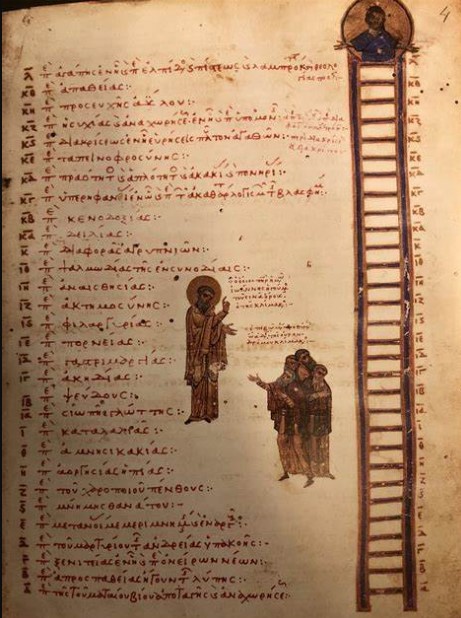
This Sunday, the fourth of Great Lent, we remember St. John Climacus, known principally for his book The Ladder of Divine Ascent. One of the most beloved works of Orthodox Christian spirituality, it describes the 30 steps by which, according to St. John, we climb from earth to heaven. On the rungs we move from Renunciation, through Penitence and Affliction, to Defeat of Vices and Acquisition of Virtue, on past Avoidance of the Traps of Asceticism, to finally arrive at the Acquisition of Hesychia (stillness) and Apatheia (freedom from passions). Along the journey we hit step 21, On Unmanly and Puerile Cowardice.
Be not afraid.
I want to address cowardice because it is something that each of us has to face on a more or less regular basis, and something that owns a particular loathing amongst our military community. The problem, however, is that cowardice doesn’t just go away on its own but is an enemy that itself needs to be confronted and defeated.
The Saint writes, “The man who spends his time in more solitary places should make every effort to avoid being overcome by… that daughter of unbelief, cowardice.” I add the emphasis because this truth meshes perfectly with our Gospel lesson this Sunday. The hapless father cries to Jesus, “I believe! Help my unbelief!” because he realizes that his unbelief was keeping him from what he most desired with all his heart, it planted the seed of doubt which crippled his prayers. “Fear is a rehearsing of danger beforehand,” says St. John, “a trembling sensation of the heart, alarmed and troubled by unknown misfortunes.” When we worry about what could go wrong, it steals our focus from the hope of what might go right.
St. John offers a solution to our cowardice. “Do not hesitate to go late at night to those places where you usually feel afraid…arm yourself with prayer. When you reach the place, stretch out your hands. Flog your enemies with the name of Jesus, for there is no stronger weapon in heaven or earth.” The idea of confronting our fears is one that is still recommended by the best of modern psychologists, because it works. At least as far back as God’s command to Moses to make a bronze serpent that victims of snake bites could gaze upon and be healed, wisdom has known that staring down one’s fears is the beginning of healing. St. John reminds us that we don’t have to do it alone, we can go to our dark, scary places armed with the Jesus prayer and the knowledge that Christ can provide what we lack.
What are you afraid of? What aspect of your life have you allowed, through unbelief, to be paralyzed with fear? Where won’t you go, what won’t you do because you fear the worst? Jesus wants us to overcome our fear through faith that He who descended into Hades and conquered death itself is present with us everywhere and is capable of doing all that we could ever ask or think, just like he did for that heart-broken father. We need to confront our fear and flog it with the name of Jesus, defeat it with hope in anticipation of the best, and then praise God and thank Him for the victory because, Climacus says, “If you continue to be thankful, He will protect you forever.”
Remember the words of St. John Climacus: “He who has conquered cowardice has clearly dedicated his life and soul to God.”
 An Orthodox Priest Abroad