I’m sharing this Easter Prayer on Pascha, rather than Easter because I can. But originally it was, as you can surmise, offered on Easter Sunday. The feast mentioned is the special meal that the command planned as a morale boost for the crew, but, for logistical reasons made more complicated by COVID restrictions, did not arrive on time for Western Easter. So that year the crew of a U.S. Navy Warship celebrated Orthodox Pascha with me with a great feast. Χριστός Ανέστη! Christ is risen!
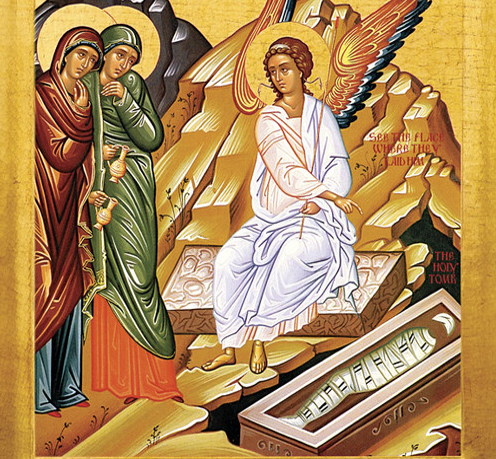
He is not here…
Happy Easter! This is actually a little weird for me to say, and a week too early. I will explain…no there is too much, let me sum up.
Though this feast celebrating the Resurrection of Jesus is the oldest Christian festival, it wasn’t called “Easter” until much later. It was first called—and still is, in most parts of the world—by its Greek name “Pascha.” This word is a transliteration of the Hebrew word “Pesach,” which, if you remember from last week, means “Passover.” Since Jesus is considered by Christianity to be the fulfillment of Passover, the Church called the feast “Pascha.” So in my Orthodox tradition, I’m more accustomed to wishing people a Good Pascha, Καλό Πάσχα (kalo pascha), rather than a Happy Easter. So that’s one thing.
The other thing that makes it weird was mentioned by the Captain at All-Hands call last Friday. Because the food for our Easter feast is late, we’ll have to celebrate it a week later, which he correctly pointed out is when the Eastern Orthodox Churches celebrate Pascha. So you’ll all be Greek with me this year. Why a week later?
Short answer: Orthodox Churches use a different calendar to calculate the date of the feast. All Christians celebrate Easter/Pascha the first Sunday after the first full moon after the Spring Equinox, but after centuries of using the Julian calendar, astronomers in the 16th century discovered that neither the equinoxes nor the moon phases actually occurred in the right place according to the calendar. An adjustment had to be made. So, Pope Gregory XIII introduced a new calendar correcting the flaws in the Julian calendar, and to adopt the new calendar 10-13 days had to be dropped to get caught up to reality. When North America adopted the Gregorian calendar in 1752, September was only 19 days long that year. It took until the 20th century for all of the western nations to adopt the new calendar, but for reasons of their own the Orthodox Churches have never fully adopted it, and some continue to use the old calendar exclusively, which is why Russian Orthodox celebrate Christmas in January (though, on their calendar it’s still December 25th).
Because the Orthodox use a different calendar to calculate the celestial time, Orthodox Pascha is usually a week after Western Easter. (Some years it’s more than a month later.) Once in a while we get to celebrate together, but the next time isn’t until 2025. Here’s hoping we’ll be back from deployment before then.
I’d like to share with you tonight an Easter prayer from the Episcopal Book of Common Prayer.
LET US PRAY
Christ our passover is sacrificed for us :
therefore let us keep the feast;
Not with the old leaven,
nor with the leaven of malice and wickedness :
but with the unleavened bread of sincerity and truth. (1 Corinthians 5.7b, 8)
Christ being raised from the dead dieth no more :
death hath no more dominion over him.
For in that he died, he died unto sin once:
but in that he liveth, he liveth unto God.
Likewise reckon ye also yourselves to be dead indeed unto sin:
but alive unto God, through Jesus Christ our Lord. (Romans 6.9-11)
Christ is risen from the dead :
and become the first fruits of them that slept.
For since by man came death :
by man came also the resurrection of the dead.
For as in Adam all die :
even so in Christ shall all be made alive. (1 Corinthians 15.20-22)
Glory be to the Father, and to the Son: and to the Holy Ghost;
as it was in the beginning, is now, and ever shall be:
world without end.
AMEN
 An Orthodox Priest Abroad