I had to go back and update the numbers on this one, and was surprised to find that, while two years ago the Cubs and Dodgers were tied for the lead in the dubious distinction mentioned herein, both have added to their totals and they are no longer tied. I noticed this time, that more than half of the occasions have occurred in this century! That invites some research and maybe a different kind of entry on this blog. In any event, this story was another fun ride for me because it involved both historical and statistical research. The fact that I could use it to provide a moral lesson completed the trifecta. I hope you enjoy it as much as I did.
Focus on the next pitch.
The course of United States’ history changed forever on April 20th, 1916. At 1060 West Addison St on the north side of Chicago, IL the Chicago Cubs played their first game at what was then known as Weeghman Park. It is now known by most people—and loved by any true baseball fan—as Wrigley Field. Both the team and the park had been around for a few years already, but on this date 107 years ago they were paired for the first time into what has become a baseball classic.
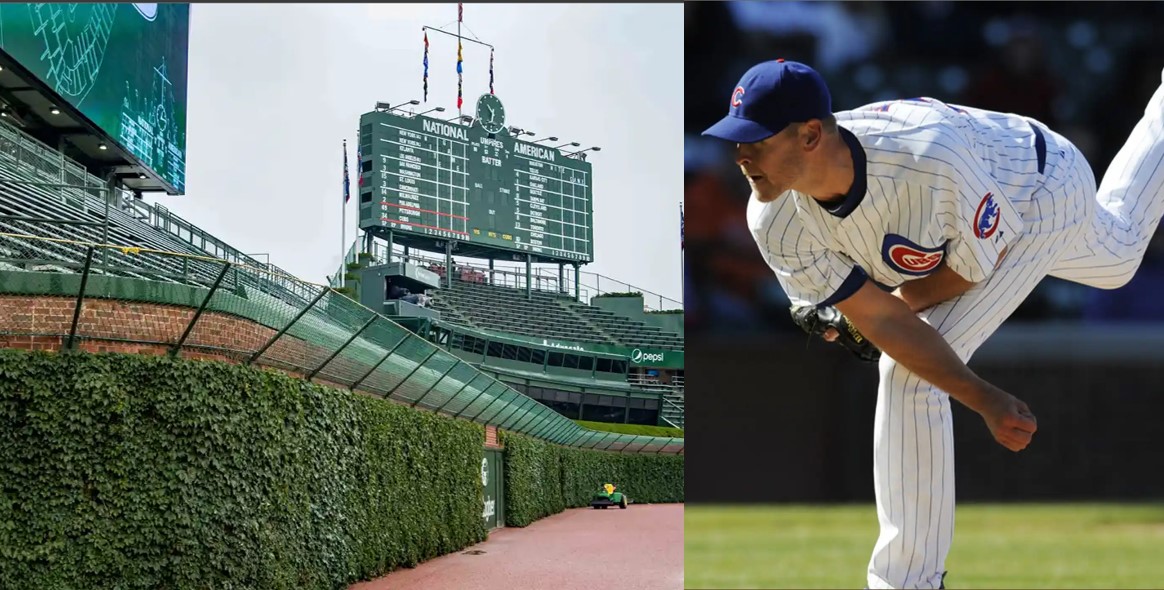
The ivy-covered walls of the Friendly Confines have witnessed a lot of history. Babe Ruth famously called his shot on a home run there in the 1932 World Series. In 1943, spring training for the brand new All-American Girls Professional Baseball League was held there. The Bears of the fledgling National Football League took up residence there until they got their own stadium downtown in 1970. In fact, Wrigley Field held the record for the most NFL games played in a single stadium until 2003, when Giants’ Stadium overtook it. Of course, that stadium hosts two teams so how impressive is that, really?
It was in Wrigley that Kerry Wood became the first National League pitcher, and one of only three men to date, to strike out 20 batters in a single game. It was also at Wrigley where Kerry Wood struck out four batters in a single inning. That’s right, four k’s in one inning.
If there are two outs or no one is on first base, and the catcher fails to catch a third strike, then the batter can attempt to reach base and must be either tagged or forced out at first base. Sometimes the ball gets away from the catcher far enough that the runner reaches first safely and the pitcher then has to get a subsequent batter out. It doesn’t happen often, but even more infrequently (only 93 pitchers have done it) the pitcher gets a fourth strike out to end the inning. The Dodgers with nine are the only team to have done it more often than the Cubs’ eight times, a dubious distinction. Only four players have done it more than once: Chuck Finley three times; A.J. Burnett, Zack Greinke, and Craig Kimbrel twice each.
What makes such a feat so rare (only 100 out of millions of innings in MLB history) and also so remarkable is the guts it must take to come back from the frustration of having gotten the out, but then losing it the next instant. It would be really tough to snap off another really good breaking ball if the pitcher could no longer trust the catcher who’d just let a pitch get past him.
So the defining characteristic of a pitcher with four strike outs in one inning would have to be either courage or trust—probably both—but whichever it is he would have to have some grit to forget the mistakes and focus on the next pitch. That is a skill that can be learned and applied anywhere by anyone.
All of us goof up and make mistakes, but the real problem comes after the fact when we become incapable of forgetting about it, of learning from it, and focusing on the next task. We tend to brood over our mistakes and “if only” ourselves to death. “If only I’d done it a different way.” “If only I’d said something.” “If only I hadn’t goofed.” But no matter how much we brood over a mistake, we cannot undo it. The runner stays on first unless you get another man out. So, like a pitcher has to focus on his next pitch, we must focus on what we can do, on what’s next. We must focus on the things we can control and leave to God the things that we cannot control. He’s the only one for Whom nothing is impossible, and it’s the only way to throw a strike on the next pitch.
LET US PRAY
All-knowing God, You hold all of our tomorrows as memories, help us to keep our yesterdays from poisoning our todays. Give us the wisdom to learn from our past, and yet focus on the present, so that we can craft our future. Give us the courage to acknowledge our mistakes in a constructive way and the strength to face our next challenge, one pitch at a time. For You, O God, are our strength, our protection, and our redeemer, and it is in Your name we pray.
AMEN
 An Orthodox Priest Abroad