Χριστός Ανέστη! Christ is risen!
Today the Holy Fathers of the Church have us read about Thomas the Apostle. We do this for a couple of reasons. Primarily because it is historically accurate, it actually happened. Jesus appeared to His disciples on the day of his Resurrection. Last Sunday. Thomas wasn’t there then, but he was with them when Jesus appeared again on the eighth day, today.
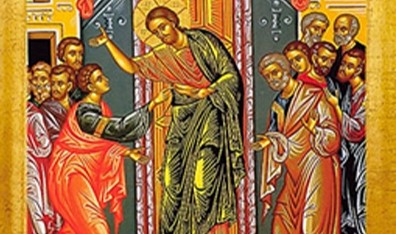
Hope for Skeptics.
Now, Thomas gets a bad reputation from this episode. We call him “Doubting Thomas” in such a way as to say that if I had been there, I would have believed it when my friends told me that they’d seen Jesus alive, silly Thomas. But would we really? All of us are skeptics to some degree.
For example, once while serving as an engineer on submarines, I was standing watch in the main control space of the engine room with two electrician’s mates and an officer. Suddenly the electrician standing watch on the main engine throttles jumped and shouted in surprise, and a little pain, “The K-circuit just shocked me!”
The k-circuit is the throttleman’s indicator showing how fast the ship’s propeller is turning, and it’s a big dial in a raised box on the throttle control panel. He’d been leaning on it, like throttlemen often do, and it was hard to believe that it could shock him. That casing is supposed to be grounded.
So, without any other immediate external indication of what his shipmate claimed, the other electrician on watch with us reached over and touched the casing himself. He immediately yelped in pain, jumping back away from it as he did so. By then the roving electrician had come to the control room and saw what was going on, and he touched the k-circuit with the same—now predictable—result.
While the other two dummies were doubting him, and getting shocked in the process, the throttleman had gone to fetch a voltmeter to see if there was potential on the casing. There was, in fact, more than 100 volts measurable between the k-circuit casing and ground. It turned out that two failures, a short to the casing and a broken grounding wire, were responsible for the throttleman getting shocked. Those failures couldn’t be blamed for the other two men being shocked, however, that was a result of their own skeptical disbelief.
And this, though unusual, is a perfectly natural, run-of-the mill announcement. Imagine being told that someone had risen from the dead. It’s too incredible to believe. And this leads me to the second reason we hear about Thomas this Sunday. Not only is it historically accurate, but it sets the stage for us.
We are now in the place of Thomas: We have heard about the resurrection, but were not present to see the risen Lord, and yet are expected to believe in His resurrection. And now, through the Divine Liturgy, we will have the chance to see and touch him ourselves. Today the Church, through the power and grace of the Holy Spirit, will make us present in the upper room.
You’ll hear the priest say “the doors! The doors! In wisdom let us be attentive!” And just like the disciples we will be shut in. And despite our closed doors Jesus will make His appearance to us.
He appears, though the doors are shut, and we worship him, we touch him, we consume his flesh and blood in Holy Communion. We become the body of Christ, His Church, through communion. We see Jesus in the chalice and in the person sitting next to us and across from us. And though we see, though we worship, yet we doubt. We doubt that Jesus really rose from the dead, we doubt His presence in the Holy Eucharist, we even doubt our own salvation. Will we really live forever? Always there is doubt.
And that’s okay. Thomas is the hope for us skeptics. He’s the intellectually honest one who gives voice to his doubts and actually asks the question. Did the other disciples genuinely believe that they’d seen him? Matthew tells us in the 28th chapter of his gospel that when the disciples saw Jesus, they worshipped Him, but some doubted. Thomas isn’t singled out by Matthew. Mark tells a similar story, and Luke mentions several occasions where those who had seen Jesus were rebuffed and disbelieved by the people they told about their encounters. Really, it’s only natural.
Many Christians who grow to later reject their faith often do so because they were never allowed to ask questions, or felt like they couldn’t. They weren’t allowed to explore the depth of the mysteries of faith. And that is a tragedy. For without the questions our roots will never get deep enough to hold us steady in the face of challenges to our faith. And it is our thirst for knowledge which drives our roots deeper. We were created with curiosity so that we would seek out knowledge, because any honest quest for truth is a quest for Christ, who is Truth Incarnate.
As Christians we are often accused of checking our brains at the door, being asked to believe the unbelievable—like, for instance, the resurrection form the dead. Because it is so unbelievable there are those who even try to make it unnecessary to the core teaching of Christianity. And they don’t stop with the Resurrection. They try to remove anything from the faith that doesn’t line up with their experience and understanding of the world, things that they believe are too fantastic. They want to make things fit into their preconceived notions of what and who God is, what religion is, what the world is. It is an unhealthy skepticism that is unwilling to consider evidence that contradicts its own preconceived notions, that is unwilling to follow where the evidence leads, that will only accept a truth of their own manufacture.
By contrast, a healthy skepticism is one that asks questions and accepts the answers it finds, one that conforms its own understanding to reality as it is revealed, one that when Jesus appears can say with Thomas, “My Lord and my God.”
No matter how fantastic it may seem, we do worship a risen savior. And we remember his death and resurrection through this service of the Holy Eucharist, by celebrating the Divine Mysteries. Mysteries that we are meant to explore, but not solve. And in those mysteries we encounter Jesus in a real and substantive way. We join our experience to that of Christians throughout the ages. Like Thomas we get to see Him, touch Him, handle Him. And when we do, we should have the same reaction that Thomas did.
St Gregory the Theologian notes that Thomas “saw one thing and he believed another; divinity could not be seen by a mortal person. He saw a human being, and he confessed him as God.” We don’t really know from the text whether or not Thomas actually touched Jesus. I kinda like to think that seeing Jesus and hearing his voice was plenty enough to cause him to exclaim, “My Lord, and my God.”
We ARE getting ready to actually touch Him. The Holy Eucharist is the answer to our doubts. What will be your reaction? Will it be just another thing we do today, another check in another box on the “to do” list? Or are our eyes opened to the wonder and majesty of our Risen Lord Jesus Christ? Are we encountering Christ? Are we experiencing the presence of Jesus? He IS here, can we see him? Can we feel Him? When we come to the chalice, will we, like Thomas, exclaim,” My Lord and my God!”
And to whom will we exclaim it? Because after we partake of the Holy Mysteries we can then say, as John the evangelist does in his first epistle, “That which was from the beginning, which we have heard, which we have seen with our eyes, which we have looked upon, and our hands have handled, concerning the Word of life—the life was manifested, and we have seen, and bear witness, and declare to you that eternal life which was with the Father and was manifested to us—that which we have seen and heard we declare to you, that you also may have fellowship with us; and truly our fellowship is with the Father and with His Son Jesus Christ. And these things we [say] to you that your joy may be full.”
When our joy is full it overflows. It overflowed so much in Believing Thomas that he went farther than any of the disciples in his missionary efforts, as far as India and China. So far, in fact, that he couldn’t make it back to Israel in time for the Dormition of the Theotokos.
May our joy be full this morning. Filled with the joy of our Lord’s glorious resurrection, filled with the Holy Communion, filled with Jesus, filled to overflowing and watering the world around us with joy.
Χριστός Ανέστη! Christ is risen!
 An Orthodox Priest Abroad