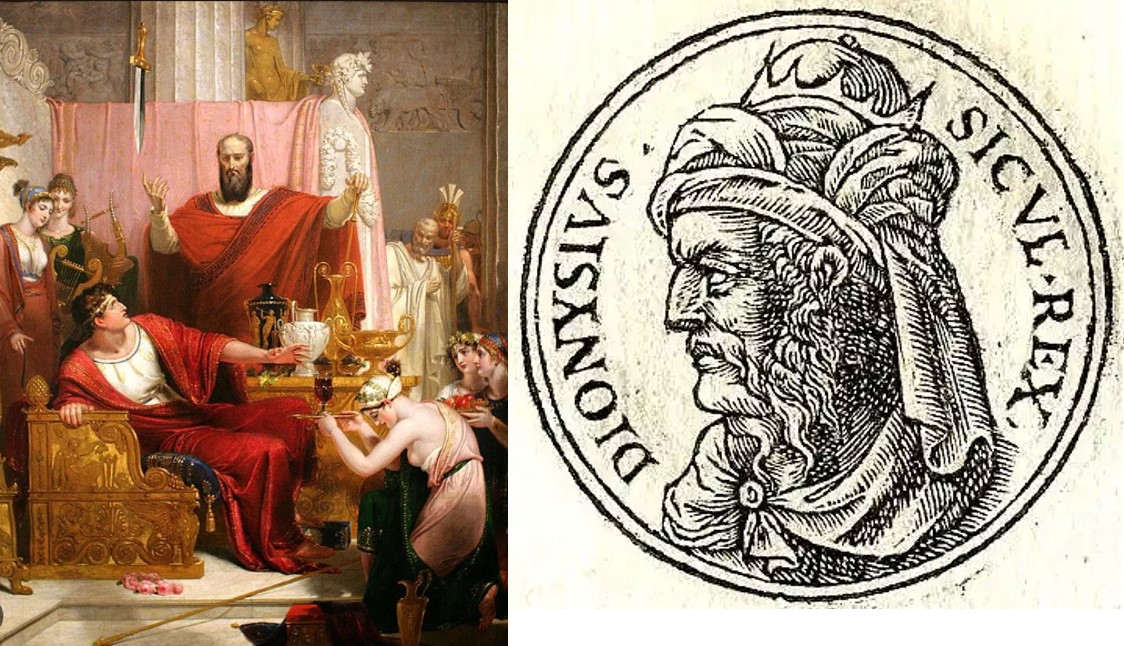
On the island of Sicily, one of the islands that we blew right past on our way through the Mediterranean—it’s the one that looks as though it is being kicked by the boot of Italy—there is a city called Syracuse. Much older than the American city of the same name, it goes back three millennia. In the fourth century BC it was ruled by a tyrant named Dionysios.
Always tell the truth.
Dionysios fancied himself a man of letters as well as a conqueror, and spent some of his time writing poetry. He would sometimes read his poetry to the fawning praise of his courtiers, all of whom praised the genius and beauty of their master’s poetry.
The tyrant became so convinced of his talent that he summoned to his court the most learned man of the city, the philosopher Philoxenos—himself an accomplished poet. Dionysios wanted to hear the praise of this renowned scholar, which he was certain to hear once he’d read Philoxenos a few lines of his own work.
The prideful ruler read to Philoxenos from his best poem. When he’d finished, the scholar said that what he’d heard was so bad that it didn’t deserve to be called poetry, nor did the author deserve to be called a poet. Dionysios was incensed, and had Philoxenos immediately sent to the marble quarries to live out the rest of his now-shorter life in hard labor.
The philosopher had friends, however, and a considerable following, and they demanded that Philoxenos be released. Dionysios, instead, invited him to a banquet and gave him another chance to hear his poetry, hoping the philosopher would reconsider his opinion. Maybe the tyrant thought the friends who sued for his release might persuade him to say what the king wanted to hear. Maybe he thought he could read it better or that Philoxenos hadn’t heard it accurately the first time.
Whatever his motivation, Dionysios again read his poem to Philoxenos, who listened without expression. When he’d concluded his reading, and the crowded room was silent, Dionysios asked for his opinion of this his best poem.
The philosopher replied, “Take me back to the quarries.”
Having already seen the consequences of his honest opinion, Philoxenos opted to skip repeating himself and go straight back to prison. Dionysios, submitting to the honest opinion of a widely respected man simply released him, and bade the real poet to go in peace.
Sometimes we have to tell people things that they would rather not hear, and sometimes their reaction is just what we’d feared it would be. But we cannot let a negative reaction force us to give up the truth. It might be, as it was for Philoxenos, our constancy alone that convinces our hearer of the truth, and once past their initial reaction he or she will likely be grateful for having heard it from someone. Even the tyrant Dionysios appreciated that.
LET US PRAY
Heavenly Father, give us eyes to see the truth, the wisdom to learn from the truth, and the courage to speak only the truth. We know that if we acknowledge you, O Fountain of Truth, that you will direct our paths. Help us to hear the truth when it is spoken to us, grant us endurance to sustain the truth when someone would rather not hear it, especially when that someone is us. Do this for us for You are the Way, the Truth, and the Life and it is in Your name we pray.
AMEN
 An Orthodox Priest Abroad