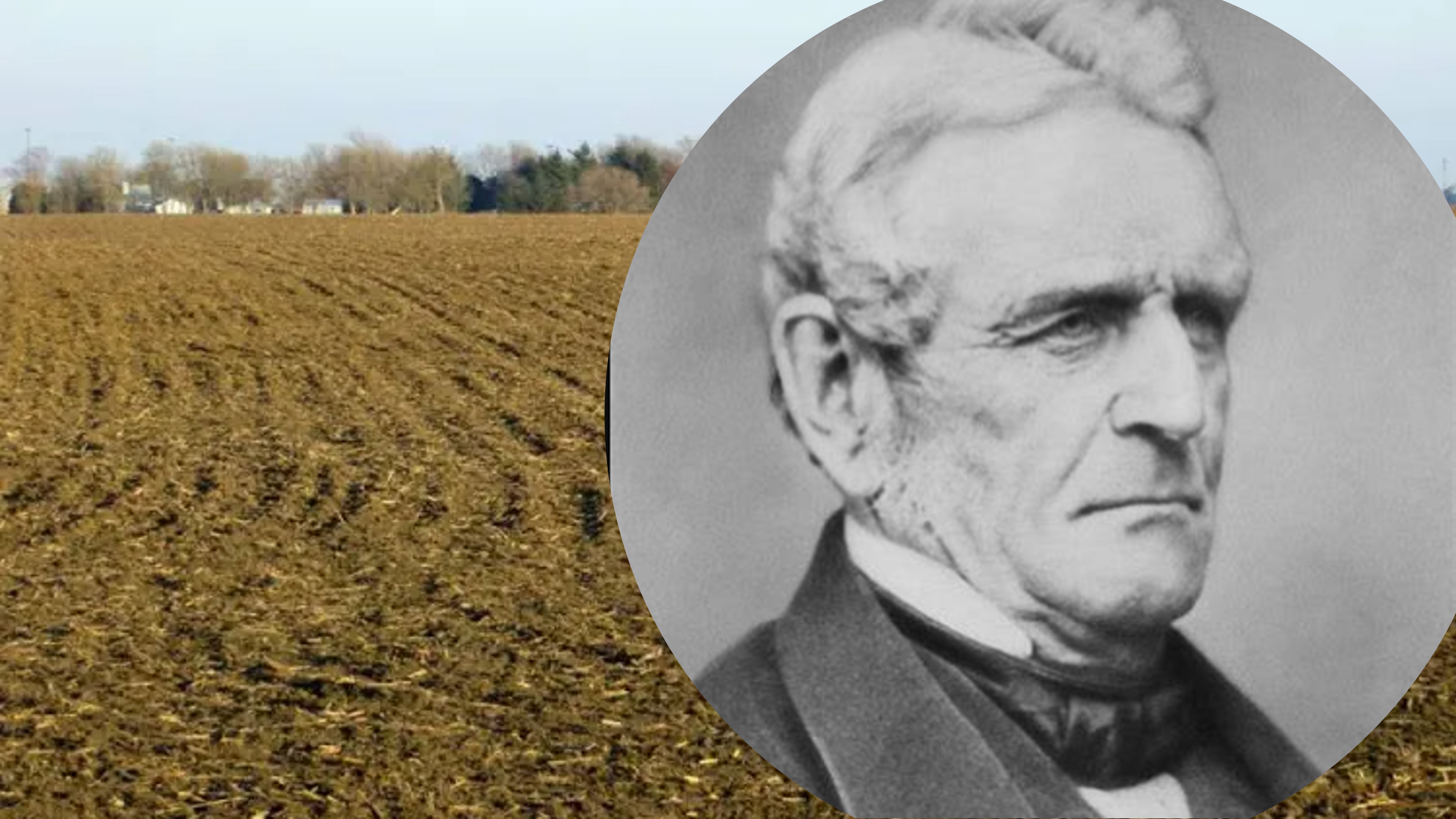
Rutland, VT is a small town nestled in a hollow of the Green Mountains along Otter Creek, which flows north from there into Lake Champlain. It’s a beautiful spot and it was where John was born and grew up. He started college in Middlebury, some 45 miles downstream, but didn’t take long to decide that it wasn’t for him and at 17 apprenticed himself to a local tradesman. Five years later he opened shops in nearby Vermont towns and was doing well, but his family was growing at the same time business was slacking, so, like many before him, he pulled up stakes and headed west.
Make God your goal, and it’s difficult to choose poorly.
He landed in another small town, this one in Illinois. Here the Rock River takes an unusually large bend to the north and west before turning south and then resuming its southwestern course towards the Mississippi. The town was called Grand Detour. In this recently founded village there was plenty of work to be done and few tradesmen to do it, so John thrived. The best, however, was yet to come.
Farmers in the Midwest were finding it difficult to cultivate the soil there, which was thicker, stickier, and more tangled with roots than was the sandy soils of the northeast. A farmer would have to stop often to clear clumps of soil from his plow, which was still made of coarse material, either wood or cast iron.
In his trade as a blacksmith, John found himself repairing the same overmatched plows again and again and thought there must be a better way. He believed that polished steel was the answer, and in 1837, after experimenting with several shapes and designs, John Deere invented the self-scouring steel plow that came to be known as the “plow that broke the plains.” It was such a hit that he sold his shop in Grand Detour and opened a factory in Moline, IL, where the Rock River flows into the Mississippi. There he had better access to steel and transportation, and by 1855—18 years later—he was producing 1000 plows a year.
However things may have gone had John Deere had stayed in college, it would likely have meant that there would not be green and yellow tractors all over the Midwest with his name on them. The path for success is different for every individual, and much of the difference lies in how you define “success.”
Deere and his wife had nine children. His choices were guided by his desire to provide for them, and in the process he built an international manufacturing concern recognized the world over. I don’t think that he’d have had that kind of success in business if business alone had been his guiding desire. Though he likely hoped for financial security when he left school to become a blacksmith, he couldn’t possibly have dreamed that when he leapt into the unknown in a new place that he’d build the kind of national icon that he did. But because he made the best decision that he could, based on what he knew at the time, and was open to trying new places and new ideas, he has left a legacy that has lasted for five generations.
Whatever course you choose in life, be confident in your choice if it is carefully considered and your goal is noble and aligned with your values. By doing so any choice can be a good one. But do your homework first, because you can’t dance until you whet the plow.
LET US PRAY
Lord, You often come to us in ways that we least expect. You are the Lord of circumstances, people, and possibilities that we could never expect. When problems mount and we wonder how we are going to make it, You give us a thought that turns out to be the key to unlock the solution. When we stumble upon and answer to a problem, we find that it was You who guided us at the fork in the road. We belong to You and You are in charge, You have not given up on us, You have plans for us. Thank you for the confidence that You will use everything that happens today and always for Your glory and for our growth, for You, O God are good, and You love mankind, and to You are due glory, honor, and worship, now and forever, and to the ages of ages.
AMEN
 An Orthodox Priest Abroad