When deployment after deployment is conducted without significant incident, crews begin to think nothing can happen, which was the primary failure of the crew of the USS Stark. Thus, we often offer reminders of just how dangerous our work is, and particularly that work in the places where we deploy. One of those places, by the way, is commonly called the Persian Gulf, but because it is Saudi Arabia not Iran who is our ally, the Navy refers to it as the Arabian Gulf. There were some members of our crew who knew some survivors of the attack on the USS Stark. So the following prayer was both reminder and memorial.
Greater love hath no man…
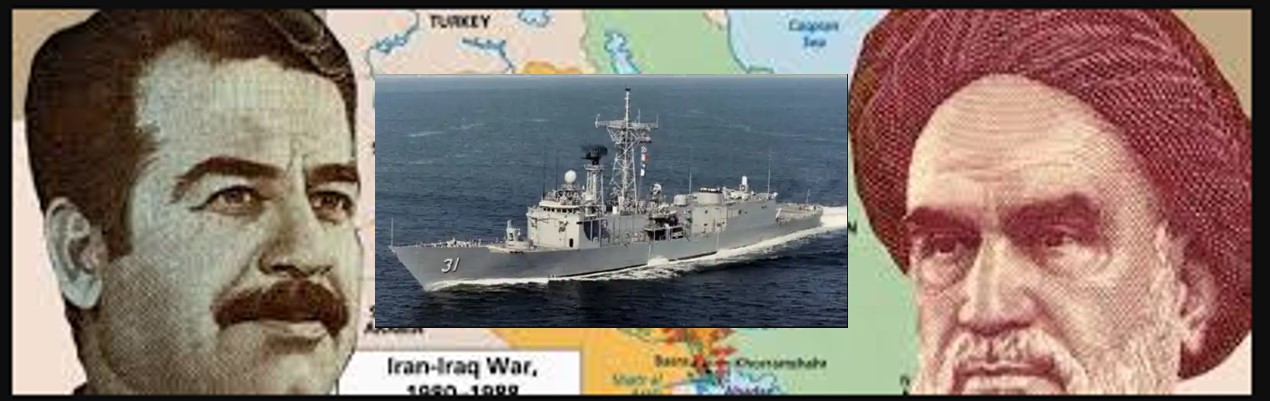
May 17th was a Sunday in 1987. Iran and Iraq had been in a state of open war for seven years, and their conflict had begun to spill out into the Arabian (Persian) Gulf. Both sides began attacking each other’s commercial shipping—including oil tankers. Both sides declared Exclusion Zones, warning foreign ships to stay clear, and the United Nations Security Council passed a resolution prompting the U.S. Navy to patrol the boundaries of the Exclusion Zones and protect neutral shipping, primarily Kuwaiti ships. The USS Stark was one of the warships assigned to Operation Earnest Will.
Neither Iran nor Iraq had declared hostilities with the U.S. In fact, Iraq was—as it is now—a de facto ally of the United States. So, when the crew of the Stark detected an Iraqi Air Force jet at 2058 on the night of the 17th, there was no particular cause for alarm. The Tactical Action Officer (TAO) and Combat Information Center (CIC) watchstanders—even the Commanding Officer—expected it to pass by without incident, and began collecting data of the encounter for required reports. No one noticed when the Iraqi F-1 Mirage turned inbound towards the Stark at 2105 until two minutes later, at which point the crew began issuing warnings to the inbound aircraft. Their warnings were unheeded.
At 2108 the Mirage fired two Exocet anti-ship missiles that the crew of the Stark didn’t detect until a lookout spotted them on the horizon through his binoculars, moments before they struck the ship at 2109. Over the course of the 11 minute engagement, Stark never maneuvered to unmask her batteries, never assigned weapons or even engaged the inbound fighter plane, and never fired a single shot in either self-defense or retaliation.
Today is the 36th anniversary of the only successful missile attack against a U.S. warship. It was a sucker punch, to be sure, but it should serve to remind us just how dangerous our work is, and why it is that we practice so often and follow strict protocols and rules, and why vigilant watchstanding is so important.
Many of the Navy’s most important lessons have been paid for by the blood and lives of fellow Sailors. 37 of our shipmates perished in the attack on the USS Stark. May their sacrifice prompt us to maintain our vigilance and dedication to be ready at a moment’s notice to spring to the defense of our ship and our nation.
In honor of the Sailors lost on the USS Stark, we will begin this evening’s prayer with a moment of silence.
LET US PRAY
[Moment of silence] “Greater love has no man than to lay down his life for another.” Lord, tonight we remember and commend to Your great mercy the Sailors on a routine deployment who were put to the test and paid the ultimate sacrifice. May our service honor their memory and their spirit as we continue to wave the banner of freedom with renewed commitment and inspiration. Comfort the families and friends of those who perished 36 years ago. Continue to bless and protect this ship, and all ships of the strike group. Keep us vigilant in our duties and rigorous in our action, for You are the God of strength and justice and You are holy always, now and forever and to the ages of ages.
AMEN
 An Orthodox Priest Abroad