Living overseas is an educational experience. Of course, one learns a little of the local language and customs, visits the historical and cultural sites, but it’s in the smaller, more mundane aspects of life where the education can be most surprising.
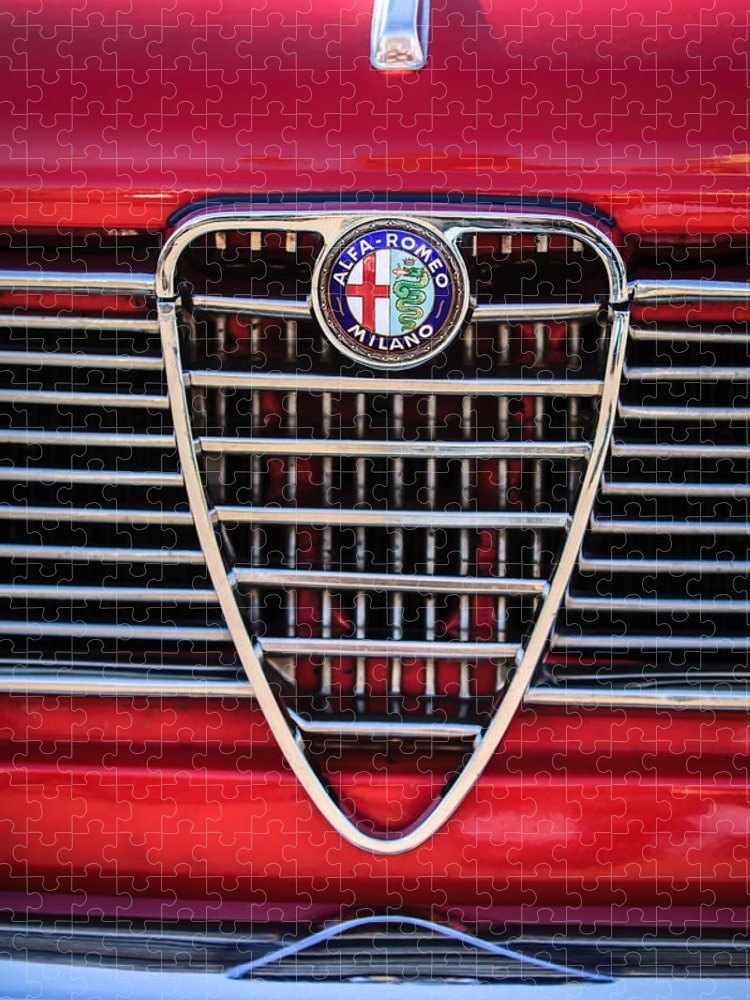
Take auto repair and service, for example. In the states I could easily find an auto parts store that would have whatever parts I needed, usually in stock. I could use English to ask for what I need. And mostly I can understand how the car works in the first place.
I have replaced stereos in several cars, and even one in Okinawa, but I have never faced the complications I did when I tried to install a new unit into my 2006 Alfa Romeo 147 here in Italy.
To begin with, my education in Italian cars began with a cultural lesson. The officer from whom I purchased the car, one in a sequence of several previous owners, explained that she had replaced the factory stereo when she’d bought it, but her new unit had been stolen. Ripped right out of the dash. So she’d just shoved the original, non-functional unit back into the console when it was time to sell it. Unfortunately, it no longer fit properly and blocked my use of the cup holder. (The cup holder is another educational experience, it only holds espresso-sized cups.)
Apparently, petty theft is a big, big problem around Naples. We were told on our orientation brief to leave our car doors unlocked so thieves can simply open the door to verify there’s nothing worth stealing. They might break the glass to do the same thing if the doors are locked.
So, like most of the personnel assigned here who drive temporary, local cars, I bought a Bluetooth speaker to use when I’m driving and that I can take with me or hide in the trunk to avoid being stolen. But this introduces other problems, like how to keep it charged or where to put it when I have passengers. Controlling it while I’m driving can be a problem also. I thought it was time to replace the non-functional, interfering stereo deck. After all, it was old enough to include a CD player.
Since we live on base and usually only park in garages when we go into town, I thought it’d be safe try. We hadn’t yet had any problem with things being taken from our car. To minimize the potential for loss I would buy the cheapest unit I could find, one that had Bluetooth connectivity for less than $30, so even if it were stolen, it could be easily replaced with another one just as disposable and still not cost us much. Amazon was the logical choice, since with Prime we get free shipping, but that meant buying a unit designed for American cars. My education expands.
It proved to be much easier to remove the original unit from the console than I had expected, and with it out of the way I could then see the connectors installed in the car. The factory unit also had a diagram on it displaying the pin layout of the connectors so I could see what the installed coupling provided the unit and where. This raised questions immediately, because there seemed to be no pin assigned to ignition-controlled 12v DC. There were, however, a couple of connections I didn’t recognize, and figured I’d find it there and cross that bridge when I got to it.
I started shopping Amazon for a replacement, and when I found one with a socket that looked like it would fit the connector in the car and had the functions I was seeking for a price I wanted to pay, I got excited and ordered it. With any luck it would be plug-and-play like modern computer peripherals are supposed to be. (That should have been my first clue of impending trouble.) Even if I have to move a pin or two in the connector, at least I won’t have to splice all 12 or so connections.
It didn’t take long for the new stereo to arrive, and, eager to get started, I took it straight out to the car. The first step was putting a voltmeter on the car’s connector to see what was actually there. As I had feared, there was no 12v supply controlled by the ignition. There was instead a 5-6v constant supply that I could not explain on one of the connections with unfamiliar labels, and my European education continued.
I found out that many cars (and nearly all European cars) since the mid to late 2000s (including my 2006 Alfa Romeo) use what’s called a CAN bus to control pretty much everything on the car-including the stereo. That was the 6v supply I was seeing. So, having only the constant 12v supply on the plug where the new unit wanted ignition-controlled 12v, and nothing on the plug where the new unit wanted constant 12v, I tried simply plugging the unit into the dash connector. Since the constant voltage is really only for maintaining memory functions, like station presets and clock time, I thought I could at least check that the rest of the system worked. It didn’t.
Well, maybe I need to connect the 12v to both the constant and ignition-controlled supply inputs for the stereo to work. The new unit came with connectors, so I plugged the power supply connector into the stereo and tried plugging the wires from the connector into the car’s plug 12v supply. I drew a spark trying to get the stripped wire ends into the connector plug. This didn’t really surprise me, and it wasn’t very big, but that effort didn’t work either. I would have to splice some things together to figure it out.
By now, late evening, I felt like I was being swarmed by mosquitos as I spliced the new unit’s connector into the car’s wiring and plugged in the stereo to connect its 12v inputs directly to the car’s power supply. Still nothing. Either I had a defective stereo or there was more to this car than I’d anticipated. Already scratching my mosquito bites, hot and sweaty from the heat, I called it a night. I’ll try again tomorrow.
When I got in the car for my commute the next morning, the dash fan didn’t start when I turned on the car. I had no AC. “Super,” I thought, “What have I done to the car? I’ll just have to use windows today, and I’ll fix it later. I have to get to work.” But when I mashed on the button for the power windows, nothing happened.
Unbelievable. I must have done some extensive damage to break both the AC and the power windows. I couldn’t imagine what I could possibly have done, simply installing the radio, that could do such a thing. The only indication I had that I’d done anything destructive was the short spark that came out of the connector when I’d tried to insert the new plug. Frustrated, I had to put off doing anything until after work, though I had to take the Dodge and leave Nora stranded at home for the day.
Upon reflection, I figured that I must have blown a fuse when I raised that arc, which gave me a little hope. It meant that maybe the new stereo wasn’t faulty, but simply didn’t have power when I finally connected it, and fuses are easy to replace. At least in America they are. Here in Italy it required more education.
First, I had to check the fuses. I knew there was a fuse box in the engine compartment. It was easy to get to and didn’t have many fuses, so it should be easy to check. It was, and all those fuses were good, so I was back to worrying that something was seriously wrong with the car. I hit the internet for a little more research.
The fact that people survived abroad without the internet and smartphones is a wonder to me. My phone has been invaluable for finding my way around and helping me communicate with locals in four European countries so far. And now the internet showed me that there is indeed an additional fuse box, located inside the cabin of a 2006 Alfa Romeo 147. I expected-and hoped-that there must be another one, but hadn’t been able to find it.
What I didn’t know, until after my internet search, was that I had to remove two screws and pop the bottom half of the dashboard open, and it would then hinge down to expose the fuse box. In a classic theme of Italian design, the builders made the console look nice, prioritizing appearance over practical accessibility.
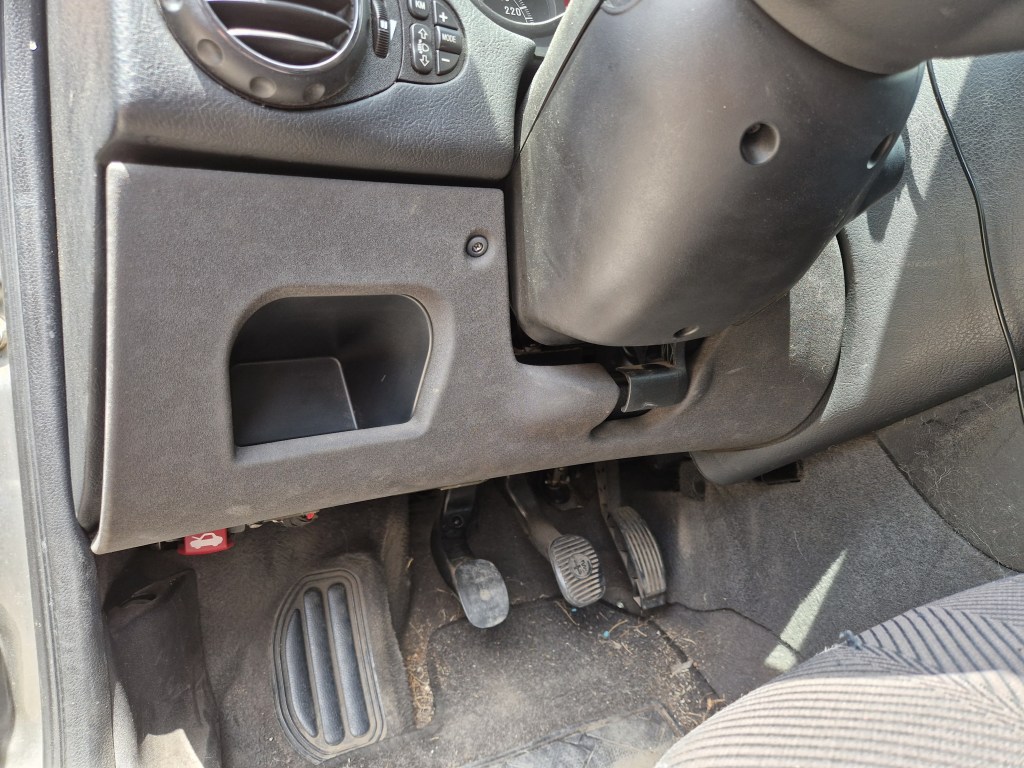
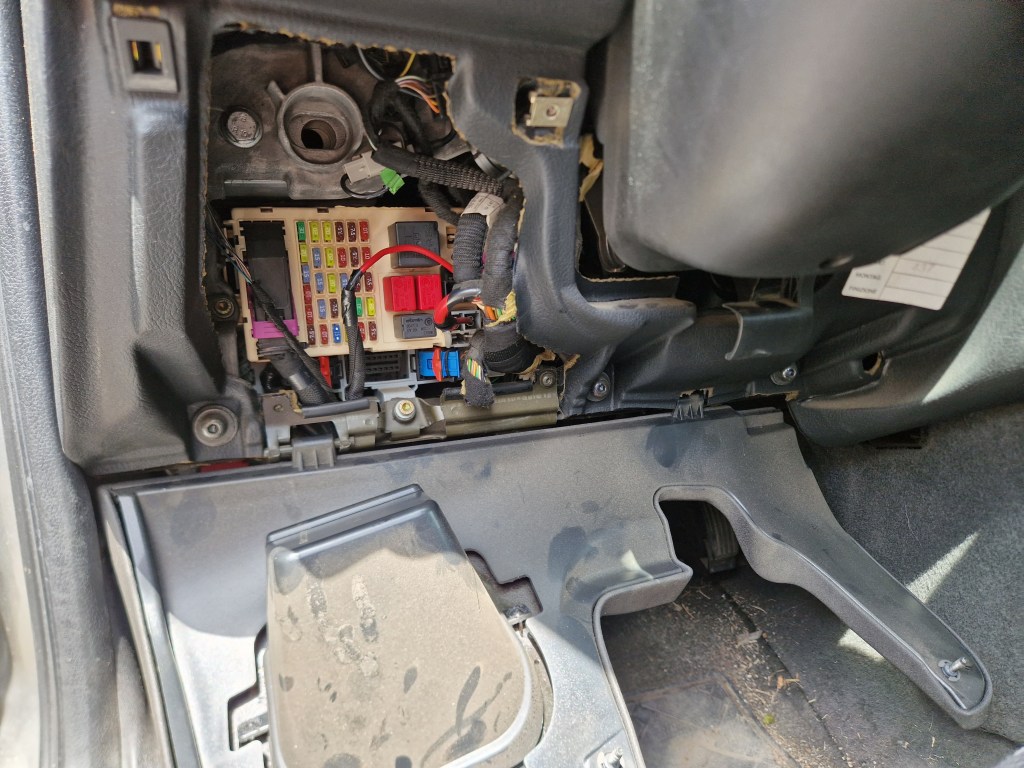
Now things got really interesting.
Presented with a bank of fuses, unlabeled except for their amp rating, I went back to the internet for some help and found this helpful diagram. Scanning the list of fuses and their assigned loads, I saw that fuse #39, only a 15amp fuse, could have up to 9 (!) loads, three of which were the radio, from which I’d drawn a spark that could have blown the fuse; the climate control system, which would explain the fan not blowing when I started the car; AND the driver’s door control unit, which would keep me from rolling the window down. I don’t know why ALL of those things are connected to the same 15a fuse, all I know is that ain’t right.
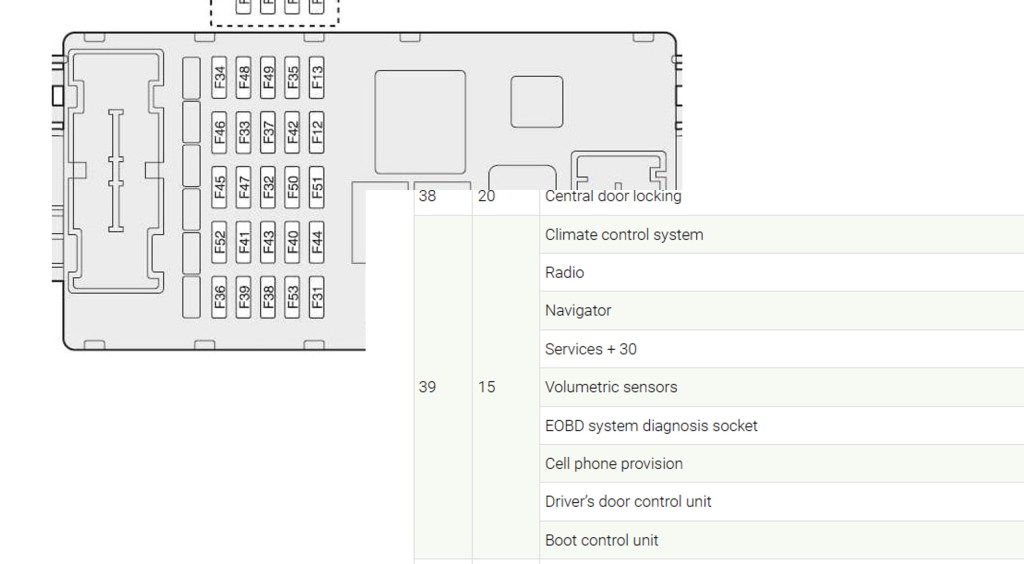
Much relieved to find an explanation, however unreasonable, I pulled the fuse and could see that it had indeed blown. Just to be sure I put a meter on it and confirmed that it needed to be replaced. Now to find a new 15a fuse.
Back home in the US, this would be easy. Auto parts stores on every corner, and even WalMart, could sell me a new set of fuses. Here I have limited options. My first stop was to the on-base auto shop where the Navy Exchange sells automotive items (I bought a replacement battery there last year). The sign on their door informed me that they were closed for a week “for inventory.” I’d have to go out in town.
Another internet search. First, translating “auto parts” into Italian with Google Translate: autoricambi, and then mapping to the closest autoricambi.
The place I found was barely the size of a walk-in closet, and easily missed. I crowded into the store next to the two men already chatting with the man behind the counter, and wouldn’t have been able to hold my arms out to my sides without hitting various auto parts hanging from hooks and piled on shelves like a hoarder’s worst nightmare. I showed the proprietor my fuse and expected him to reach behind him for one of the packages of fuses I could see dangling on hooks behind him.
Instead, he disappeared around a corner obscured by rubber engine belts. I could hear him rustling about before re-emerging with an exact replacement for my blown fuse. Since I was already there, I used the translator on my phone to also ask for new windshield wiper blades. These he retrieved from hooks halfway up some steps on the other side of the store. I hadn’t seen the steps before, hidden behind the gaskets and air filters. Handing me the wipers and the fuse, he only charged me for the wiper blades. The fuse was “last one, take it. Ok.”
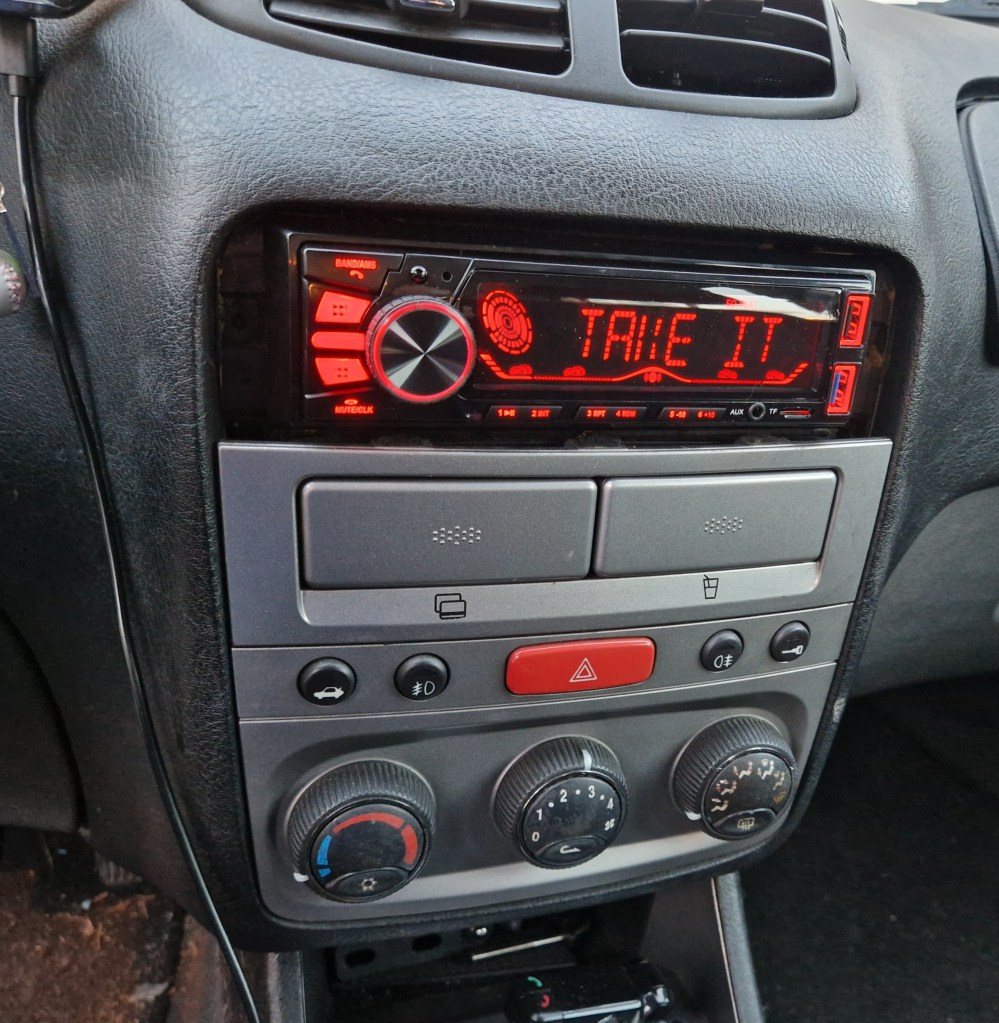
Once I had the new fuse placed in its proper slot, the rest was easy. I connected my spliced connector and the speakers to the new stereo, and bingo! Sound emerged from the car’s speakers for the first time since I’ve owned it. The windows and AC worked just fine too. The only thing left to connect is the radio antenna, which will have to wait until I get an adapter to connect the European car’s antenna to my American stereo. They are not the same connector, I’ve discovered. My primary aim, however, was to have the Bluetooth so I can listen to podcasts on my daily commute. That, I now have. I also have a much deeper knowledge of the car I drive, and the local community from which and for which it was made. Though I can’t say I fully understand it, because the way they built this car just ain’t right.
I have to remember to turn it off when I get out of the car, but the new stereo looks much better and is much easier to use while driving than my portable speaker was. That, plus the education involved, made it worth all the frustration.
 An Orthodox Priest Abroad