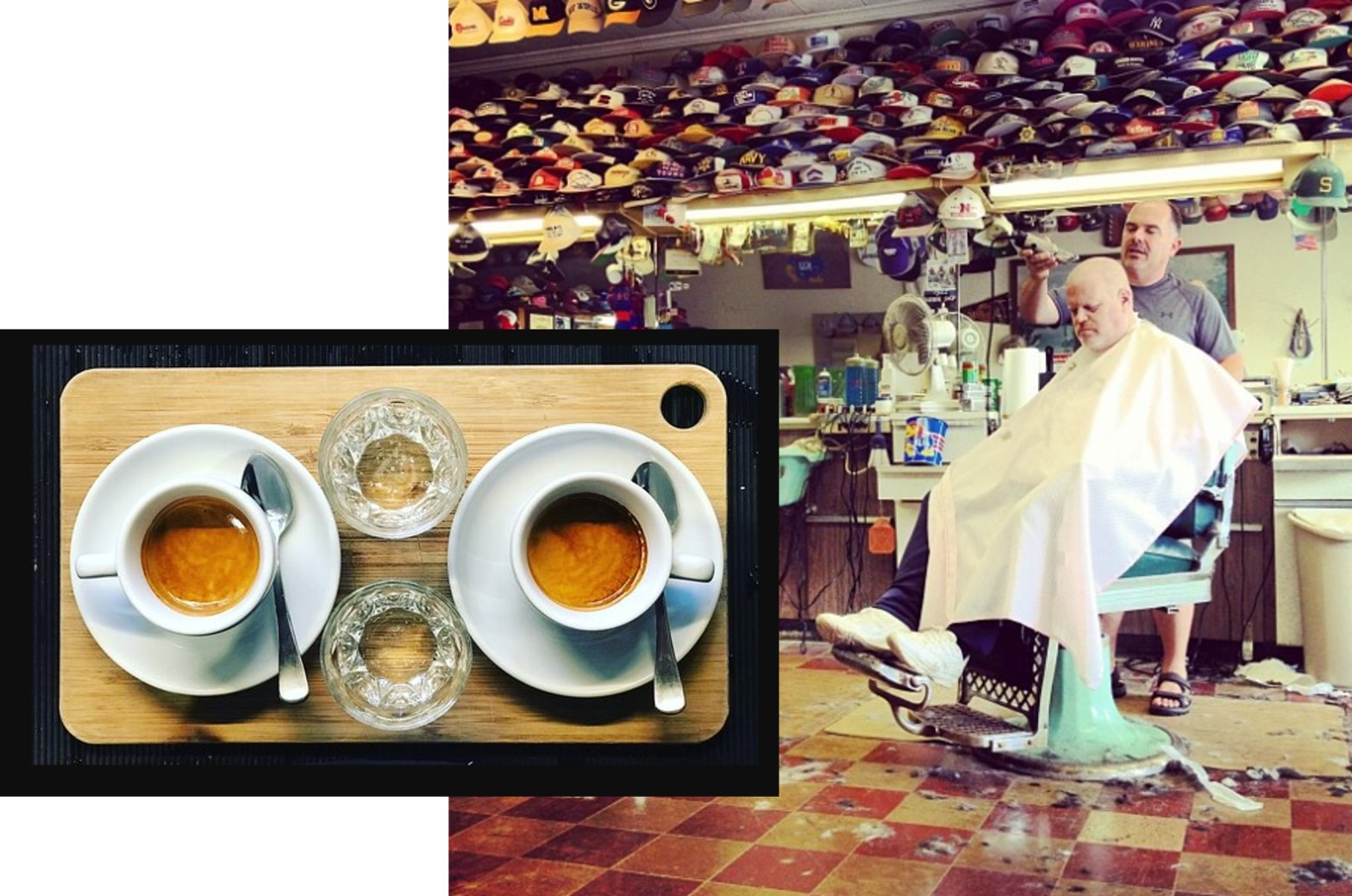
I used to love going to the barbershop. Okay, I admit that I didn’t like it at first, and when I was a teenager I once asked my father to take me someplace else (a salon of some kind) to get my hair cut. He reluctantly agreed, warning me that “they treat you like a girl.” Having sons of my own, I grew to see the appeal of the barbershop. It really is probably one of the last men’s clubs still standing. I mean, they would cut a woman’s hair, but I expect few women would like the result—or the experience.
I’ll take mine short and black.
When they were little, I took my older sons to the barber shop around the corner from our home in Aurora, IL, where the barbers had been cutting hair since before many of the homes in the neighborhood—including my own—had been built. The aroma of barbers’ disinfectant and aftershave flowed out the door when you opened it, as did the sound of voices raised in conversation. The topic of the conversation was likely regarding the fortunes of the team whose game was currently on the TV, and if that weren’t the topic, then whatever it was would be easy enough for me to get caught up in sufficiently to join and be welcomed in the discussion. We were there regularly enough that we no longer had to explain how we wanted our hair cut, we just sat down when it was our turn and continued the conversation uninterrupted.
There were plenty of arguments at the barbershop. I knew which of the barbers was a dreaded White Sox fan, and which of the regulars disapproved of the new shopping center going in across the street. Curiously, I don’t remember ever learning who amongst us was Republican, Democrat, or otherwise. Political discussions only ever surrounded local topics and were very common sense—even in disagreements. Not many idealogues in the barbershop, as I recall.
Since I’ve been on active duty, I have been unable to find this kind of barbershop experience. To begin with, for financial reasons, I began cutting my boys’ hair when I was in seminary and continued doing so until they entered high school and/or began caring about what their hair looked like. As for my own head, I’ve used military barbers almost exclusively since I’ve been on active duty, and the on-base barbers are not that interested in getting to know the occupants of their chairs, and you often wait for your turn in a separate area. Base Exchange barbers charge less for each hair cut than a civilian barbershop (which is why I go there) and so count on volume to make up the difference, and thus prefer a higher rate of turnover. Moreover, I’ve been deployed overseas for much of the past decade and the barbers can only speak enough English to understand how I want them to cut my hair—theoretically (more on that later). But having utilized barbershops on overseas bases, the differences reflect the local cultures as much as—or more than—that of the Navy.
In Okinawa the shops were immaculate and quiet except for the buzzing of the trimmers. The barbers were without exception perfectly polite, and the system they ran was smooth and efficient. Take a number, wait until they call you to the indicated chair, get your haircut, take the ticket, and then go to the counter to pay the cashier. No extra words, no extra motion. Very little conversation is shared even amongst the barbers. I think they may have thought it rude to speak their native tongue in front of their customers who didn’t understand it, so they kept it to a minimum.
The barbershop here in Naples is different, and in many ways reminds me of the shop back in Aurora. Unlike the Okinawan barbers who regularly rotated chairs and shops, Naples’ barbers are permanent fixtures who have customized their workspace with photos and mementos—no sterile, industrial, Japanese environment this. Though I’m a regular I don’t know if either of the two barbers recognize me because they always ask what I’d like, and no matter what I tell them they give me the same cut. I don’t think they know what “a little off the top” means. It’s like they’re trying to tell me, like Luigi from the movie Cars, “You don’t know what you want. Luigi know what you want.” But the cut is always good—even if not exactly what I wanted. Given the time it takes for them to do it, it should be. They never rush.
What makes the experience in Naples particularly unique is that this barbershop is never silent. Often men come in to chat with the barbers without any intention of getting their hair cut, and the conversation is animated and energetic. They are not at all bashful about speaking Italian in front of their monoglot patrons. In fact, as I sit in the chair and listen to the lilt and cadence and timbre of their voices, two men often speaking simultaneously, I am often struck by the musicality of it, and it makes perfect sense to me that opera originated not far from here. I hear one every time I get my hair cut. The Italian language is almost sung, rather than merely spoken.
While there this past week for a trim I saw another thing that makes the Naples experience unique.
Since we’ve been here, we’ve often lamented that there is no option to have food delivered. If we don’t feel like cooking, we have to go out. Naples is famous for its pizza, and rightfully so. We’ve learned that there are schools here where one can be certified in the making of Neapolitan pizza, without which you can’t call your pizza “Neapolitan.” People come from America to get the certification so that they can make Neapolitan pizza in America. Which is another reason the USA is awesome: You can get the best of Italy there, but in Italy it’s hard to find a good burger place or Mexican restaurant (or any other ethnic foods). Neapolitan pizza is really good, for a thin crust pizza, and can be made with a bewildering variety of toppings combinations, any of which are satisfying. (I plan to write more about pizza in another post.) But no matter how you like your pizza, what you cannot get is one delivered to your door.
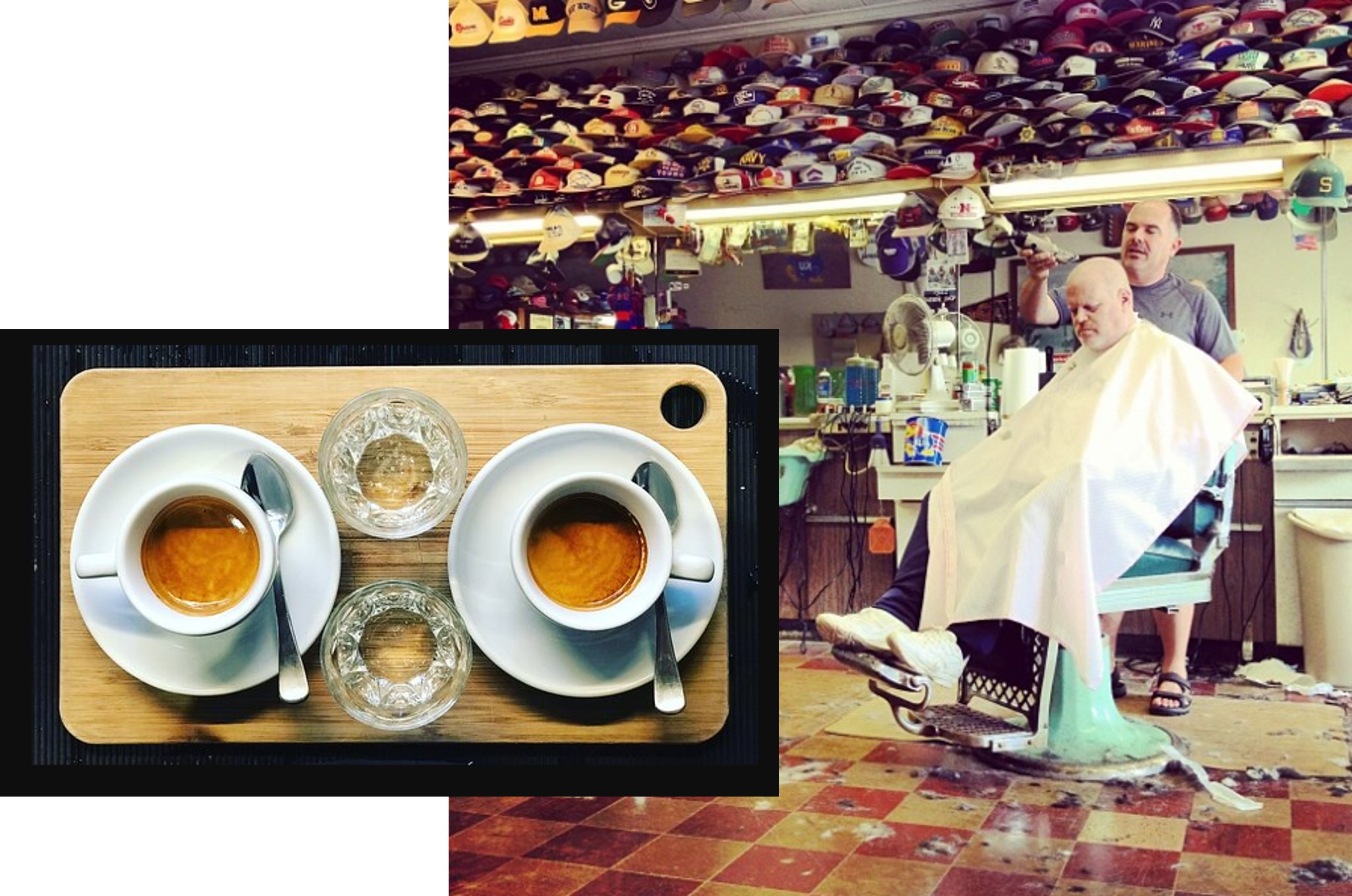
The only thing I know that is made in one place and delivered to another (without the aid of a third party) is coffee. Yes, coffee. Spend any time walking around Italian cities or towns and you will see someone in the uniform of a café carrying a tray covered with a clear plastic dome under which you can see cups of coffee and water. (In Naples, coffee is always served with an accompanying small glass of water, which I’ll explain in a future post.) I knew I could get a good cup of espresso on base. The Dunkin Donuts in the food court serves it rather than the brand’s usual arabica coffees. What I did not know is that they also deliver. While I was in the barber’s chair, in walked a man carrying coffee for the staff of the barbershop. The coffee-bearer was, of course, greeted with loud cries of appreciation and the energy of the conversation picked up immediately. It was sustained—perhaps by the caffeine—even after he had departed. Naturally, my barber took a break to enjoy his coffee.
I’ve had barbers stop to answer the phone, help a customer or another barber, or to switch tools. I have never, before now, had one take a break for coffee. Since they only drink espresso, Italian coffee breaks are never long, and he was back at the chair within a couple minutes. This is an Italian custom I could go all-in on: Coffee delivered to your office, at which point everyone must stop and enjoy it, and interact with each other. More coffee breaks like this for everyone sounds like a winner to me.
As I think about it, maybe even barbershops with a café—and no wi-fi—might be a winning business model. Maybe it could bring back the barbershop experience of my memory, with men lingering a bit to talk with his neighbors about things that concern everyone, both small and great. Perhaps it could even reinvigorate the art of public discussion and debate. Then again, I may just be given to wishful thinking, or envious that I had to wait and get my own coffee after my time in the barber’s chair this week. Still, I think it would be great if guys went to the barbershop for more than just a trim.
 An Orthodox Priest Abroad