In America, we have devised a system for controlling the flow of traffic on the highways and byways across the continent. Our system principally utilizes colored lights, signs (both passive and active), barrier rails, and painted lines. I have found that other countries use these same means for traffic control, and for the same or similar purposes (universally red means stop, green means go), but here in Italy things are…different.
For example, speed limits are posted in Italy, but as Jeremy Clarkson of Top Gear fame points out, the Italian attitude towards them is unique. This results, I believe, from a lack of enforcement. There is no such thing as an unmarked police car, there are no speed traps, and the only thing you are likely to be pulled over for is in town, by an officer with a “lollipop” (called a paletta del poliziotto) at a checkpoint to ensure that your tax documents are in order.
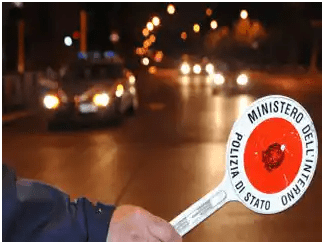
A paletta del poliziotto, or “lollipop.”
Arriving service members are warned about the driving in and around Naples almost as soon as one steps off of the plane. One senior officer described Naples traffic as “just like water.” It seeks, finds, and fills any open space, and you have to just roll with it. You don’t want to interrupt the flow. Area Orientation briefs acknowledge that some drivers will approach at a *ahem* high rate of speed, flashing their lights, and expecting you to yield right away. All of the horror stories have quite an impact.
I felt that impact as I sat behind the wheel of a friend’s car preparing to drive off the base for the first time, and must have argued with myself for ten minutes or more whether I should try to drive myself to work. I don’t remember being so nervous as a teenager during my first road test. Or, for that matter, even during the second test I had to take because I failed the first time. I was wracked with anxiety. What if I wreck his car? What if there is actually a toll on that road? Can I pay it with cash? Will I be able to call someone if I get into an accident? What if I get hurt in an accident? On and on for far too long.
I chose a toll-free route and started the car.
The installation here occupies several locations in the region, but principally two—one outside of Naples where most of us live, and the other in the city where most of us work. I had to leave the safety of one base and traverse the unknown Neapolitan streets to arrive at the relative safety of the other base. I eased the car into gear and began my 8-mile odyssey.
The first traffic circle I had to navigate was on base and large, a training-wheels experience for those who have never used one. But even for someone like me who has had some experience with rotaries, the mixture of Americans and Italians here causes some confusion. Some people stop before entering, others don’t, and no one seems to know just who exactly is supposed to yield. This last despite the signs posted to help guide you. I would discover later that in Naples no one actually reads, let alone obeys, any sign.
Through the rotary and out the gate, one must cross what is known colloquially as the “bridge of death,” so named because it is barely wide enough for the two way traffic that crosses it, yet must also accommodate pedestrians, cyclists, and scooters that share the narrow crossing, which one enters and exits via blind curves. The “death bridge” spans the highway and allows me to get to the east-bound lanes on the other side. Entry into the highway, however, was not as familiar as I’d hoped.
First, many (if not most) entry ramps in the region are too short to accelerate to highway speed before you get to the end of the ramp. Then, even if it were long enough, they are often (as is the case with this one) so pocked with potholes and semi-patched potholes that any speed faster than a brisk walk shakes the car enough to rattle the teeth from your head. (Road maintenance in Italy is apparently not something the confiscatory gas taxes fund. The only roads comfortably driven at high rates of speed are the tollways, with their own exorbitant rates for usage.) This combination of entry-ramp conditions is likely why speed limits are lowered around every highway exit and entry, but since no one here bothers with the speed limits, merging onto a highway is always an adventure. Trucks will honk at you to let you know they’re coming, but won’t move over or slow down; cars will sometimes accelerate to block your entry. What never happens is someone willingly allowing an easy merge into the space in front of them. Most local drivers thus simply ride on the shoulder for a while until they can ease over into the travel lane.
This entry/exit ramp chaos is one thing that I believe leads to the fact that on the highway there are really only two acceptable speeds: unbearably slow in the outside lane and terrifyingly fast in the inner lane. Switch lanes at your peril.
Once on the highway I opt for the former and remain a safe distance behind the car in front of me. This is an invitation for some of the maniacs speeding along the inner lane to jump in front of me. Sometimes this is to avoid an even faster driver bearing down on them, other times it’s to get to the exit ramp, more often the reason is indiscernible.
As I approached my first exit, traffic slowed. No one wants to enter the washboard surface of the exit ramp at highway speeds. The only other option to an Italian driver is to wait until the very last moment, when the exit turns away from the highway, then cut over into the line of exiting cars. This often results in two exiting lines where only one is marked. There’s only ever one lane marked, there seldom is only one line of cars. Italians don’t form lines on the road or anywhere else, they crowd through openings like sand through the neck of an hourglass.
The road that I exited onto is another four-lane highway. At least, I thought it was. It is an elevated road with no shoulder, and though it looks wide enough for two lanes of traffic, and has as a dashed white line down the center, the yellow lines that mark the boundary of the road narrow so that to stay between them one must straddle the white center line. I had no idea what to do with this. The local drivers that may have been less confused than I was by this, nevertheless differed on what to actually do about it. While I straddled the white line and stayed between the yellow lines like the driver ahead of me, the driver behind me chose to straddle the left-hand yellow line, flashing his headlights and honking at me for having the temerity to travel a speed approximating the posted limit and blocking his way.
The final obstacles to tackle before getting to the base where my office is found, is a series of three rotaries. Also called roundabouts or traffic circles, in Italy they are “rotunda stradale,” and they are not for the faint of heart. Having learned to drive in New England, I am familiar with rotaries, and have driven on them, but that was in a land where traffic rules have the force of law. Here it is every driver for himself. The only ascertainable rule is that “he who comes to a stop first loses.”
Before I got to the first circle, traffic had backed up so that there were no longer lanes of traffic entering it, but a homogenous crowd of cars pushing into a space wherein they all could not possibly fit. “Pick an opening and fill it” is the principal Italian method for dealing with traffic. I’ve discovered that two lane divided highways can actually hold four or five lanes of traffic, especially when none of them are moving. Somehow we made it through the first roundabout and approached the second, where I learned that bumpers are considered in play here in Naples.
Most cars in Naples are dinged and scratched with what U.S. Service Members refer to as “Naples Kisses,” minor body damage from misjudging gaps in traffic (or over estimating the distance between buildings and other obstacles when driving in older parts of town). I merged into the traffic on the second circle which then came to a stop, and there was a gentle lurch through the car that made me think at first that I had stalled the car. But my foot was still on the clutch, and the odometer still showed idling RPM. The car shuddered because I had been bumped by the car behind me. I looked around to see the driver ignoring me like nothing happened, and so I did the same.
I only had to make a right turn at the last circle, which is always easy, even here by the entrance to the Naples International Airport, and I was safely at the gate to the base where driving is much less stressful.
It turns out that driving in Italy isn’t as terrifying as I’d feared in those minutes before I started the car, though it does take some getting used to. I still haven’t figured out how Italians use their turn signals, except that it isn’t to indicate a turn or a lane change. Intended lane changes are indicated by getting a wheel or two onto the dividing line, then over the line, then after a couple miles easing into the lane. And that’s if you get an prior warning at all. Neopolitan drivers routinely ignore lane lines, often passing another car without ever completely leaving the lane they both start and end in, and never signalling first.
My biggest fear now when it comes to driving is that I’ll carry back to the U.S. some of the habits I’m learning here. While that might be fine in New York City, it will likely earn me a ticket elsewhere. I guess I’ll cross that bridge when I get to, though, hopefully, it will be wider than the “bridge of death.”
Until then, I will try to keep it between the lines, even if no one else here does.
 An Orthodox Priest Abroad