This past Tuesday, 28 November, the Church commemorated St. Stephen the New, and his story stuck with me throughout the week as I prepared for this Sunday’s sermon. He was born in 715 AD to pious Christian parents, and was named Stephen after the newly elected Patriarch of Constantinople asked God to bless him “through the prayers of the holy First Martyr Stephen.” The Patriarch’s blessing proved prophetic.
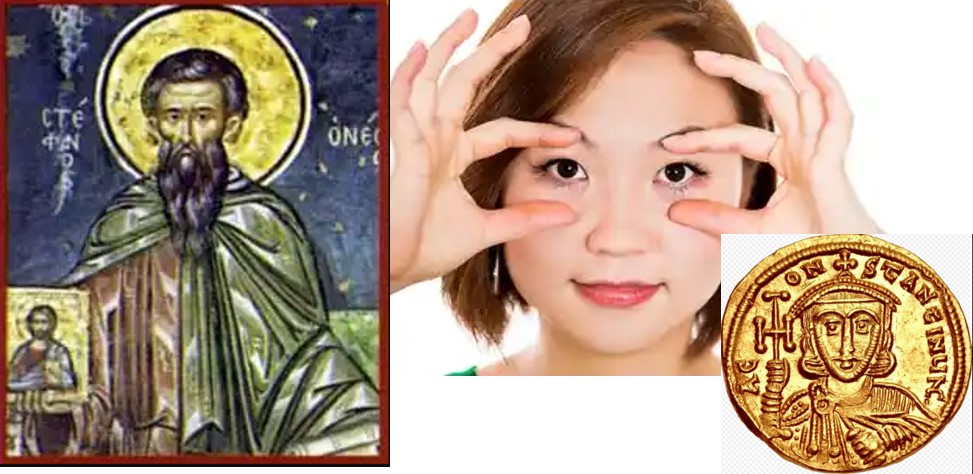
Stephen became a monk of such labor and great goodness that he was elected Abbot of his monastery on Mt. Auxentios in Bithynia, across the Bosporus Straights from Constantinople, which is where he was when Constantine V became emperor. Called “Copronymus,” which means “name of dung,” for having soiled the water during his baptism (an act that proved to be its own sort of prophecy), this Constantine became a vicious iconoclast, persecuting the monasteries for defending the use of icons in worship. This is how he managed to cross philosophical swords with St Stephen, and on the basis of false accusations exiled the monastic iconodule.
Even in exile the saint won many converts from iconoclasm and so was brought before the Emperor yet again to suffer accusations. This is the part of the story that stuck with me this week.
Stephen “showed him a coin and asked whose image the coin bore.
‘Mine,’ said the tyrant.
‘If any man trample upon thine image, is he liable to punishment?’ asked the Saint.
When they that stood by answered yes, the Saint groaned because of their blindness, and said if they thought dishonoring the image of a corruptible king worthy of punishment, what torment would they receive who trampled upon the image of the Master Christ and of the Mother of God?
Then he threw the coin to the ground and trampled on it.”
https://www.goarch.org/chapel/saints?contentid=313
He groaned! As if to say, “You idiots! Why can’t you see the inconsistency of your own argument? It is so obvious!” Beginning with Constantine, none of them could see what was obvious to the saint, because they were blinded by their ignorance, by their lack of faith. Though seeing, they did not see; though hearing, they did not hear or understand.St. Stephen was stoned to death, like his namesake, in 767 by iconoclasts, for failing to venerate an icon of the emperor.
In this morning’s Gospel reading a blind man calls out to Jesus until the Lord answers him, asking “What do you want me to do for you?” To which the blind man answered “Lord, let me receive my sight.” The beggar must have thought Jesus crazy to ask such a question. What else could he want, but to see? It isn’t such an obvious question, however, because some of us can be pretty comfortable in our blindness.
“If you see something, say something” read signs all over the command that apply to things as varied as information security to sexual harassment. But saying something often means doing something, and that something isn’t often in our plans for the day, and like the priest and the Levite of the parable, we cross to the other side of the street to avoid seeing the thing that would require of us something that we don’t want to do. Blindness can be willful.
It isn’t always willful. Sometimes we just don’t know how ignorant we are, and like Constantine Copronymus we think we’re the smart one and it’s the other guy who is blind. We are so certain of ourselves that we refuse even to consider that we might be wrong. Such an admission is a prerequisite for any fair hearing of an argument, but who among us can honestly say that this is how we listen? How many of us are willing to risk being wrong, to place our beliefs to the test? But this is what faith does. This is why the blind man received his sight: he had faith in the Truth.
We Christians know that Truth is not a philosophical principal. It isn’t a set of moral codes. It is a person. Only at the feet of Jesus, of Truth, do we shed our demons and come to our right minds, only when we come to ourselves can we see that we are in the midst of a mess—and that of our own making, only if we lay aside every distracting thing that we think is important and sit at the feet of Jesus do we receive the one thing needful, which is a relationship with Him who is Truth.
As the world around us sheds more and more of its relationship with Christ (Can I even hear just one reference to Jesus in Christmas music anymore?), it is also shedding its relationship with the Truth, so that it is now impossible to even agree that there is such a thing as THE truth. There’s only “my truth” or “your truth” based on our own lived experiences. This, of course, leads to chaos as every encounter between competing “truths” must be left unresolvable. In the worst cases these unresolvable truth claims lead to conflict that is particularly destructive. “Who are you to tell me ‘my truth’?”
The Apostle Paul warned his disciple Timothy about this very thing when he wrote him to “avoid irreverent, empty chatter, which will only lead to more ungodliness, and the talk of such men will spread like gangrene.” Such men were those “who have deviated from the truth.” They had given up their relationship with Jesus.
Timothy, and by extension all of us, must rather “not quarrel but be gentle to all, able to teach, patient, in humility correcting those who are in opposition, if God perhaps will grant them repentance, so that they may know the truth, and that they may come to their senses and escape the snare of the devil, having been taken captive by him to do his will.”
We must all know the Truth if we are to come to our senses. There is no other way. The evidence of the world around us seeking desperately for another way to truth should be enough to cement in our minds the necessity of Christ to enlighten us.
Which is why in this week’s epistle, the Apostle wrote the Ephesians to “Awake, O sleeper, and arise from the dead, and Christ shall give you light.” That light will expose the truth of who we are and what we do, which is why we all fear it so much. In the light of Truth we can no longer deny our sin and insufficiency. So, like the Israelites to whom Isaiah was writing, we “say to the seers, ‘Do not see,’ And to the prophets, ‘Do not prophesy to us right things; Speak to us smooth things, prophesy deceits. Get out of the way, Turn aside from the path, Cause the Holy One of Israel to cease from before us.’” Truth often hurts, and we don’t want it.
Once we see the Light, however, we receive our sight and see also the Truth, the way C.S. Lewis did when he said “I believe in Christianity as I believe that the sun has risen: not only because I see it, but because by it I see everything else.” If we have the courage, if we have the faith to open our eyes to the Truth, we will find Him reflected in all of creation, and those things like ‘my truth’ and my shame fade into insignificance. Exposing our insufficiencies to the light removes their control over us, heals our blindness, and allows us to see that our neighbor is suffering from the same blindness that we were. With our recent enlightenment from blindness in mind we should then be able to “not quarrel but be gentle to all, able to teach, patient, in humility correcting those who are in opposition,” hoping that by doing so God will “grant them repentance, so that they may know the truth, and that they may come to their senses and escape the snare of the devil,” just as we did.
It is a tall order, but Paul tells us how to do it. We must “be filled with the Spirit, addressing one another in psalms and hymns and spiritual songs, singing and making melody to the Lord with all your heart.” Which is why we are here: to worship, to receive the Holy Spirit, to learn the psalms and hymns and spiritual songs with which we can address each other and make melody to the Lord. As we enter into Holy Communion today, let us pray that Christ strengthens our faith so that he can heal our blindness and illumine us with the light of Truth. May His light then, through us, radiate to the world around us, which is so desperately starving for the Truth.
 An Orthodox Priest Abroad