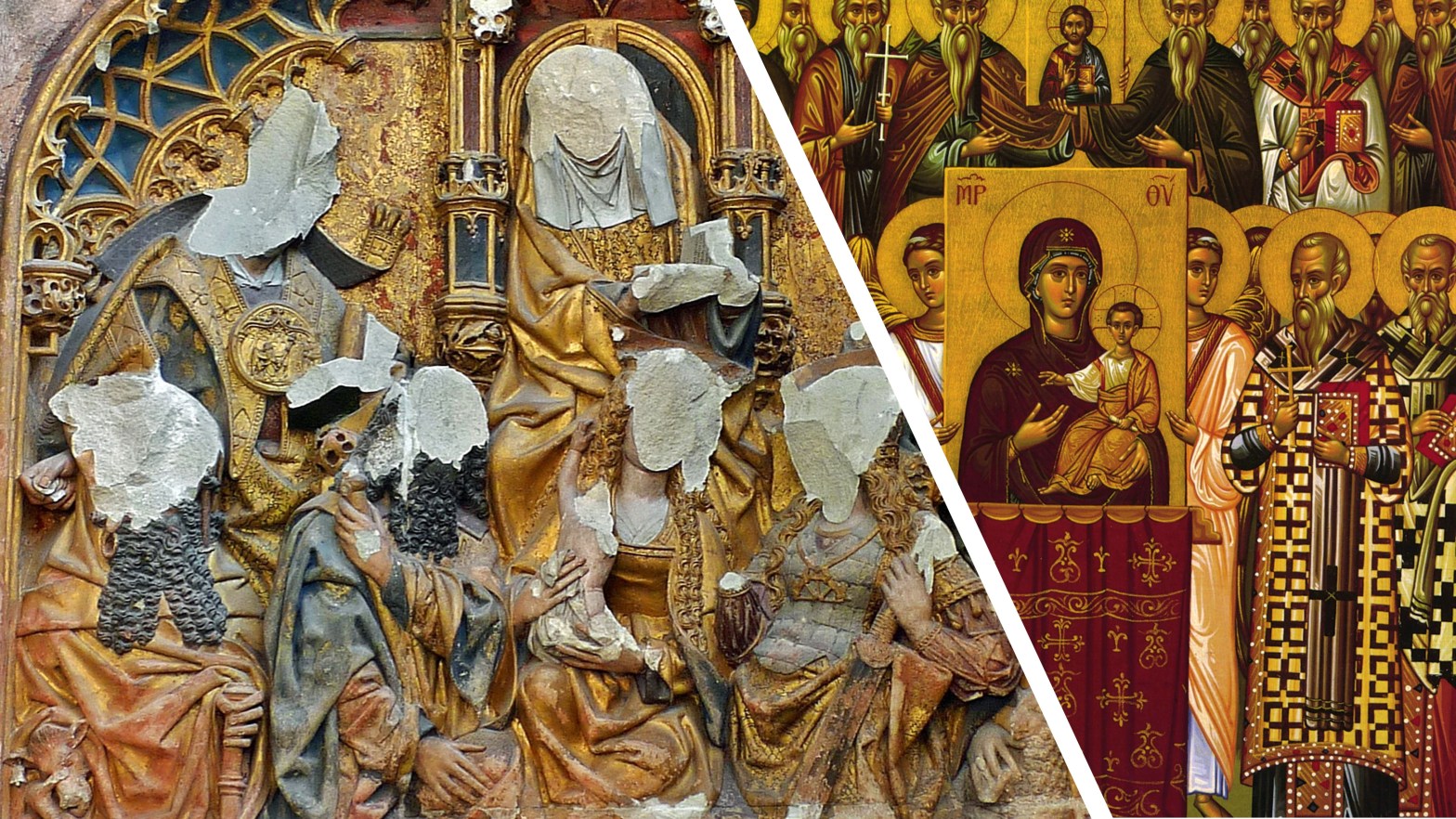
The empire was collapsing. Over several decades the followers of the new religion of Mohammed pushed their way out of Arabia conquering as they went. First fell the ancient See of Jerusalem, the Holy Land where the Lord was born, lived and conducted His earthly ministry, and then Antioch, whose first bishop was St. Ignatius and which was the birthplace and nurturer of St John Chrysostom, Ephraim the Syrian, and many others. Next to fall was Alexandria, home of the great saint Athanasios and others whose spiritual and Biblical knowledge helped forge Christian understanding of the Holy Trinity. The armies of Islam pushed all the way across Christian North Africa, rolling over the ancestral home of St Augustine of Hippo (in what is now Algeria), going even so far as Europe, crossing the Gibraltar straight (known then as the Pillars of Hercules) and conquering the Iberian Peninsula as far north as the Pyrenees, Islamizing lands that had produced the great saints Vincent, Melania the Elder, and Lawrence—this last martyred as a deacon in Rome some four centuries earlier.
Where was God? Why could His Holy Roman Empire be thus beaten about by the forces of Islam? Could it be that, like the Philistines of old, God was using these new armies to execute His judgement on a sinful people? And if so, for what sin does the punishment follow?
Could it be that the icons that fill our churches are to Christianity what the idols were to the ancient Israelites, a besetting sin that brings about the wrath of God’s judgement from foreign armies?
This was the cultural condition and political situation of the seventh and eighth centuries. These were the questions that demanded answers of the empire’s political and religious leaders. Together these circumstances precipitated Iconoclastic controversies that shook the Church and prompted the Seventh Ecumenical Council, an event that we commemorate this morning.
Both sides of the controversy, the iconoclasts and iconodules, made strong arguments from both scripture and the practice and traditions of the Church, and each considered the other heretics. There were emperors, bishops, and priests of impressive education and skill on both sides. The controversy was tearing the Church apart and needed to be settled, so Empress Irene convened the Seventh Ecumenical council, the second held in Nicaea, in 787AD.
The iconoclasts wanted to preserve a strict adherence to the Second Commandment’s prohibition of graven images and objected to some of the pious traditions emerging in the veneration of icons. Indeed, some of them did look a bit too much like idolatry. The iconoclasts also argued that one could not depict both natures of Christ in an icon, so any such representation would be de facto Nestorianism. In fact, they said, any attempt to portray both Jesus’ Divine and Human natures would inevitably only confuse them and result in being Monophysitism, yet another heresy. Best to just get rid of the things.
Iconodules, on the other hand, claimed that on account of the Incarnation God had, in Jesus, rendered Himself portrayable in images. Moreover, the inclusion of icons in the worship of the Church was already widespread and long-standing throughout the empire and a produced a depth of piety and beauty that the Church would be foolish to discard. To the charge of idolatry, St John of Damascus offered this reply:
Icons are not idols but symbols, therefore when an Orthodox venerates an icon, he is not guilty of idolatry. He is not worshipping the symbol, but merely venerating it. Such veneration is not directed toward wood, or paint or stone, but towards the person depicted. Therefore, relative honor is shown to material objects, but worship is due to God alone.
We do not make obeisance to the nature of wood, but we revere and do obeisance to Him who was crucified on the Cross… When the two beams of the Cross are joined together, I adore the figure because of Christ who was crucified on the Cross, but if the beams are separated, I throw them away and burn them.
When I was deployed aboard a submarine, I had in my rack a photograph of the woman who is now my wife. I would wish her goodnight whenever I turned in and good morning each time I awoke (I may have even blown it a kiss or two). I had no delusions that the photograph could itself transmit those wishes to her, or that it possessed any of the essence of my beloved, but that photo (which I still have) kept her close to my mind and my heart in ways that would have been impossible without it. This is the point that St John is making about the icons.
With icons, though, there is even more involved than the endearment they engender within us for the persons or event depicted therein.
When the Seventh Ecumenical Council met, they did so in a world not yet disenchanted by the materialistic rationalism that would beset Western Civilization after the Enlightenment. To a modern mind the idea that painted wood could possess any power at all is patently absurd, and the use of icons becomes an aesthetic, more than spiritual, exercise. He may even grant that the use of icons in prayer and worship have some good psychological—even spiritual—effect but is far less likely to give the icon itself the credit that iconoclasts feared he would. This also is a mistake.
If the world is only physical, separate from the spiritual world (if there is a spiritual world at all), and if such a world is governed only by a predictable series of causes and subsequent effects, then icons are a reminder within this world of the spiritual other world that awaits us. In this case, when we refer to the icons as “windows to heaven” we mean that we see things that aren’t here, but on the other side of the glass.
However, if the world is at the same time BOTH physical AND spiritual, as the Fathers of the Seventh Ecumenical Council certainly believed, then icons participate in the reality that they depict and allow us to do the same. They are more than panes of glass through which we view another world, they are the means through which we participate in that world. When we say icons are “windows to heaven” in this case, we mean that the spiritual reality depicted therein is made real and present with us in a way with which we can interact. This is a lot like the icons on your computer desktop that both point to and are part of the program that they represent.
Thus, the Fathers were able to make the following Proclamation:
We define that the holy icons, whether in color, mosaic, or some other material, should be exhibited in the holy churches of God, on the sacred vessels and liturgical vestments, on the walls, furnishings, and in houses and along the roads, namely the icons of our Lord God and Savior Jesus Christ, that of our Lady the Theotokos, those of the venerable angels and those of all saintly people. Whenever these representations are contemplated, they will cause those who look at them to commemorate and love their prototype. We define also that they should be kissed and that they are an object of veneration and honor, but not of real worship, which is reserved for Him Who is the subject of our faith and is proper for the divine nature, … which is in effect transmitted to the prototype; he who venerates the icon, venerated in it the reality for which it stands.”
Like the picture in my rack, icons help us to “commemorate and love their prototype,” the one represented in the icon. Because Christ became incarnate and filled all of creation with His presence through the Holy Spirit, our veneration of the icons is “transmitted to the prototype.”
Ultimately, we must use icons because to disallow their use is, according to the Fathers of the Seventh Ecumenical Council, to deny the Incarnation of Christ. The use of icons, they said, is a tradition “useful in many respects, but especially in this, that so the Incarnation of the Word of God is shown forth as real, and not merely fantastic, for these have mutual indications and without doubt have also mutual significations.”
Those indications and significations are explained within the hymns of the Church that are sung on the evening before the first Sundy of Great Lent,
Thou who art uncircumscribed, O Master, in Thy divine nature, was pleased in the last times to take flesh and be circumscribed; and in assuming flesh, Thou has also taken on Thyself all its distinctive properties. Therefore, we depict the likeness of Thine outward form, venerating it with an honor that is relative. So, we are exalted to the love of Thee, and following the holy traditions handed down by the apostles, from Thine icon we receive the grace of healing.
Healing that comes from God, though the icon, because we inhabit the world now shot through with the Divine Presence and share our human nature now united with the Eternal Word. But there’s more:
The grace of truth has shone forth upon us; the mysteries darkly prefigured in the times of old have now been openly fulfilled. For behold, the Church is clothed in a beauty that surpasses all things earthly, through the icon of the incarnate Christ that was foreshadowed by the Ark of Testimony. This is the safeguard of the Orthodox faith; for if we hold fast to the icon of the Savior whom we worship, we shall not go astray. Let all who do not share this faith be covered with shame; but we shall glory in the icon of the Word made flesh, which we venerate, but do not worship it as an idol. So let us kiss it, and with the faithful cry aloud: O God, save Thy people, and bless Thine inheritance.
The Ark once contained the law, but our humanity now contains the Divine Logos. As the Israelites followed the Ark into victory, so we now cling to the Icon of Christ into eternal salvation. It is no coincidence that this hymn ends with the same words exclaimed by the priest at the conclusion of Holy Communion in the Divine Liturgy, for the Holy Eucharist of which we partake at each Divine Liturgy makes us physically the bearers of Christ, each thus becoming an ark of testimony and the most perfect Icon of Christ.
The Incarnation changed the whole world, and especially our humanity. Creation is no longer a thing wholly separate from God but is now something in and through which we can know and communicate with Him. This was His design from the beginning, manifested fully in the Person of Jesus Christ, and allows us to partake of His divinity, becoming by grace what Jesus is by nature. This is what the icons teach us if we have eyes to see and ears to hear.
 An Orthodox Priest Abroad