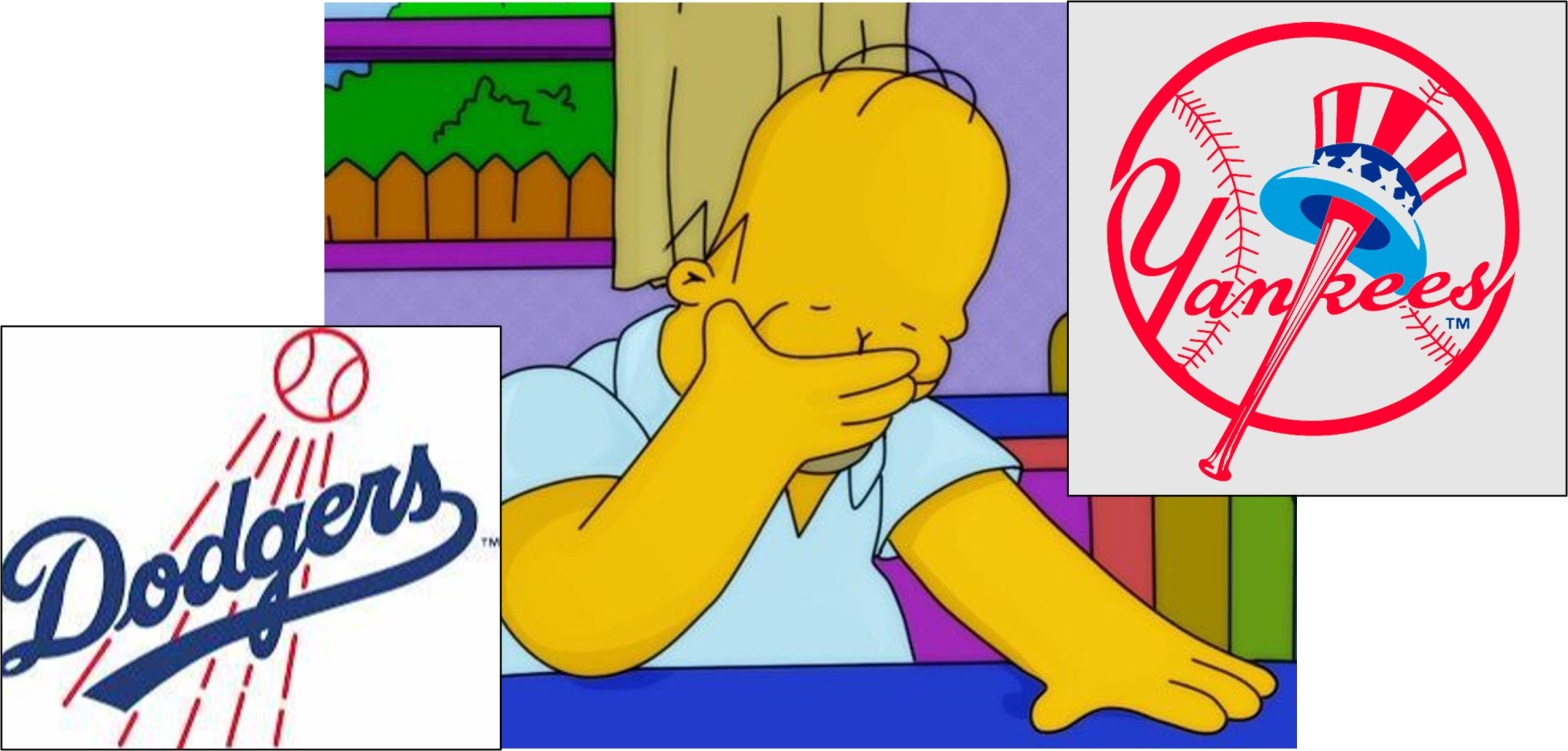
And just like that, I have lost all emotional interest in the World Series. The worst part about it isn’t even that I haven’t got a team to root for. As a rule, I cheer for three specific teams: the Chicago Cubs, and whoever is playing the Dodgers and the Yankees. Now that the latter two are facing off for the final games of the season, I’m reduced to purely academic viewing because they can’t both lose. But that isn’t the worst part about the upcoming World Series.
The worst part about a Yankees/Dodgers World Series isn’t even that it rendered the playoffs a useless exercise that just as easily could have been skipped. Both teams had the best regular season records in MLB, thus earning the right to play for the World Championship, but the multi-level playoffs exposed them to the risk of inferior teams upsetting them. In the end, however, the exercise only served to drag out the other teams’ fans’ hopes just a little bit longer only to end in ultimate failure. Though it did also serve to fatten the coffers of the owners and MLB, which I’m sure they would likely say is only a happy side effect to the added excitement of the “post-season.”
Whether deliberate or a side effect, the additional earnings must be rather helpful–even necessary–for teams paying the kind of salaries the Yankees and Dodgers are paying. In fact, the last three teams standing were the three highest paid lineups in baseball this year, which should come as no surprise since they are all from LA and New York, the two largest and most lucrative broadcast regions on the planet. Only teams with that kind of coin could afford to pay Shohei Ohtani $432,099 for each of his 162 strike outs this season, and Aaron Judge $116,959 for each of his 171.
The worst part isn’t even that these two teams are primary exemplars of all that is wrong with the modern game. The Yankees and Dodgers took more bases on balls than any other team in the league. They were also two of the top three homerun hitting teams in MLB, and both struck out more than 1300 times. Now, the fact that their strike out numbers are actually below the league average may seem like a good thing until you compare it to the last time these two teams faced off in the World Series.
Well, not the last time they met. That was in 1981, a season shortened by an MLB Players strike that turned it into a split season and a disaster of playoff confusion. In a weird coincidence, two of the Dodgers’ six World Championships came after a shortened seasons and, shall we say, unusual playoffs. The other was shortened by the late unpleasantness of 2020 prompted by COVID-19.
The last time they met in a World Series after a full season, however, was in 1978 when the Dodgers drew 610 walks (not much of a change), but only 818 strikeouts. The Yankees drew fewer walks, 505, but also struck out far less than the Dodgers had, only 695 times. This year’s teams struck out nearly twice as often as the teams did in 1978.
Altogether, this means that about 35% of all the Dodgers’ and Yankees’ 2024 plate appearances ended with the ball never being touched by the defense, and in nearly 90% of those cases without the batter putting the ball in play at all. This modern baseball practice of taking lots of pitches, drawing walks, getting lots of strike outs, and hitting the occasional homerun makes for long, boring baseball games. Leave it to NY and LA to make games last >3 hours even in the pitch-clock era. But even that isn’t the worst part of a Yankees/Dodgers series.
Long, boring baseball games are what prompt networks to add in-game interviews, on-field cameras, and useless graphics telling me the odds of specific sports bets (e.g. the probability that the Dodgers will score >4 runs in a game.) that can be made at the gambling websites now sponsoring the MLB broadcasts. Then there’s the cartoon graphics added to try and explain why the game should be more exciting than it seems. As if the broadcast itself is more interesting than the subject of the broadcast.
To be fair, the graphics are easier to watch than the extreme close-ups. (Do we really need to be able to see the batter’s nose hair?) There is never a time when we must be so close to a player that we can’t see the logo on his Jersey. Ever. Unless there is a runner on base or an unusual defensive alignment, any shot other than the view from the outfield camera showing the pitcher and batter is just unnecessary until the ball is put in play. Which is rare these days, to be sure, and so we get all the broadcast superfluity.
I get around some of this because I stream the games on MLB.TV and use the radio broadcast audio feed rather than the TV audio. On the radio they have to describe what they see, forcing hosts to talk more about the game and thus have less time for the extraneous nonsense–especially the in-game interviews. Seriously. Why aren’t you watching the game? Yet even the cloying, superlative-laced, over-produced, and scatter-directed national broadcasts isn’t the worst part.
No, the worst part is that despite having no one to root for in a series of long and boring games covered by annoying broadcasters, I will still watch nearly every pitch. Stupid game, why do I love you so much.
 An Orthodox Priest Abroad
You can tell you love the game!
LikeLike