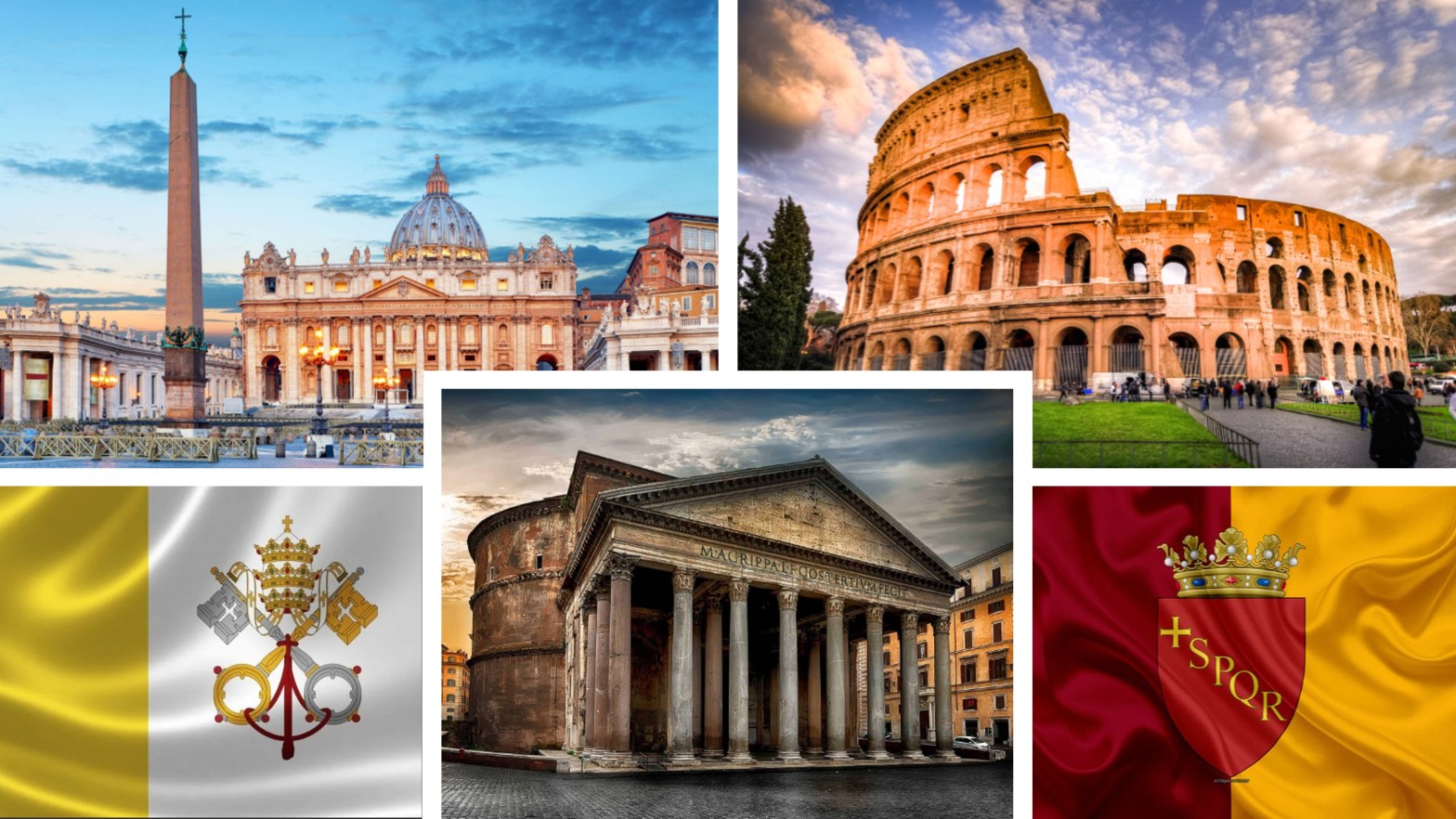
I am astonished to be able to say that I’ve been to Rome half a dozen times. With only one exception, however, I’ve never spent the night there. Living in Naples, we are only an hour away by high-speed train and so we’ve made several day trips to the Eternal City, enough that I’m rather comfortable using the transit system and finding my way around.
Not nearly as well as does Sev Borzak, the founder and director of Anno Domini Tours, and the tour guide who first introduced me to Rome in 2011 when I visited with my classmates in seminary. His two-day tour then was so memorable that I’ve sought to replicate it while living in Italy and succeeding when I hired him for the day trip planned with my parents.
Sev gave me the option to purchase the tickets myself or have him do it, which was an easy decision to make for two reasons. First, the navigation of Italian websites isn’t always intuitively obvious to me, and I’m often left a bit anxious about whether my ticket will actually work when I arrive at the venue. Additionally, even with months of advance planning, there were no tickets available for the Vatican Museums when we first contacted Anno Domini. But Sev worked some of his tour guide magic to secure tickets to all of the venues we wanted to see, including the Vatican Museums. Because, as I’ve mentioned elsewhere, it is easier to find morning tickets to venues in Italy, we would be amongst the first through the door of the Vatican Museum that day.
Thus, early on a Saturday morning we drove to the Afragola train station to catch an early train to Roma Termini, where we transferred to the subway that took us to the Vatican. We met Sev at the entrance to the museum, where we began our Day-in-Rome tour.
The art within the Vatican Museum’s collection is worth viewing on its own merit, even without knowing its history and the connections between the various works. But Sev added even more depth to our appreciation by showing us how Michaelangelo, who considered himself a sculptor rather than a painter, utilized sculptures within the collection as models for his paintings on the ceiling of the Sistine Chapel. He also showed us the room that served as his workshop while he was there and the Bramante Stairs, an area of the museum we’d not seen before and requires a special ticket. The views from the top of the stairway were breathtaking, my photos don’t do them justice.
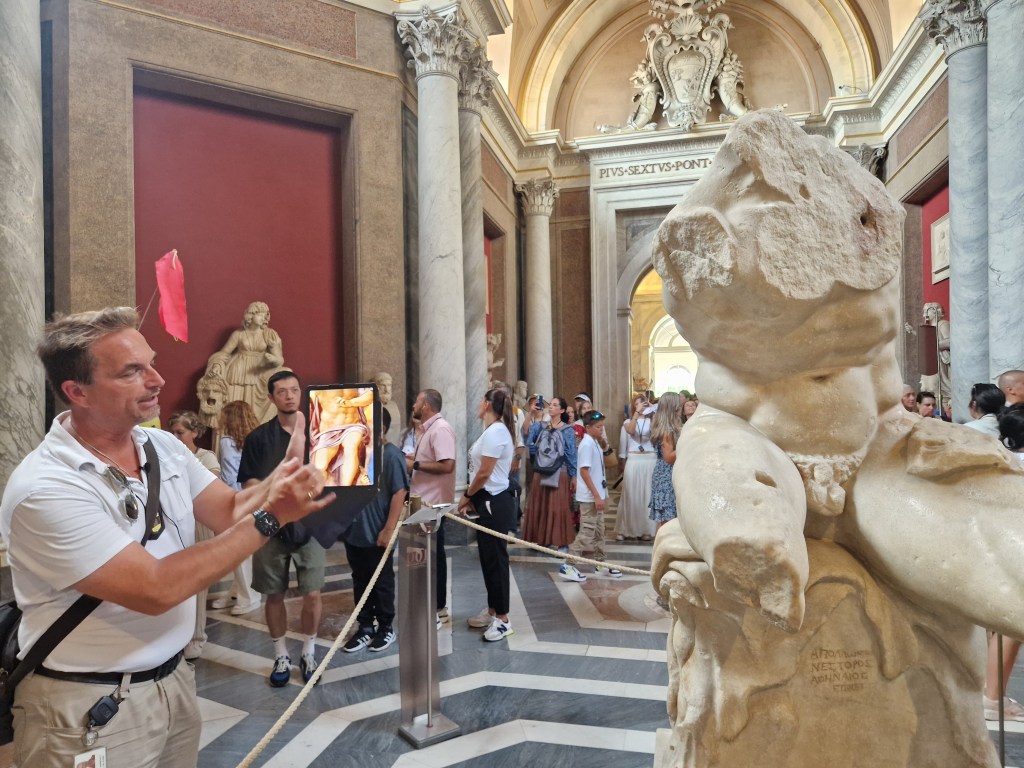

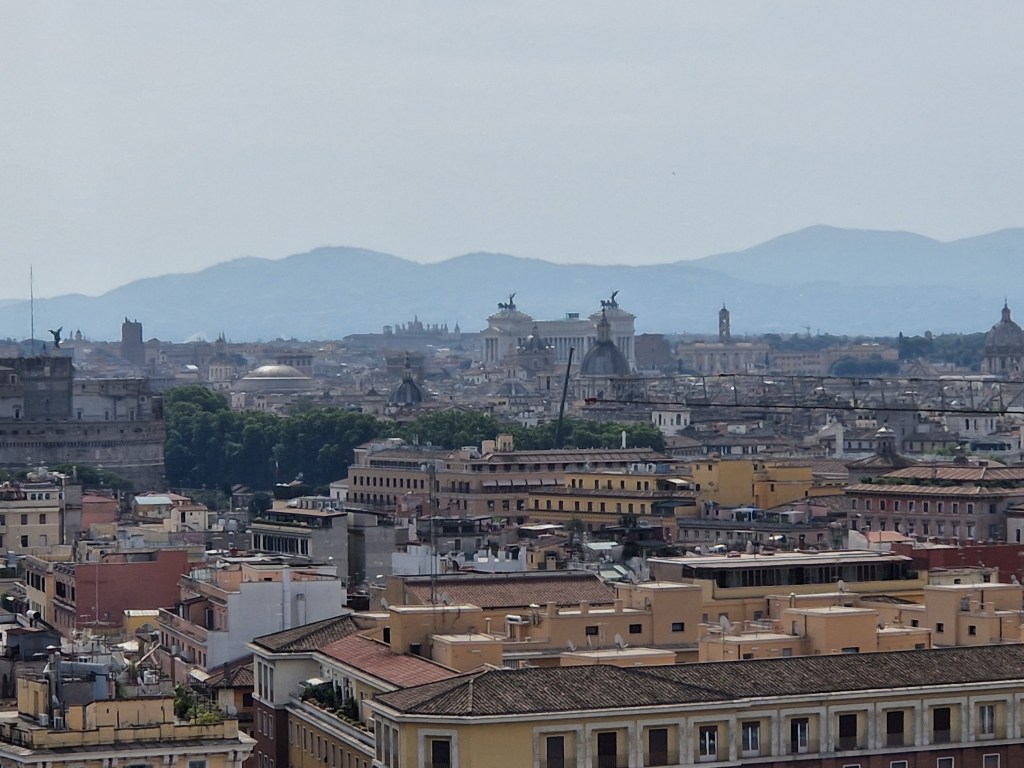
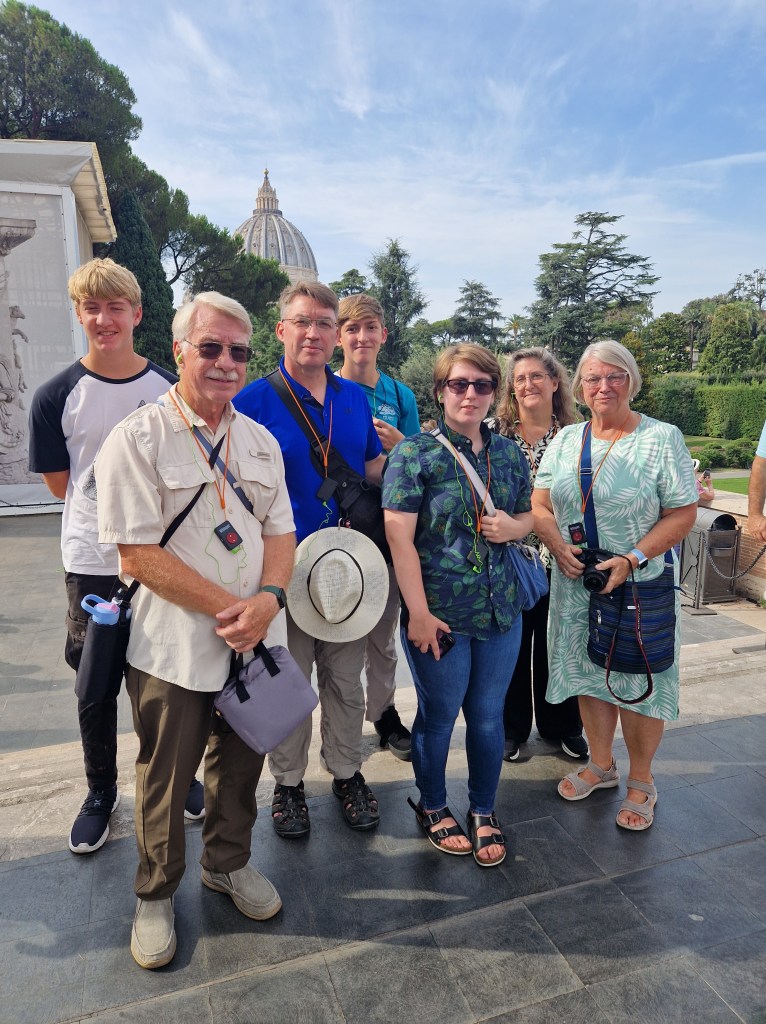
With much to do before the day was through, we didn’t have much time to examine any particular work of art or linger in any particular exhibit hall, and we paused only briefly for a coffee and snack in the café before entering the Sistine Chapel. Here we did linger, it’s impossible not to simply stand and gape at it all. We couldn’t take pictures, and we weren’t supposed to talk, and that really does seem appropriate.
From there we descended the Scalia Regia, which is permissible only to official guides, to make our way to St. Peter’s Basilica. This route allowed us to skip going through another security line (we had to go through one to get into the museum) and go directly to the basilica’s entrance.
A place I have visited more often than I ever thought I would, St. Peter’s is always an awesome sight, and Sev is good at pointing out the things we find interesting. He doesn’t focus only on the connections between the artists who contributed to the beauty it contains, as most tour guides do—though he mentions the most important artists we are likely to know—but also on facts such as that the gilded letters that circle the ceiling are over nine feet tall and that nothing inside is painted—even the painting originally by Raphael is now a mosaic reproduction, and it is amazing.
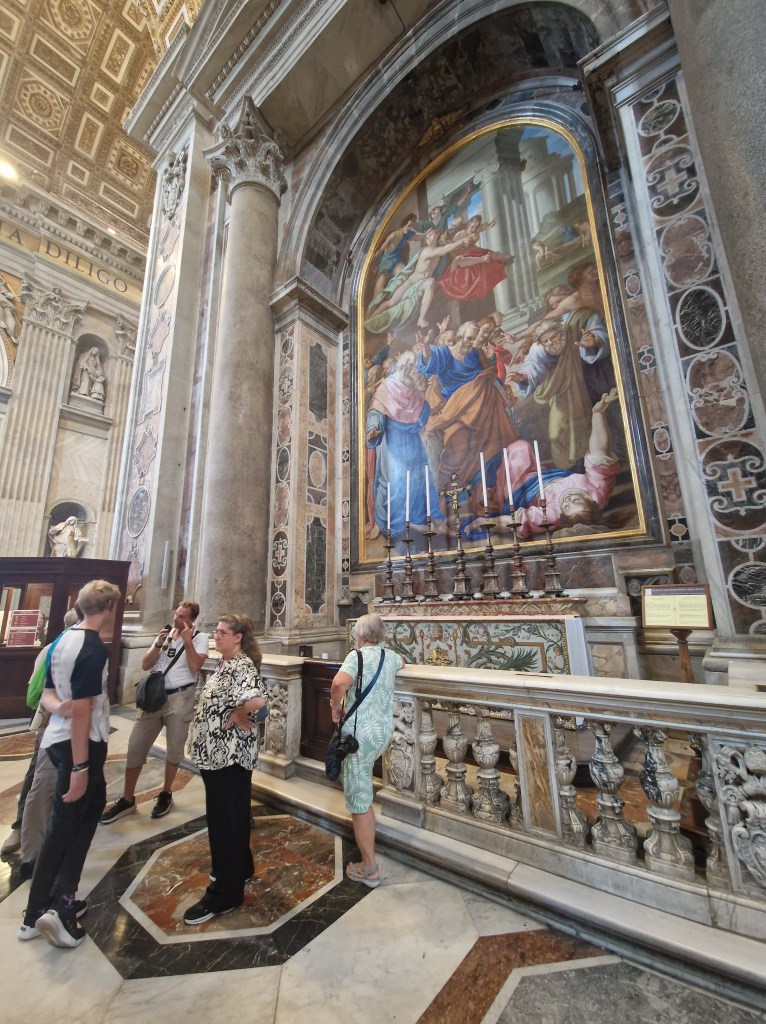
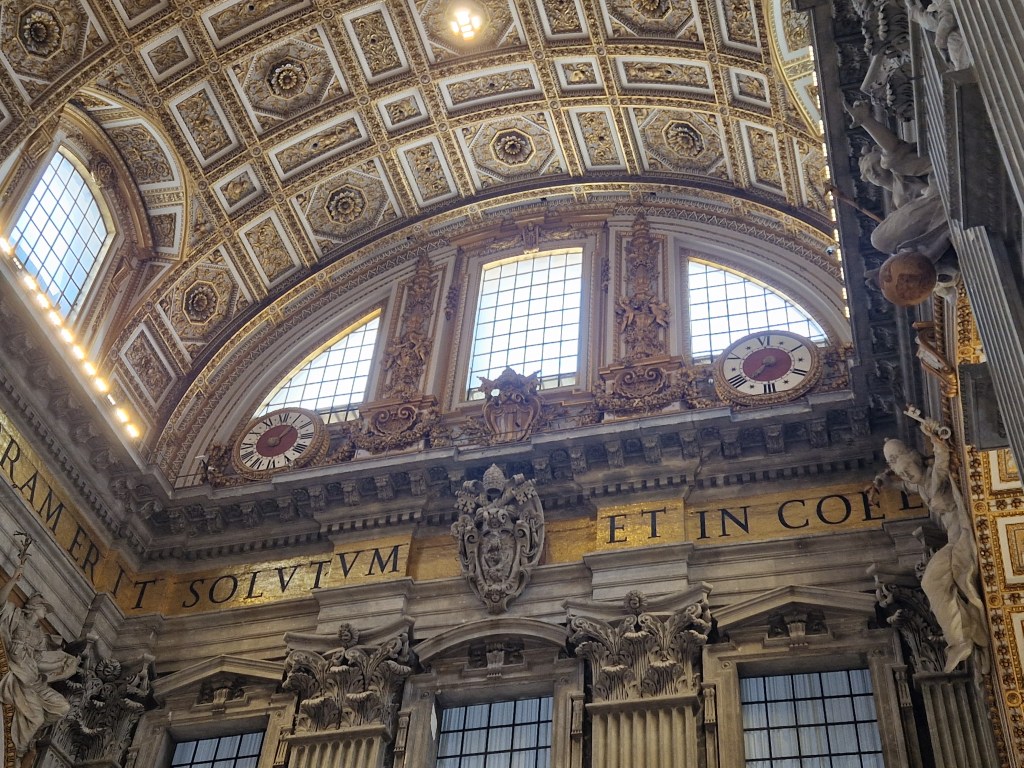
After a whirlwind tour through the basilica, we paused for a moment at the gift shop and took a few pictures before finding a taxi to take us to our next destination: the Pantheon.
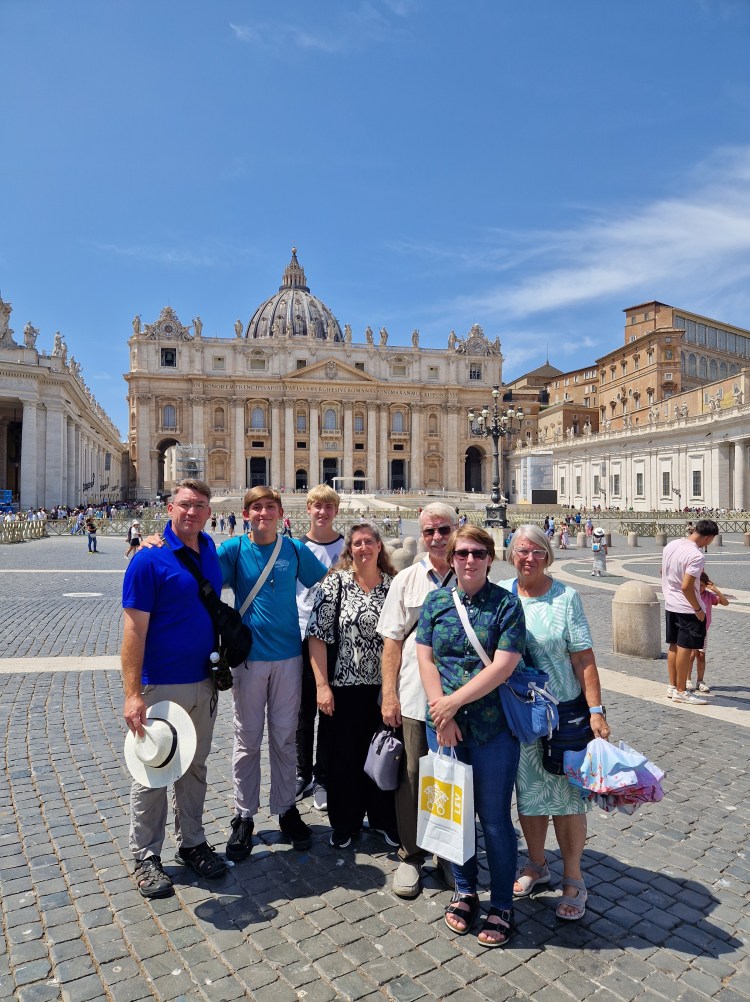
Before continuing though, we needed food and so we ate at the nearby Come ‘Na Vorta restaurant. Fresh handmade pasta in traditional sauces. I had the tagliolini in their cacio e pepe sauce, one originating from the local area. It was delicious. The pasta in Italy is always served al dente, which has become my favorite way to do so, and freshly made with fresh sauces makes culinary perfection. The service was good, the food served promptly, and all for a reasonable price. If you’re in Rome at the Pantheon give it a try.
The Piazza della Rotunda is one of my favorite spots in Rome because in addition to the historical significance and engineering genius of the building that dominates its southern side, the square itself square contains some of the best cafes in Italy. Our tour started with learning about the construction of the Pantheon, which is capped by what is still the largest unreinforced concrete dome in the world, and that’s just the beginning of its amazing features. Another can only be seen on April 21st, the traditional birthday of Rome. At noon on that day, the oculus—the only source of natural light in the structure—shines a shaft of light on the doorway in an amazing special effect for the Emperor’s entrance.
The Pantheon also contains the final resting place of Raphael, the first artist afforded such an honor and upon whose tomb is inscribed the following epitaph: “Here lies Raphael, by whom Nature feared to be outdone while he lived, and when he died, feared that she herself would die.”
After the Pantheon tour we walked by one of those cafes I mentioned above, Antigua Tazza d’Oro, where I stopped to try my first café granita. I was reluctant at first because, though I love coffee, I’m not usually a fan of coffee flavored things like ice cream or candy. This, however, isn’t coffee-flavored, it’s frozen coffee and it was both delicious and refreshing on a hot August afternoon.
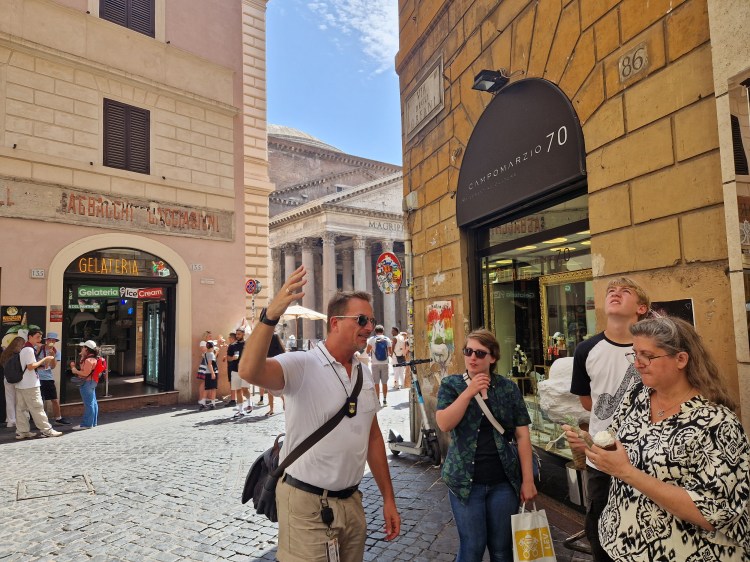
The other café I’d recommend is Café Sant Eustachio which, like Tazza d’Oro, has their own custom roasted bean blends that are uniquely Roman. Unlike the Neapolitans who prefer strong robusta bean blends, Roman use more arabica beans. This makes their coffees a bit milder and sweeter, which I prefer, making these two of my favorite cafés in Italy. There are always long lines, but the coffee is always worth the wait.
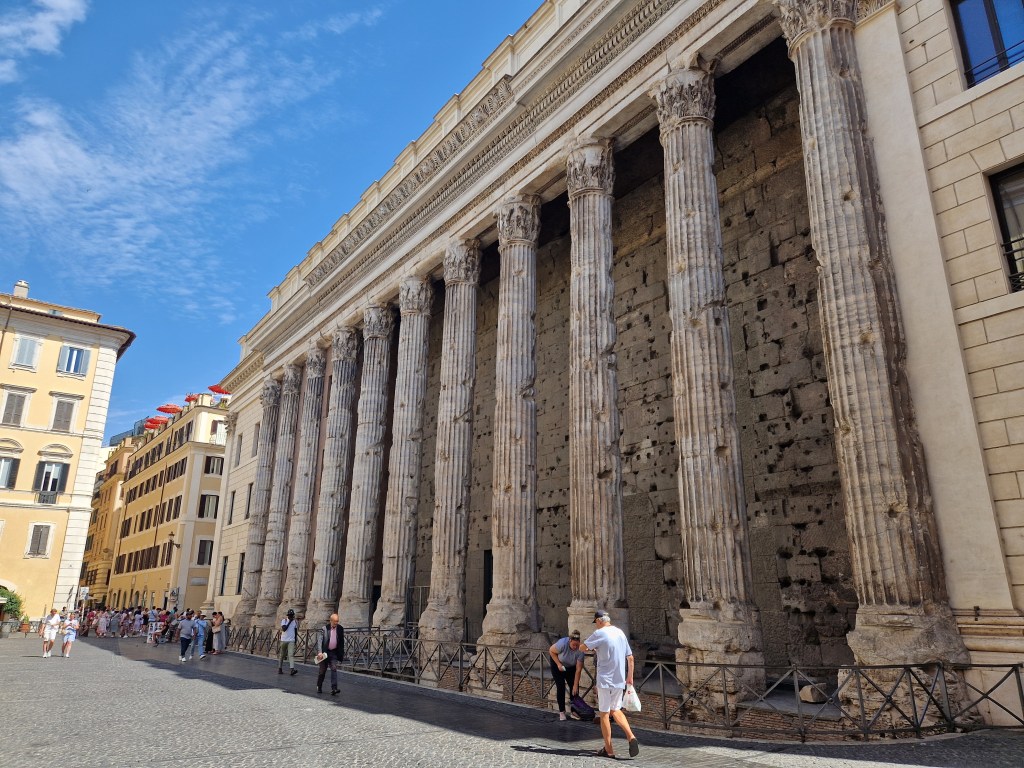
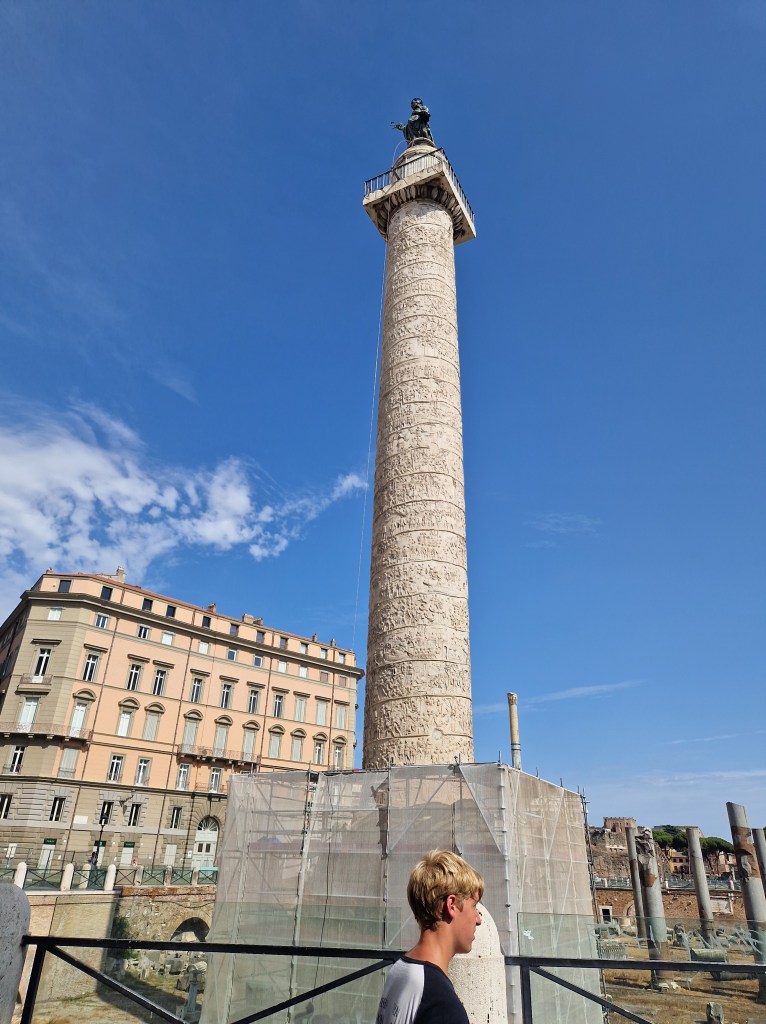
Thus refreshed we continued our tour past Hadrian’s Temple, which is still used as a government building and people walk by without even really noticing the ancient facade. It is one of the spots that is excavated to the original street level of Rome, so you can see the ground upon which ancient Romans walked. We walked by it, too, on our way to the next landmark on our tour, past the Column of Trajan to the Colosseum. It was a long walk on a hot afternoon, but the whole trek was educational as Sev regaled us with the historical significance of the things we passed, highlighted by engaging stories of the characters involved.
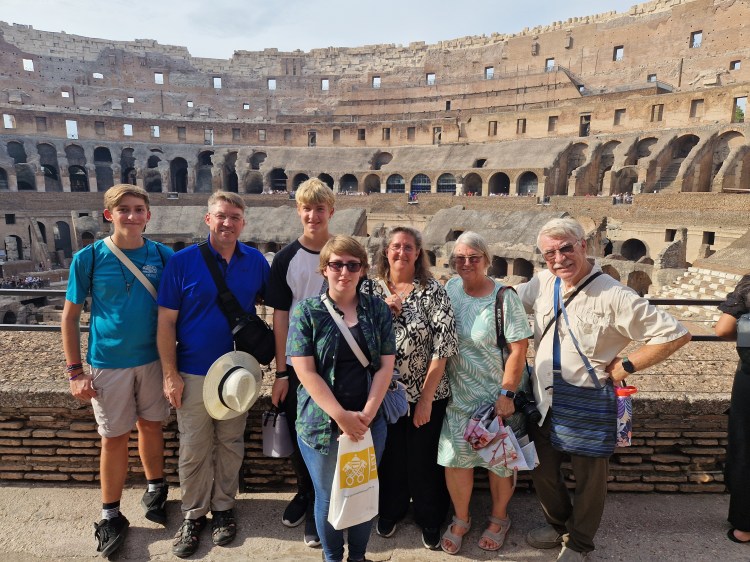
My family’s first tour of the Roman coliseum began with a tour guide telling us that Christians were not killed there, only criminals. She omitted that Christians were considered criminals by ancient emperors who demanded to be acknowledged as divinities, something Christians refused to do. This was the first, but not nearly the last, of our awkward tour guide experiences of guides’ biases clearly clouding their interpretation of the history they were discussing or simply overstepping the boundary of their expertise. This is why we appreciated Sev so much and are as careful as we can be when choosing a guide.
As always, we learned new things from Sev in his discussions of the Roman Colosseum. For example, I had already learned to recognize Roman construction in ruins by the use of brick, but I’d never known that many of those bricks—and most in the Colosseum—are triangular when viewed from the top.
Our whirlwind tour of Rome now complete, Sev departed and we returned by bus to Roma Termini to wait for our train back to Naples. The only place to find a seat in most train terminals in Italy is at the restaurants therein, and since we were hungry and needed to sit down after having been on our feet all day we got supper at the Five Guys. Before you judge us, keep in mind that it’s difficult to find a good burger in Italy, and, after all, it’s kind of cool to be able to say I’ve been to Five Guys in Rome. How many people can say that?
 An Orthodox Priest Abroad
One thought on “Only in Rome is it Possible to Understand Rome.”