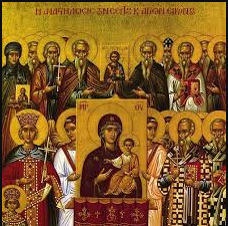
When I was in the process of becoming Orthodox, one practice I found difficult to accept was the veneration of icons. Bowing and kissing seemed an awful lot like worship to me, dangerously close, so close that maybe we’d be better off if we just didn’t do it.
Well, no, in fact we would be worse off without the veneration of icons.
The first thing we get wrong about the icons is an honest mistake, because it is a byproduct of the time in which we live. Our modern mind is so steeped in materialistic determinism that we fail to see how God interacts in the world, we give Him no credit for the things which happen to us nor acknowledge his activity in the everyday events and circumstances of our lives—as if we ourselves are the sole directors of our fate.
Not so the Christians of the 8th century who were certain that the ebb of the Roman Empire in the face of Ottoman Muslim invasion was a judgement of God against them. They just didn’t know why, but the fact that the Muslims were iconoclasts and Christians were using icons led to the widespread misbelief—and it did become widespread, the iconoclast controversy lasted more than a century—that icons were the problem. That Christians, like the ancient Israelites, had fallen into the sin of idolatry and their defeats at the hands of the Muslim iconoclasts was the result.
To believe this kind of thing you have to believe that God is active in the world. That he operates in and through man in ways that we cannot explain nor fully comprehend, that He can execute His will even through men who are against Him. The Old Testament is replete with stories demonstrating this truth. Too bad we don’t read it much anymore.
One also has to believe that God works his will in and through creation, which is also the means He is known by men—even those who have never heard of him. To ancient man the forces of nature we can’t control became gods, and man fashioned idols to try and exert some measure of control over or cooperation with those forces. The household gods we read about—again in the OT—were ascribed by their worshippers with actual powers of control over nature and the circumstances of their lives. Or at least having some influence on those things.
Our modern perspective finds this foolish. The teaching of Christ has been so effective in eradicating these idolatrous beliefs that we could never believe a statuette could have any power of its own and cannot comprehend that men could ever have believed it was possible that a piece of painted wood can have any agency of its own. But in our eradication of idolatry, we have inadvertently become iconoclasts ourselves. We no longer believe that the icons have anything more than sentimental meaning, and deny their participation in the deeper, more expansive spiritual world which, because we can’t see it, we have trouble believing exists.
If we claim we love the icons (are iconodules – literally the “servants of icons”), which we must if we claim to be Orthodox, then first we must understand what an icon is.
Windows to Heaven
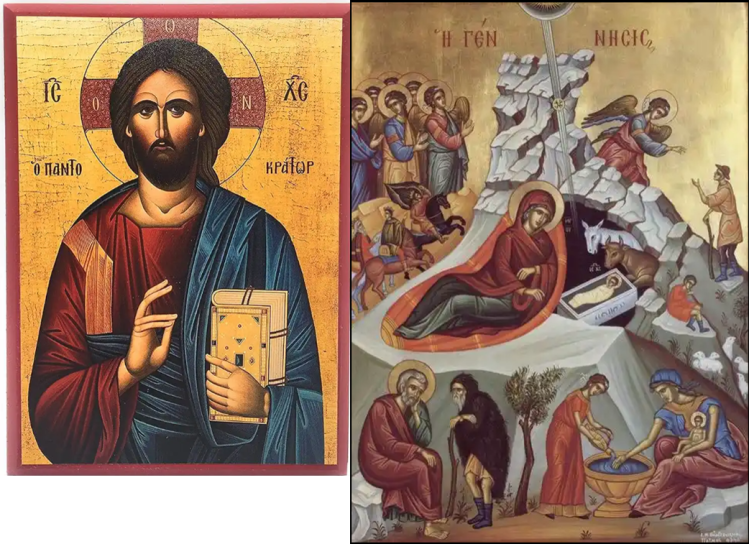
The first thing that comes to mind, I expect, is what we all learn in Sunday School or in catechism: that icons are windows to heaven. They allow us to look, as if through a window, into the “other” realm that we cannot always see, the spiritual world. Within the icons things are not depicted realistically, but to illustrate meaning. For example, art schools teach that full length portraits should depict the subject’s height as about eight times the height of his head—we’re all about eight of our own heads high. Iconographers use a 1:10 ratio, making full height portraits of saints appear much taller than they would be when they were living in this age. This is one method among many used to emphasize the saints perfected traits—Chrysostom’s large forehead indicating his wisdom and knowledge, Christ’s crucifixion is both peaceful and passionate.
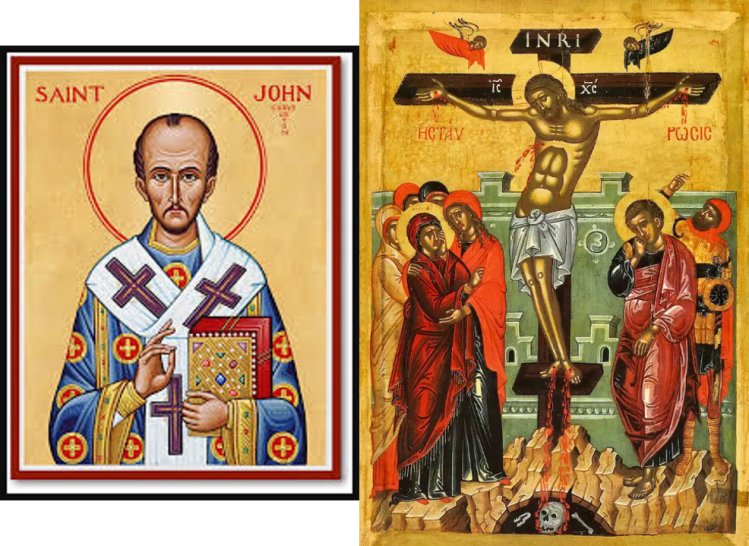
Icons also use reverse perspective, so that things appear smaller at our end than at theirs. This is easily seen whenever a Gospel book is shown, the far side is wider than the near side rather than being drawn smaller towards a distant vanishing point.
Not only is space inverted in icons, but time is meaningless as distinct events are simultaneously depicted—the icon of Nativity of XC depicts at once Jesus’ birth and the arrival of the Magi and the announcement to the shepherds.
Although it is a helpful metaphor to refer to icons as “windows to heaven,” it is limited, and if we don’t grow beyond it then it makes the spiritual world into something over there, outside the window, and not something immanent, right here inside the room with us. In this view the symbolism of the icons becomes pedantic and pedagogical, rather than vibrant and alive, and hinders our participation in the spiritual world here wherein we stand.
The icons are more like eyeglasses that help us see reality clearly. *
Because they help us to see fullness of reality, we venerate them.
The difficulty I had with icons was because I didn’t understand that the world is both spiritual and physical enmeshed, not a two-level universe. Only the latter view could lead one to ask, “why are you bowing before and kissing painted wood?”
The first and simplest answer to that question came to me from a priest to whom I related my concerns about icons. He knew that I had been a Sailor, so he asked me if I had had a picture of my wife in my rack. Of course, I did. “Do you ever talk to it? Kiss it?” I had to confess that I did sometimes. He said the only difference between the picture of my wife and the icon of the Theotokos is the relationship I had with the subject of the image, and that my wife was still able to receive my adoration physically. I only loved that picture for what it represented, not for its own sake. This was a breakthrough, but it is only the beginning.
Unless we grow beyond even that viewpoint, the icons are only pictures of distant loved ones, not men and women present here with us, worshipping with us, praying with us. It again makes the spiritual world something separate from the world in which we now live.
More like Icons you Click
Here it would be helpful to address what we mean when we in the Orthodox Church talk about “symbols.”
We refer to the bread and wine of Holy Communion as the symbols of Jesus body and blood. When we say this, we don’t mean that one unrelated thing represents the other in some abstract way, like when a football coach uses Xs and Os to represent his players on the field when illustrating the play he wants them to execute. There is nothing in the symbol (the X’s and O’s) that suggests on its own the thing it is symbolizing, nor does the symbol itself share in the being of the thing it represents.
When we use the word symbol, we mean that the thing is part of and participant in the wider reality that it represents. One way to help understand this is to think of the icons on your computer desktop. Because you have a program loaded on your computer, you have the icon that represents that program. The icon is a symbol of the program but is also a part of the program and participates in its function. Likewise, the bread and wine in Communion mystically share and participate in the essence of Our Lord and God and Savior Jesus Christ, so that even one particle contains the fullness of Christ. The same holds true of the icons.
Because the spiritual realm is real, because it is immanent, we move in and through it whether we can see it or not. The icons focus our attention on that realm, sometimes in miraculous ways. Icons don’t themselves perform miracles, but because they are nodes of intense spiritual focus, God can, and does, work through them to perform wonders both visible and invisible. This is how the icons make us participants in the spiritual world, help open our eyes to heaven, help us to see greater things than the mere matter of this age. *
Now What Do You See?
Today we celebrate the Holy Fathers of the Seventh Ecumenical Council and the triumph of Orthodoxy they achieved, which is why we call it the Sunday of Orthodoxy. At that council, the Fathers pronounced that not only are icons useful and permitted, but they are essential in our spiritual life. I’ll say that again: Essential.
The holy icons are more than just decorative pictures, they teach us, and their instruction is more than just what is represented in each one. During our procession with the icons today, we will read a portion of the Fathers’ proclamation at the conclusion of the Seventh Ecumenical Council, but before the part we read the Fathers said the following:
“We keep unchanged all the ecclesiastical traditions handed down to us…one of which is the making of pictorial representations, agreeable to the history of the preaching of the Gospel, a tradition useful in many respects, but especially in this, that so the incarnation of the Word of God is shown forth as real and not merely phantastic, for these have mutual indications and without doubt have also mutual significations.”
Before Jesus, we could not paint a picture of God, He was Spirit, immaterial, unseeable. Now that Jesus has been born, God is incarnate. He can be seen, and touched, and thus can be represented in pictures. The icons demonstrate the truth of the Incarnation. *
To deny the use of icons is to deny the Incarnation.
What this also means, is that if icons are things that participate in the spiritual world, if they are a verification of God’s humanity, then that means that we also are icons. You and me. Because God participates in and is part of our humanity, our humanity likewise participates in and is part of God’s divinity. The work that God began when He created us in His image was made complete by His Incarnation. Jesus knew the implications of this when He told us in Matthew’s Gospel that when we minister to least of His brethren, we minister to Him—because we are all icons of Christ. *
C.S. Lewis explains the implications in the best way I have ever read:
“There are no ordinary people. You have never talked to a mere mortal. Nations, cultures, arts, civilizations – these are mortal, and their life is to ours as the life of a gnat. But it is immortals whom we joke with, work with, marry, snub and exploit – immortal horrors or everlasting splendors. This does not mean that we are to be perpetually solemn. We must play. But our merriment must be of that kind (and it is, in fact, the merriest kind) which exists between people who have, from the outset, taken each other seriously – no flippancy, no superiority, no presumption.”
In this morning’s gospel reading Nathanael was amazed that Jesus knew something about him that He shouldn’t. Jesus told him if you think that’s impressive just wait, “You shall see greater things than these.”
We also shall see greater things, if we can see in the icons the immanence of the eternal world, the world that is always present, though sometimes veiled, not just in the mosaics and painted icons, but especially in the living icons all around us. Seated next to us. Because it is through them, that we see our Lord, and God, and Savior Jesus Christ.
 An Orthodox Priest Abroad