I can’t remember ever being particularly superstitious. I have never feared walking under a ladder, or dreaded bad luck if I broke a mirror, and never thought twice about going out on a Friday just because it was the 13th. None of these or many similar things ever really made sense to me. How could the date influence the events of my life, or a broken mirror condemn me to years of bad luck? What even is luck?
It hadn’t even occurred to me that today was Friday the 13th until I ran across this gem:
March 14, 1592 “Ultimate Pi day”: on this day at 6.53am is the largest correspondence between calendar dates and significant digits of pi, since the introduction of the Julian calendar (3.14159265358).
Of course this only really applies if you write the date in the format unique to the USA and its territories , and we weren’t around then, but I digress.
I found during a quick internet search that Friday the 13th is considered unlucky for its association with bad events that happened on a Friday the 13th, or simply because of the number 13 (which for various reasons is considered unlucky and is a belief that has a long, difficult to pronounce, Greek name), or because Christ’s Crucifixion was on a Friday. The confluence of the latter two holds the most weight, for me at least, as to the origins of the superstition.
No one I know really believes that Friday the 13th is bad luck, or even that 13 is an unlucky number. Many things that men and women once did consistently to stave off misfortune have fallen by the wayside. Athletes now never think twice about wearing #13, race car drivers don’t hesitate to paint their cars black, and no one stays home on a Friday that happens to fall on the 13th day of the month. We’re much more enlightened these days.
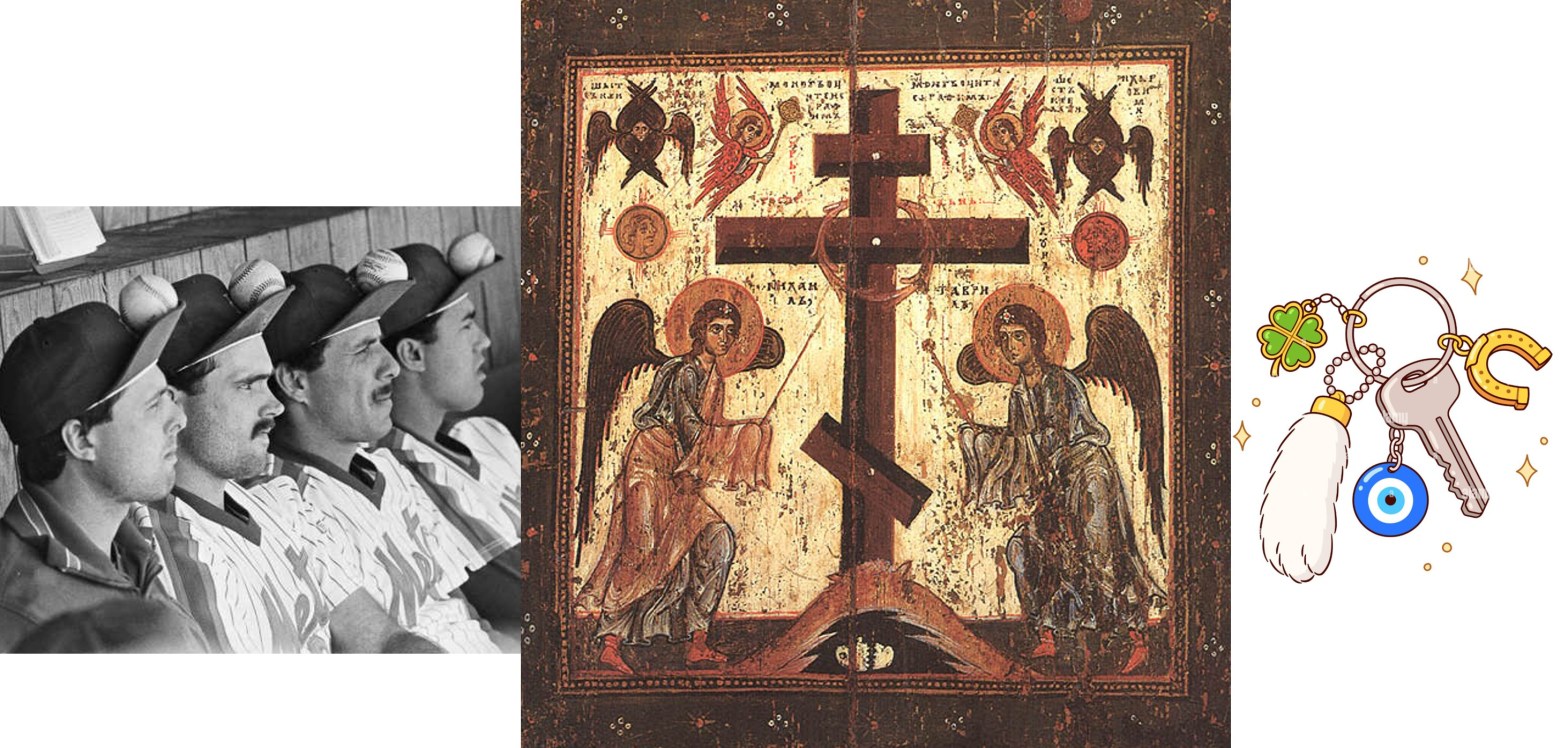
In fact, when I looked up the word superstition, the first definition explained that a superstition results from “a belief or practice resulting from ignorance, fear of the unknown, trust in magic or chance, or a false conception of causation.” You see, just because you wear your ballcap inside out and backwards doesn’t mean that your team will begin to score the runs they need, and you’re an ignorant fool if you think so. And maybe that’s true, but what if I don’t…
None of us wants to be duped or thought a fool, so we tend to discard or downplay our superstitions, which would be good if we could differentiate superstition from supernatural. These days we have a problem doing that and throw out everything that can’t be quantified empirically, stuff that can’t be sensed or measured, and believe that there is nothing outside of our perception that can possibly influence the events of our lives. But that belief, that there is no supernatural world, is also superstitious.
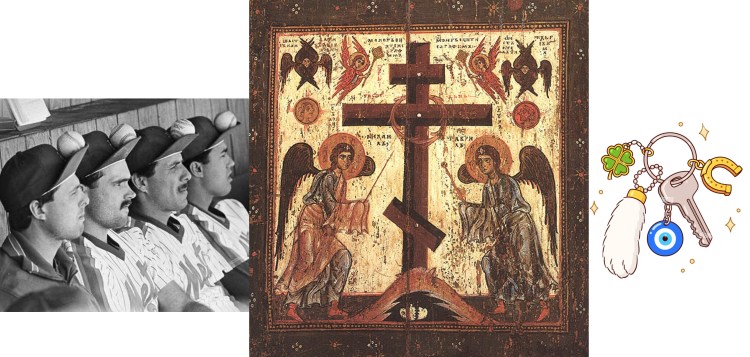
This Sunday we celebrate the Sunday of the Holy Cross, marking the halfway point in our Lenten journey to Pascha.
The Church “now brings to our help the all-holy Cross, the joy of the world, the strength of the faithful, the staff of the just, and the hope of sinners, so that by venerating it reverently, we might receive strength and grace to complete the divine struggle of the Fast.”
Sunday of the Holy Cross – Greek Orthodox Archdiocese of America
We will do a procession with the Holy Cross, and venerate it, and it will give us strength to endure the remainder of the Great Fast.
That sounds awfully superstitious.
But just because we cannot measure its effects, nor explain how it works, yet our veneration of the Cross of Christ is encouraging and enlivening. All you have to do is see it work, experience it yourself, and be open to knowing something in a new way to believe that God is with us. Symbols have meaning beyond their substance.
Before a recruit becomes a United States Marine, he or she must endure the Crucible. Over two days Recruits must hike almost 50 miles carrying 45 pounds of gear, complete several combat tests, maneuvers, and exercises, with limited sleep and even less food. It is the culmination of their weeks of recruit training giving them the opportunity to put into practice what they have learned.
Only when they have successfully completed the Crucible, are the recruits gathered and congratulated. Then one by one their Drill Instructor drops into each pair of hands an Eagle, Globe, and Anchor (EGA) pin. A piece of tin worth maybe 50₵, but to the newly minted Marines it is of immeasurable value. That pin represents the blood, sweat, and tears of basic training successfully completed, and the right now earned to call oneself a United States Marine and to share in a brotherhood that spans time and place. To wear the EGA means to uphold the honor of the Corps, and a Marine will find untapped reserves of strength before he will fail in his mission or dishonor the Corps.
When we venerate the Cross of Christ, or we wear our cross, or make the sign of the cross, or even just see a cross, we can join ourselves mystically to Christ and unite our suffering with His. “For we have not a high priest who is unable to sympathize with our weaknesses,” as St. Paul wrote in his letter to the Hebrews, “but one who in every respect has been tempted as we are, yet without sin.” Through the eternal symbol of Christ’s Holy Cross we are connected with our God, because like us He knows what it is like to endure the crucible of life with its suffering and pain, and this empowers us with hope. With that hope in mind, we can then “with confidence draw near to the throne of grace, that we may receive mercy and find grace to help in time of need.”
Though we live in a world still plagued with suffering and death, the Cross of Christ reminds us that the power of death has been destroyed. Moreover, by joining our suffering to Jesus’, He will give us grace and strength to endure our struggles. We will find in ourselves what St Paul found when he wrote to the Philippians
“I have learned in whatever state I am, to be content: I know how to be abased, and I know how to abound. Everywhere and in all things I have learned both to be full and to be hungry, both to abound and to suffer need. I can do all things through Christ who strengthens me.”
Philippians 4:12-13
Whatever crucible we endure, the Cross of Christ has the power to teach us to be content therein, to be truly glad according to the days in which we have been afflicted and the years in which we have seen evil. Because after the Cross comes Resurrection.
Modern psychology has recently come to accept that one’s spiritual well-being is a big part of our mental well-being, and even our physical health. Science, recently thought to be at odds with things supernatural, is lately forced to admit that there are indeed some things that are observably true that cannot be empirically measured or explained.
Superstitions see coincidences and think they see causes and then try either to repeat (if they’re good) or avoid (if they’re bad) those same circumstances in the future. They fail at least as often as they succeed, usually more often. But a pattern that repeats itself time and again and is consistent in its effect across all times, places, and peoples becomes scientific.
Because it orients us to the world, because it helps us make sense of our suffering and shame, because it joins us to the brotherhood of Christ in which we find meaning and though which we fulfill our purpose, one of those things is the power of the Holy Cross. And that’s not superstitious, it’s just true.
 An Orthodox Priest Abroad