American warships need lots of gas, and on the way through the Mediterranean, if you don’t get it from underway replenishment, than you have to stop in a port. After Rota, Spain, the next place ships tend to stop on their way through is in Souda Bay, Greece, which is on the island of Crete. This is why were pulling in to Greece, however, COVID restrictions still kept us on the pier only, and we didn’t get to explore the island. For me, though, simply seeing Mount Ida and plying the waters of the Aegean is enough to stir my imagination. I tried with this prayer to stir that of my crew as well, and because hubris is such an easy trap for the crew of a U.S. warship, I also wanted to illustrate why history is important to learn, especially in the profession of arms.
Well, we’re pulling into Greece tomorrow, which is exciting for me in particular because I’m married to a Greek and am a priest in the Greek Orthodox Archdiocese of America. If you know any Greeks, then you know that it doesn’t usually take long to discover that he or she is Greek. They are a proud people.
Greeks have good reason to be proud of their history. Situated at the crossroads between the Eastern and Western Mediterranean and the outlet of the Black Sea, the Greeks have often had to be courageous and daring in defense of their homeland against invasions. One of the most ancient and well-known of these was the attempted invasion by the Persian Empire under Xerxes in 480 BC. Many of you may know about the opening of this invasion—retold in the movie 300— Spartans led by King Leonidas held back the Persian Army at Thermopylae for several days. Far less well-known, however, was the role the Greek navy played in turning Xerxes back to Persia. That effort was led mostly by Athenians.
When the Spartans finally fell at Thermopylae and the Greeks were forced to fall back, most commanders advised moving south of the narrow isthmus at Corinth where, like at Thermopylae, they could best defend the rest of the Peloponnesian Peninsula against Persia’s superior numbers. Athens, however, is north of that isthmus, so the Athenians had other ideas.
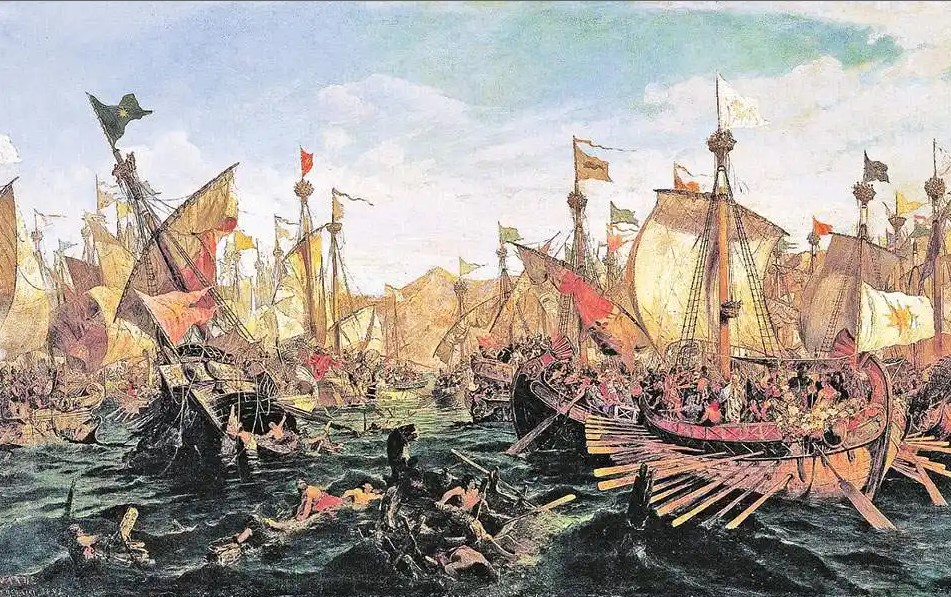
The Athenian general Themistocles persuaded the Greeks to bring the Persian fleet to battle, hoping to drive it off of their coast. Themistocles positioned his 378 ships inside the Straits of Salamis of the Saronic Gulf between Athens and the Peloponnese peninsula, which is only about 230 miles from where we are now. From his sheltered position in the straits, Themistocles taunted Xerxes and lured him into bringing his 1207 ships into the restricted waters, effectively surrendering his advantage in numbers. The Persian fleet had to line up in successive ranks, and the Greek triremes pushed the first ranks back into the following ranks creating an uncontrollable confusion. Like they had at Thermopylae, the Greeks used their home field advantage to even the odds against a foe that outnumbered them. At Salamis, though, the Greeks won and Xerxes was forced to abandon his attempt to conquer Greece.
Though it would be better if we could see more of it, don’t miss the fact that the lands that we are travelling past and the water that we’re driving through are settings for centuries—in fact, millennia—of history, the stuff we read about in school.
I think it is worth noting that what we once called the Persian Empire is now known as Iran, and that where we will soon be heading is their home water and we have the superior Navy. So it pays to reflect on history, not just to admire the courage of the Greeks, but also to remember what overconfidence can do to the away team. So, let us all act with courage and wisdom, rather than bravado and foolishness. Only then can we be sure that we’re doing God’s work.
LET US PRAY
Almighty God, King and Ruler of the heavenly host, we thank you for guiding the history of mankind and bringing forth an ever-widening, always improving civilization. We pray that as we move into position to be instruments of your Providence that you will remind us that you are the One who directs history, and will continue to do so until the end of history. Make us receptive to your wisdom and guidance, and may our efforts improve our world according to Your will, for You are holy always, now and forever and to the ages of ages
AMEN

