Being a command chaplain means ensuring people of all faiths are protected in their right to freely exercise their religion. As a Greek Orthodox priest, I spend less of my time providing for the religious needs of my faith and a little more time, facilitating the religious needs of others. For example, I must see to it that a Catholic priest visits as often as I can arrange, or Protestant Christian pastor, or a Jewish Rabbi. Deployed at sea these options are limited, and often I am the only religious professional the crew will see or hear from for weeks or months at a time. The command, under the chaplain’s supervision, assigns lay leaders to conduct worship for any faith group desiring a regular service, so on our ship we had three weekly worship services while deployed, my Orthodox service, one Catholic service, and one Protestant service. Though I attended all three, I only led one. (On every ship there are also usually a few Jewish Sailors or Marines, who, like Orthodox Christians typically, assume they are on their own and find their own way of keeping their faith. It is difficult to find Jewish lay-leaders on smaller ships.) Ever since I discovered that most men and women who enlist in the sea services are unlikely to have ever been to Sunday School or to have otherwise heard the Bible stories that were so important to the formation of our cultural conscience, I’ve made it a point to tell the stories as often as I can. Even if, like in this evening prayer, I never tell them it’s actually a Bible story.
Be courageous.
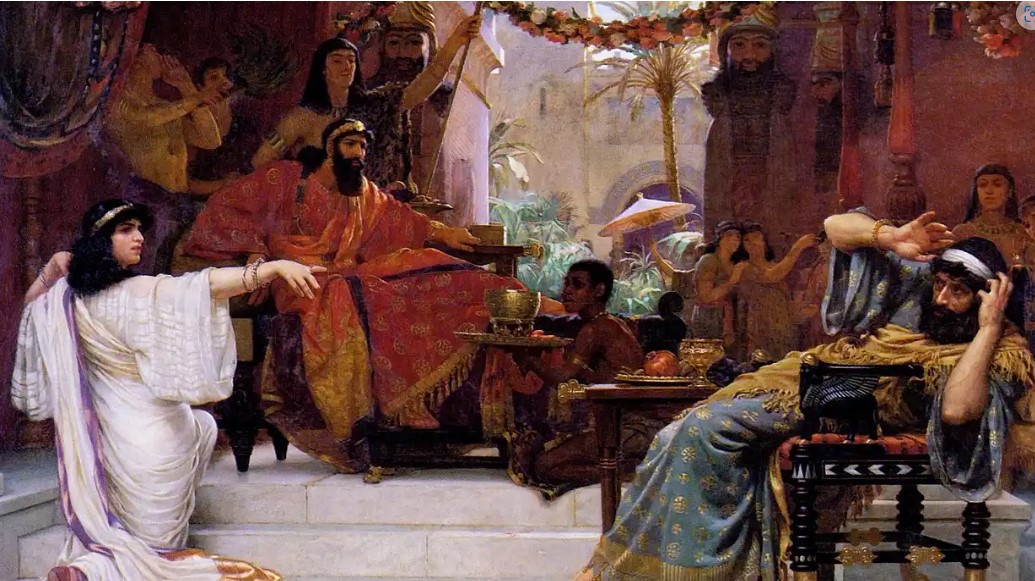
I’d like to tell you tonight about a young woman. Orphaned at a very young age, she was raised by her closest living relative, an uncle, in a land far away from their native country. The girl does not have many prospects for a prosperous future, and no perceptible reason to expect to be long remembered. But the king is looking for a new wife, and the orphan girl’s prospects are about to change.
King Ahasuerus decides to make the foreigner his queen. Though she didn’t seek it, or have any expectation of it, her life seems to become a fairy tale. The catch, however, is that fairy tale princesses have some pretty dark times, and have battles to fight, before their happy endings—if indeed the end is a happy one. This new queen is no exception.
Her husband, the King, angered by an attempted assassination, decides to exterminate from within his empire the entire race of people he believes responsible for the attack on his life. He is unaware that his queen is a member of that race. She is afraid to tell him—especially now.
She didn’t seek it, or have any expectation of it, but she is now in a position to speak up to the king on behalf of her people. The uncle who raised her pleads with her to do so for the sake of the people whose ethnicity they share, but to even approach the king that way means almost certain death—even for a queen. So her choice is as clear as it is stark: speak up and risk her own death, maybe to no effect, or remain silent and live out the rest of her fairy tale life.
What would you do?
Esther spoke up. She told the king that she also was Jewish, and that if he were to fulfill his plan, he would have to kill her too. Only then does he discover that it was Queen Esther’s uncle Mordechai who had saved his life from assassination. He reverses his earlier decree and honors both Mordechai and the Jewish people. Though she hadn’t sought it, nor had any expectation of it, Esther saved her people. She didn’t let her circumstances dictate who she was, she stood on principle, and now is forever remembered by the people she saved.
The Jewish people celebrate the courage of Esther every year on the feast of Purim, which falls on today’s date this year. So in honor of Esther and of courageous and strong women everywhere, I’d like to read a traditional prayer from the festal observance of Purim.
LET US PRAY
Blessed are you, Hashem, our God, King of the Universe, (the God) who takes up our grievance, judges our claim, avenges our wrong; Who brings just retribution upon all enemies of our soul and exacts vengeance for us from our foes. Blessed are you Hashem, who exacts vengeance for his people Israel from all their foes, the God who brings salvation.
To make known that all who hope in You will not be ashamed, nor those taking refuge in You ever be humiliated. Accursed be he who sought to destroy me, blessed be Mordechai [of the tribe of Judah]…blessed be Esther who sacrificed for me.
AMEN
 An Orthodox Priest Abroad
Thank you for sharing this. Very interesting. I’m not very well versed with the Old Testament, except for readings at church.
LikeLike
You’re welcome, Liz. We all need reminders, and these stories tell us a lot about who and what we are and ought to be.
LikeLike