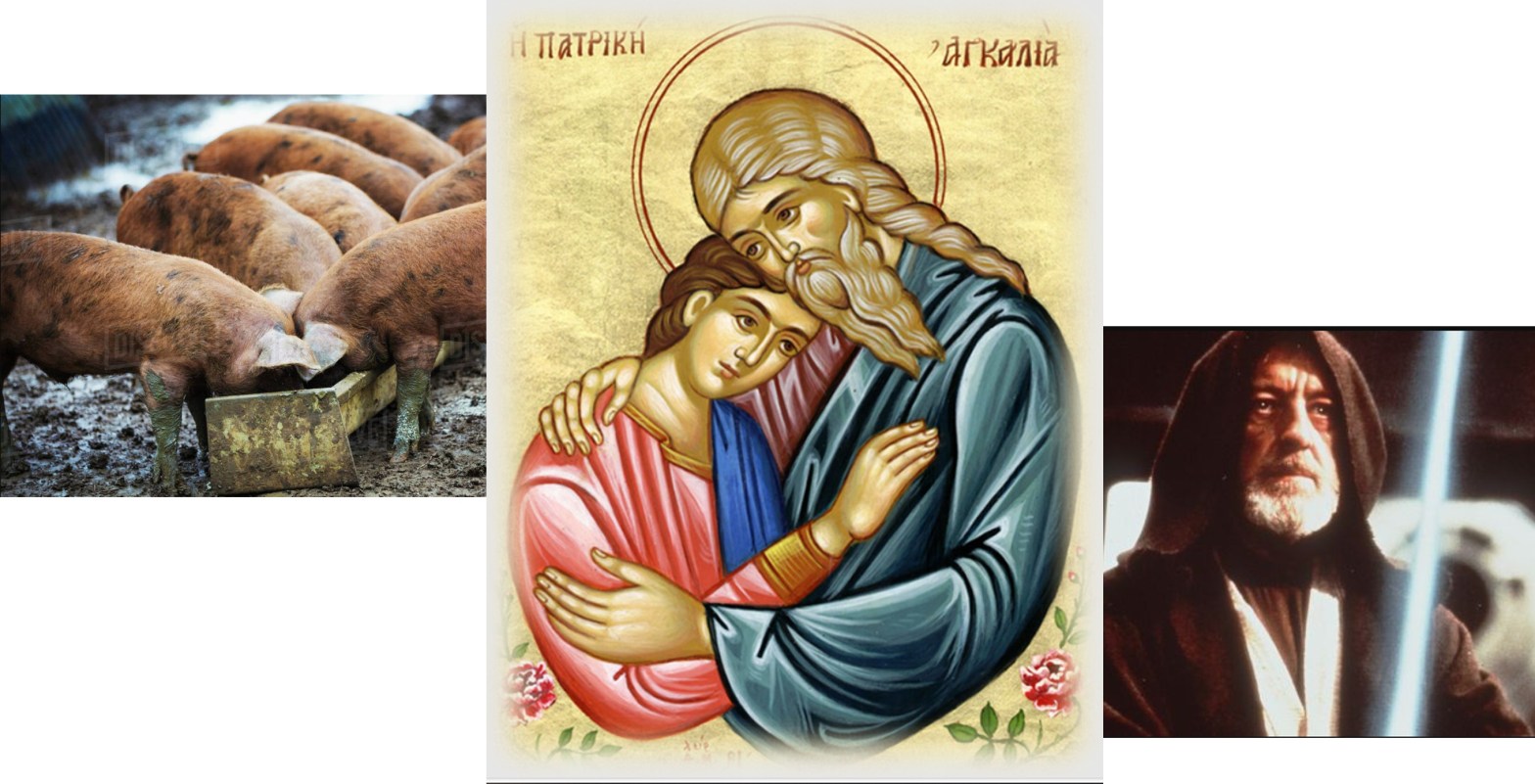
If you’ve never been around a pig farm, say a prayer of thanks. Pigs stink. A lot. So, when the protagonist of Jesus’ parable finds himself in their midst ready to eat out of their trough, he faces a certain set of awful circumstances. His reaction to those circumstances, however, is not as certain.
It is widely believed that we live in a “post-truth” society, which is defined as “relating to or denoting circumstances in which objective facts are less influential in shaping public opinion than appeals to emotion and personal belief.” A good example is a popular Congresswoman complaining that there are “a lot of people more concerned about being precisely, factually, and semantically correct than about being morally right.” Who determines what is morally right isn’t clear, but she isn’t nearly the only one who allows feelings to trump reality.
A generation of Americans raised after Star Wars has listened too attentively to the advice of Jedi Master Obi-wan Kenobi who pleads for Luke to “trust [his] feelings.” “Your eyes can deceive you,” Kenobi says, “don’t trust them. Stretch out with your feelings.” Kenobi doesn’t explain why feelings are more trustworthy than human senses, but in Dickens’ A Christmas Carol Ebenezer Scrooge offers a justification for not trusting one’s senses. He explains his disbelief in the ghost to whom he is speaking by claiming that trivial things upset the senses, “you may be an undigested bit of beef, a blot of mustard, a crumb of cheese, a fragment of underdone potato. There’s more of gravy than of grave about you, whatever you are!”
There is little question that our senses can be fooled. After all, who doesn’t like a good magic show? But why are we so much more likely to trust our feelings? Why do we consider feelings more reliable? I suspect one reason is that there is little doubt that we feel what we feel. We may not know the cause of our feelings nor clearly understand what exactly we feel, but we know that we feel something. Unable to deny its presence we must try to explain the feeling, and it is this effort that can get us in trouble because feelings seldom express themselves clearly. Am I really angry or just frustrated? Hungry, maybe? Am I disappointed that I didn’t get promoted, or jealous of my friend who did? Maybe both?
Because they are sometimes fuzzy, we tend to explain our feelings in ways that make sense to us, crafting explanations that fit into how we understand ourselves and the world around us. Now, this may not be a problem if our interpretations are correct, but it can be a big problem if we are wrong, and just how are we to know the difference since I can’t exactly share the feeling? If we are prone to negative thoughts, this internal feedback loop can often lead to depression as we can find no end of evidence to support our negative self-perception. If I view myself as worthless this will affect my view of the world by thinking that everyone hates me because I am worthless, which leads to negative Pygmalion predictions of the future that I will never be good at anything because everyone hates me, predictions for which evidence of fulfillment is easily found leading me to the conclusion that I am indeed worthless—just as I suspected. The very nature of feelings makes them subjective and so, like our senses, should not be trusted absolutely. No, Obi-wan, we should not trust our feelings.
All of us have negative thoughts, but a resilient mind knows that feelings are transient and circumstances change. Resilience is based on a more enduring knowledge or principle and views life through a wider, more comprehensive lens than what I feel now, what is happening to me now, and doesn’t allow those negative thoughts to cloud the broader reality. To be clear, this is not the power of positive thinking, it is the power of realistic thinking. Is what I am feeling or thinking true? Is it important? Is it helpful?
It is a resilient mind that can look down into the filth and stench of a pigsty and remember his home and his Father. The Prodigal Son looked past his present circumstances to his past—his home, and to a better, more hopeful future—to his Father. It would have been far easier to take the evidence of his situation as affirmation of his getting what he deserved and to wallow in filth and eat pig slop because he had earned such by being a worthless son. Instead, he used the knowledge of a better place to give him the strength to change his circumstances. To get up out of the filth and go home, a better place to be even if he couldn’t be a son anymore.
There are many times in life when things don’t work out for us. We make a bad choice and wind up eating slop with pigs. But we don’t have to stay there, allowing our negative thoughts and feelings to trap us like the undertow of a waterfall, holding us under until we drown. We are, rather, sons and daughters of a loving Father who is waiting perched on His doorstep for us to see that who we are now, what we are now, is only a shadow of what we are meant to be, and that all we need do is look up and out to break the self-fulfilling cycle of failure. We don’t need the strength to do everything correctly right now, we only need to get up and take a step in the right direction, and then the next step, and before we know it—even before we get to where we think we should go—we will find ourselves wrapped in the loving arms of God, who will take care of the rest.
We won’t feel good about that. It isn’t what we know we deserve, and we’ll feel ashamed, just like the Prodigal Son did. But don’t trust your feelings. Trust in our Father.

