Most of my childhood baseball career was spent behind the plate. I loved playing catcher, mostly because my hero—Hall of Famer Johnny Bench—was a catcher, one of the all-time greatest. Not only did I get to see him play, but Bench taught me how to play baseball every Saturday morning on The Baseball Bunch. I would bring Bench’s pro tips with me to my Little League practices until my coaches had to slow me down. “You don’t worry about inside or the plate, outside of the plate, just help him get it OVER the plate,” one of them once scolded me.
One of the things both Johnny Bench and my coaches drilled into me was when to take off my mask and hold it, when and where to throw it, and when to leave it on. The last one is the toughest, because on a sweltering summer day most kids flip off the mask as soon as the batter hits the ball. But when there is a potential play at the plate, like when a batter grounds a single into the outfield with a runner on second, I was told to leave that thing on and face the runner as he comes in. You want all the protection you can get if there is going to be a collision. But that was a long time ago.
Recent rule changes (what a good friend of mine once called the “Buster Posey ruins baseball rules”) have made the chances of face protection requiring contact dwindle to almost nothing. In fact, any contact on the base paths is exceedingly rare these days. It is rare even for a runner to go in hard at second base to break up a double play, and this can be seen in the way that middle infielders make the relay on a double play.
In bygone days, shortstops and second basemen would come across the bag without stopping, making certain to clear the area before the runner arrived—if he could. Ideally, the defenseman would keep the second base bag between himself and the runner, making it more difficult for a sliding runner to hit him. Not so anymore. Confident of their safety from contact, middle infielders routinely now hold their ground, which gives them an advantage in making a strong, accurate throw to first.
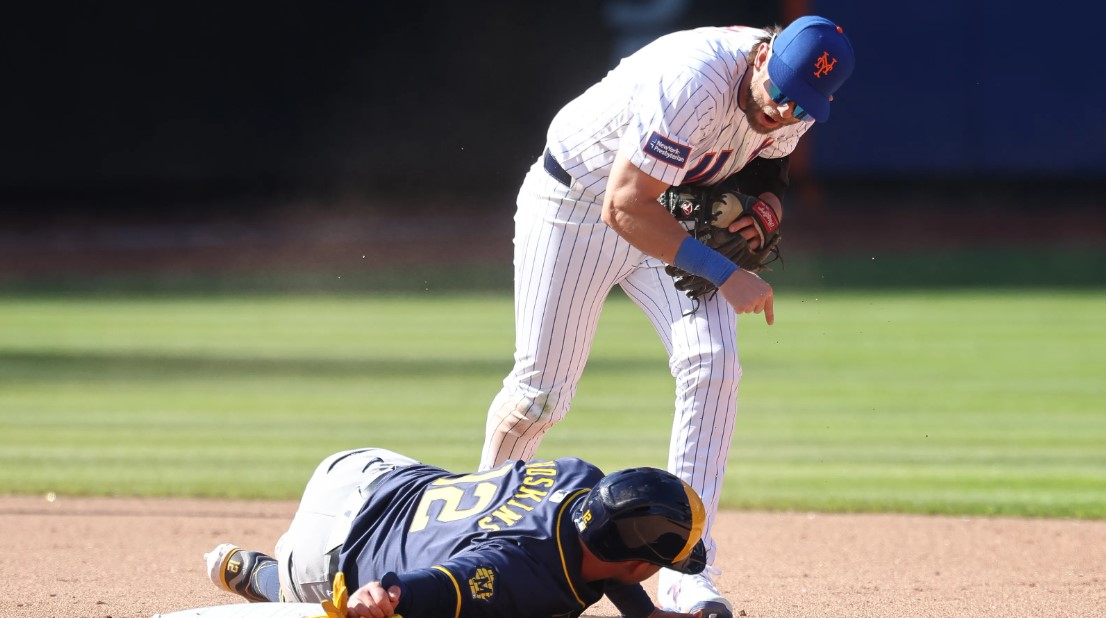
This is just what New York Mets second baseman Jeff McNeil was doing in his attempt to turn a double play against the Brewers this week, when Brewers’ first baseman Rhys Hoskins slid across the bag contacting McNeil’s leg and igniting a firestorm of controversy. McNeil had taken the throw keeping the bag between himself and the runner—so far so good—but he left his foot planted on the bag as Hoskins arrived. To me this is inviting contact. If he had stepped back or aside in his attempt to turn the relay, Hoskins couldn’t have touched him when he went in hard at second trying to break up the double play in a good, smart baseball play. The fact that this is even a controversy is testament to how far we’ve come in our attempts to make sports safe.
We are making our favorite sports ridiculous in order to avoid injuries by ignoring the unintended consequences of changing the rules. It is true that had Hoskins gone in much harder he could have hyper-extended McNeil’s knee and caused a significant injury. But is Hoskins to blame for that, or is it that McNeil felt entitled to hold his ground where he was, conditioned by rules made to eliminate such contact? MLB has essentially eliminated collisions at the plate by requiring catchers to leave an opening for runners, making every play at home a swipe tag, one that’s really tough to make and generally looks foolish.
The more we eliminate contact from contact sports, the less interesting they become. Without any actual risk, there is less incentive to become emotionally involved in the outcomes of the individual on-field contests. There’s less apprehension when a defensive end chases a quarterback out of the pocket when you know that he’s going to simply throw the ball away, avoiding the loss of yardage and erasing the defenders work chasing him back. There’s less anticipation when a runner nears the plate as the throw comes in when the catcher is standing in front of the plate rather than on it and likely to miss the tag—the only contact possible. You can keep sports safe, or you can keep them exciting. Doing both is just as impossible in baseball as it is in life—an inherently risky business.
No one wants to see players get injured, but the balance between safety and risk must tilt more towards risk, and an athlete must accept at least a little more risk than a couch potato like me does. McNeil should know this and protect himself by assuming there will be contact rather than assuming that rules will protect him. The umpires judged Hoskins’ slide legal, even by modern rules, leaving McNeil without a leg to stand on in his complaint. Maybe next time he’ll move it out of the way.
 An Orthodox Priest Abroad