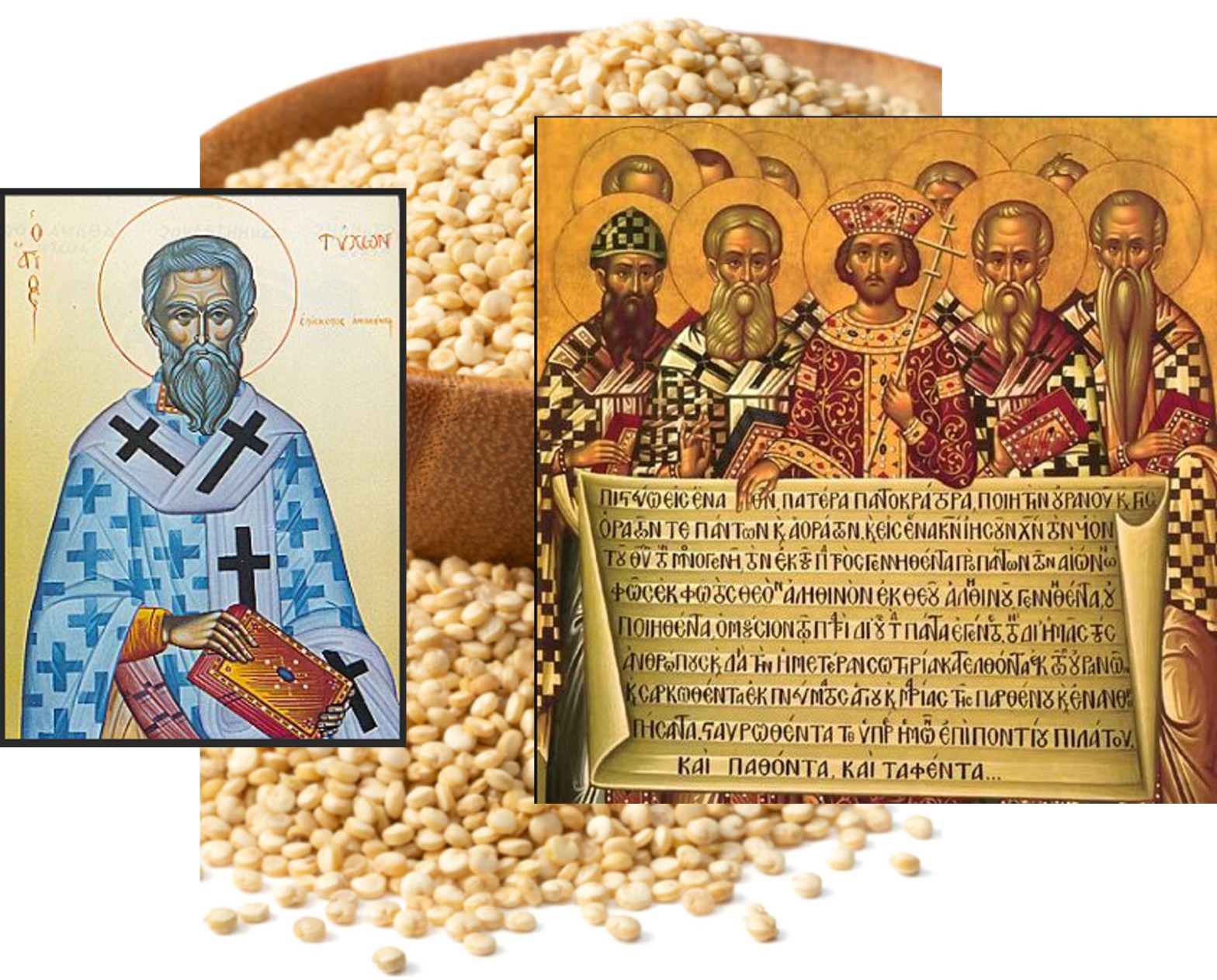
In a remarkable and wonderful coincidence, we celebrate the Fathers of the First Ecumenical Council on Father’s Day. This also happens to be the feast day St. Tychon of Amathus, whose relationship with his father was close, formative, and—in at least on case—miraculous.Young Tychon’s father was a baker in Cyprus, who charged his son with the sale of a portion of his daily product. Having seen his father give bread to the poor, Tychon gave his entire portion away rather than selling it. This left his father bereft of the money required to replenish his wheat for the next day’s baking and left him quite angry and frustrated. Tychon prayed for his father, telling him that he was letting God borrow the breads.
The baker and his generous son walked to their bakery the next morning, without any hope of baking anything but not knowing what else to do. When they got there, they found that God had repaid the debt: He had filled the father’s grain bins until they were overflowing.
This miracle reminds me of the miracle God worked for the Widow in Zarephath when asked by Elijah for bread. She didn’t have any, she said. In fact, she was heading home with her son to eat the last of their food and die. Elijah said to her “Don’t be afraid. Go home and do as you have said. But first make a small loaf of bread for me from what you have and bring it to me, and then make something for yourself and your son. For this is what the Lord, the God of Israel, says: ‘The jar of flour will not be used up and the jug of oil will not run dry until the day the Lord sends rain on the land.’” So, she did what Elijah asked, and found that she never ran out of what she needed.
It also reminds me of the Myrrh-Bearing Women whom we commemorated a few weeks ago. They went to the tomb early in the morning, not knowing who would roll away the stone for them. They arrived to find God had taken care of that for them.
I imagine that for the 318 bishops who met in Nicaea in 325, the circumstances were much the same as these. They had no idea what the outcome would be, but they knew there were problems that required their attention. They set out towards their goal with the faith born of experience that knows this fundamental truth: Just when we think our resources are at an end, God has not even begun to give.
Christendom was tearing itself apart over whether or not Jesus was fully God—of the same essence—or merely like God—of like essence. Not only was there that division, but bishops also could not agree on when to celebrate the foundational feast of the Church. Some wanted to celebrate Pascha on 14 Nissan, continuing the Jewish tradition of Passover (Pascha) fulfilled in Christ, others wanted the determination of Pascha to be separate from that of the Jewish tradition. As my son pointed out, 318 bishops are fewer than the members of the U.S. Congress, but that doesn’t increase at all the likelihood of that many men coming to an agreement on anything.
In this morning’s Gospel lesson, as Jesus is preparing for His trial and Crucifixion, he offers an extended prayer to God—His Father—on behalf of the
disciples. He prays “Holy Father, keep them in your name, which you have given me, that they may be one, even as we are one.” That prayer was fulfilled in Nicea when 318 bishops all agreed, contra Arius, that mankind’s salvation depended upon Jesus being “God of true God, begotten not created, of one essence with the Father.” They also settled on the proper calculation for determining the date to celebrate Pascha. (The formula they settled on is still used by all Christianity to this day, the only thing that has changed is the calendar used. Christian traditions descended from Roman Catholicism utilize the “new” Gregorian calendar, which is why Easter is usually celebrated before Pascha.)
Unity prevailed in the First Ecumenical Council (as it did in the Apostolic Council recorded in Acts Acts 15). Unity is a defining characteristic of the Holy Trinity who are three distinct persons, but are not separate. This is why Paul warns the first bishops of the Church in this morning’s epistle that “fierce wolves will come in among you, not sparing the flock; and from among your own selves will arise men speaking perverse things.” Men like Arius, who was a high-ranking priest. The history of the Church is replete with heresiarchs who were priests and bishops, so many that St John Chrysostom in his third homily of Acts said, “I do not think there are many among Bishops that will be saved, but many more that perish.” St. Paul points out that what the wolves all have in common is that they seek to “draw away the disciples after themselves.” It is no coincidence that significant historical heresies bear the name of their most prominent proponent.
Division comes when an individual’s ideas become more important to him than the Truth that was “once for all delivered to the saints,” and then aggrandizes himself in an effort to convince others to follow him because he is
right. Our first warning sign that we’re dealing with a wolf (or are ourself the wolf) is whether the goal is unity. We should seek truth, but it is too easy to absolutize a particular truth, which is heresy. Arius was right to defend the truth that God is spirit and wholly outside of His creation, but his absolutization of that truth obscured his vision of the full Truth and led to his downfall.
We are headed for a downfall too if we allow ourselves to sow division in the Church by insisting on our own understanding of what is true. Respected marriage counsellors often ask a husband if he would rather be right or married. Arius was so sure he was right he was unwilling to listen to the counsel of the bishops gathered at Nicaea—some of whom still bore the physical scars of their recent persecution for their fidelity to Christ. Had he been willing to be one with the council rather than right he may have had a happier, less-memorable end.
Because all 318 of the bishops gathered in Nicaea in 325 were more concerned with unity than being right, because they knew that Truth is universal and not particular, they left to all of Christendom a deep well of theology that has provided a refreshing draft to generation after generation. The Nicene Creed, like the widow’s larder and St Tychon’s grain bin, will never fail to provide the nourishment the Church needs to grow in faith and love.
If we set out seeking Truth and pursue unity, we may not know how we will get there, and our efforts may seem to us doomed to failure, but we have many examples of faithful servants throughout salvation history whose faith, likewise tested, was ultimately vindicated by the grace of God’s Providence.
So, when our faith is tested, let us proceed with confidence, knowing that God
is able to do exceedingly abundantly above all that we ask or think. He has
done it before, and He will do it again.
 An Orthodox Priest Abroad
Thank you.
LikeLike