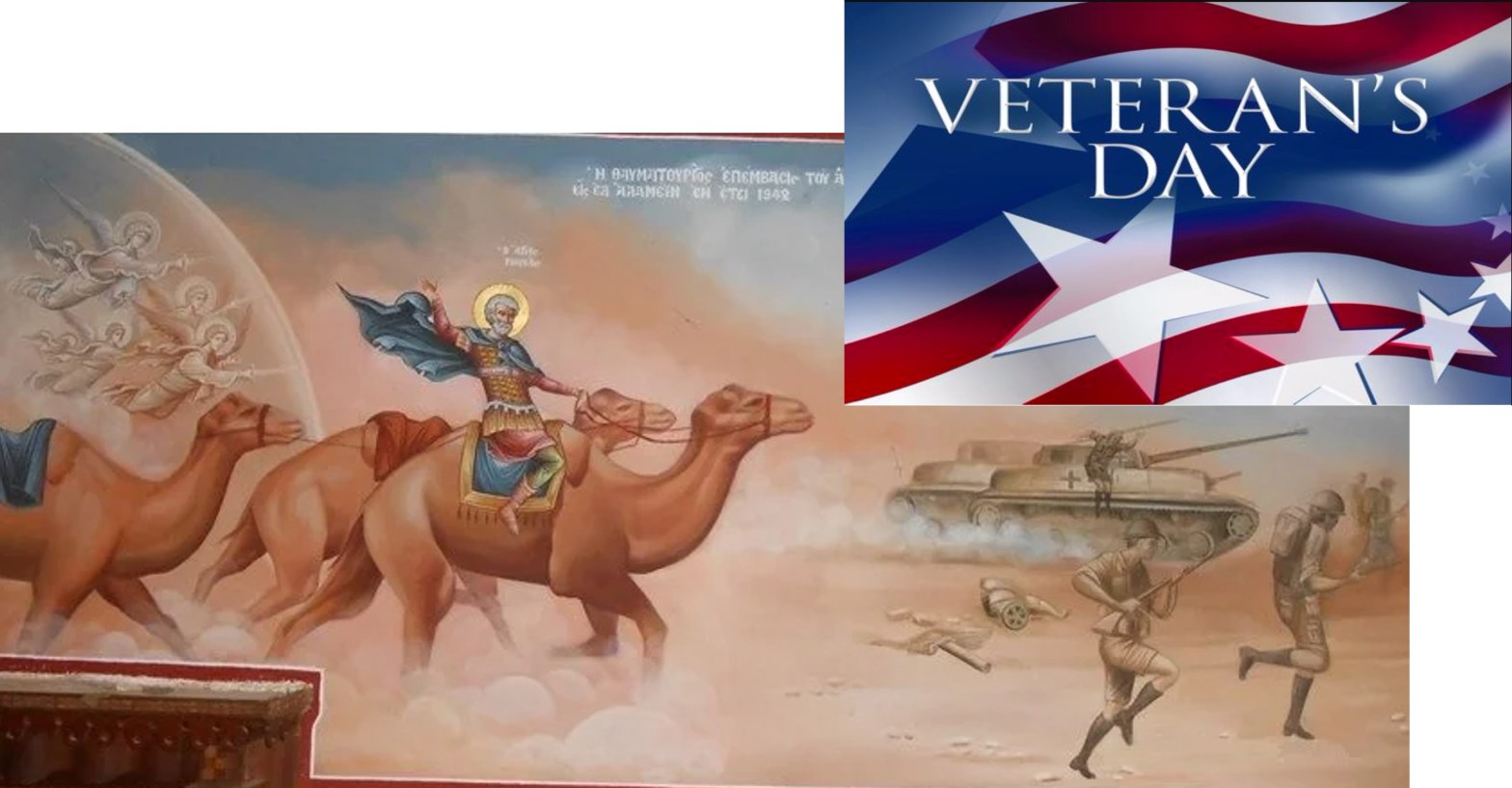
The best thing that could be said about the first battle there was that it had been a stalemate. Though the British Eighth Army had stopped the Axis Powers’ Eastward advance toward Alexandria, some fifty miles away, the month-long battle the previous July had cost them 13000 casualties and the commanding general estimated that they would be out of action until September.
Now in October, under a new commander and with reinforcements that included Americans and, not insignificantly, the 5000 men of the 1st Greek Brigade, formed after the fall of their homeland the year before and anxious to join the fight against the Axis powers, the Eighth Army prepared to attack an entrenched, rested, and reinforced enemy. Given the fact that Allied armies had never yet driven an Axis army from the field, and that the one facing them was led by Germany’s most celebrated field general the outcome was far from certain.
Battle was joined on October 23rd in the late hours of the evening. The plan was for infantry to clear paths for British armored divisions to pass through the German minefields, but from the outset things went poorly. The minefields were more extensive than anticipated and when tanks did move, they raised impenetrable dust clouds that jammed up traffic and bogged them down. Moreover, once they engaged the enemy, British armor met stiff resistance and what little ground they gained came at considerable cost.
The fighting continued there for the next two weeks in a battle of attrition, both sides fighting hard, gaining and giving ground, and with no clear advantage being gained, but which the Axis armies were unable to sustain. So, they withdrew from El-Alamein, the first significant victory of Allied arms against the Axis powers, and though fighting in North Africa would continue for weeks, Winston Churchill could say that “Before Alamein we never had a victory. After Alamein we never had a defeat.” It was a turning point that many—even today—consider a miracle.
The end of hostilities at El-Alamein was exactly 82 years ago today: 11 November. Though now known as Veterans’ Day it was already at that time, and remains, the feast day of St. Menas, the Wonderworker of Egypt. A significant coincidence given that the name “El Alamein” translates into English as “the place of Menas.” A ruined Church nearby, dedicated to the saint, was believed to be the place of his burial. However, St Menas’ presence on the battlefield involved more than his relics. According to the Synaxarion, “During the first night of engagement, Saint Menas appeared in the midst of the German camp at the head of a caravan of camels, exactly as he was shown on the walls of the ruined church in one of the frescoes depicting his miracles. This astounding and terrifying apparition so undermined German morale that it contributed to the brilliant victory of the Allies.”
The Allied victory at El Alamein was without question an answer to prayer. And it isn’t only the Coptic Christians who say so. Jews living in the lands that would later become the nation of Israel had obvious reason to fear the Nazi invasion and, in the words of Rabbi Zev T. Paretzky, they “stormed Heavens gates with their prayers.” Their prayers joined those of Jews and Christians around the globe, resulting in the miraculous turn of events in North Africa. For men and women of faith there can be no question that God is involved in history and works in concert with the prayers of men, particularly the prayers of saints, and St. Menas is a perfect saint to remember on this—and every—Veterans’ Day.
St. Menas was himself a veteran. He was a soldier of the Roman army who served in Egypt, a troublesome frontier of the Empire at the time of Maximian in the late 3rd Century. Menas left active service to become a monk, and then used the skills he learned as a warrior to organize communities in the Alexandrian desert, becoming an unofficial counselor-in-chief to hundreds. Menas’ military bearing drew to him many converts from the Roman army, and this brought him to the attention of the Prefect Pyrros.
Pyrros considered religious men weaklings and could not believe that such a paragon of soldierly manhood as Menas would degrade himself so. A soldier certainly wouldn’t defy his superior, he thought, and so he ordered Menas’ to quit his religion. But the Saint had a new commanding officer, and his new allegiance to Christ led to his martyrdom.
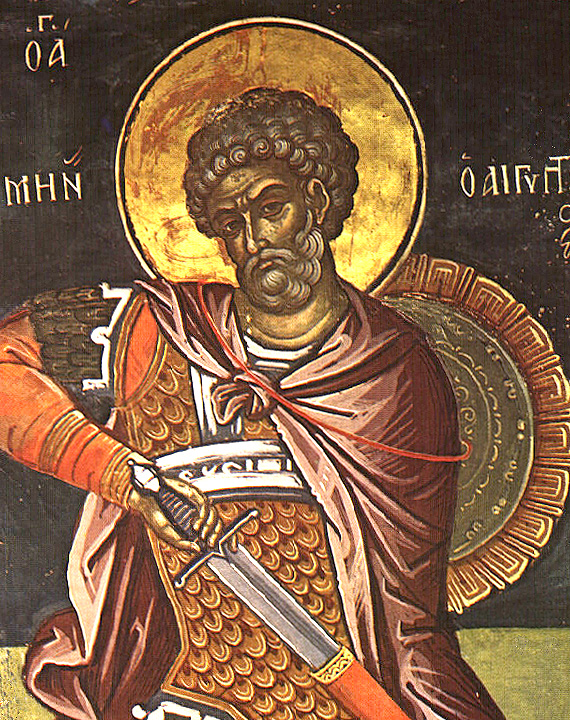
Icons of Menas can often be found on the walls of monastery chapels, since along with the ascetic saints (Anthony, Savvas, Symeon the Stylite, etc.) the monks like to have warriors around (George, Theodore, Means, etc.), because the lives of monastics and that of warriors are remarkably similar in three ways. First, just like a monk, a warrior surrenders his will to a collective and is faithfully obedient to his superior. Second, warriors must be disciplined, training constantly to be physically, mentally, even spiritually prepared for combat. Such discipline mirrors the ascetic struggle of the monks, whose battles with the demons and the passions can be no less terrible. Finally, and perhaps most important, more than anyone outside of a monastery, warriors carry with them the remembrance of death, something the monks know is necessary to cultivate the Divine Life
The warrior’s remembrance of death, however, is more insistent because it is more imminent. Marine officer and Viet Nam veteran Karl Marlantes reflects on this aspect of the soldier’s life in his book, What it is Like to Go to War. Based on his own experience, he describes the profound spiritual—even religious—aspect of warriors in combat. He says that
Many will argue that there is nothing remotely spiritual in combat. Consider this. Mystical or religious experiences have four common components: constant awareness of one’s own inevitable death, total focus on the present moment, the valuing of other people’s lives above one’s own, and being part of a larger religious community…All four of these exist in combat. The big difference is that the mystic sees heaven and the warrior sees hell. Whether combat is the dark side of the same version, or only something equivalent in intensity, I simply don’t know. I do know that at the age of fifteen I had a mystical experience that scared the hell out of me and both it and combat put me into a different relationship with ordinary life and eternity.
Most of us, including me, would prefer to think of a sacred space as some light-filled wondrous place where we can feel good and find a way to shore up our psyches against death. We don’t want to think that something as ugly and brutal as combat could be involved in any way with the spiritual. However, would any practicing Christian say that Calvary Hill was not a sacred space?
In describing their experiences Marlantes was also decrying that in Viet Nam, and maybe even today, we were not properly preparing our warriors for combat. We send our children to war without training them in those four elements, all of which should also be a part of our religious life and are clearly elements of monastic life. Though combat may be the worst there is, there are abundant sufferings to our earth-bound life, so St. Paul explains to the Corinthians in today’s epistle reading why it is important to keep our remembrance of death. He says that “we have this treasure in earthen vessels, to show that the transcendent power belongs to God and not to us. We are afflicted in every way, but not crushed; perplexed, but not driven to despair; persecuted, but not forsaken; struck down, but not destroyed; always carrying in the body the death of Jesus, so that the life of Jesus may also be manifested in our bodies. For while we live we are always being given up to death for Jesus’ sake, so that the life of Jesus may be manifested in our mortal flesh.” We remember our death because it is only when we lose our life that we gain the life of Christ.
We can learn to do this just like both military and spiritual warriors do: with obedience and discipline.
The Church has an abundance of ways to practice obedience. The most obvious is that all of us should have a spiritual father with whom we can share our innermost thoughts and feelings, and to whom we are accountable for keeping a prayer and fasting rule and avoiding sin. Only slightly less well known as a means to practice obedience is the hierarchy of the Church. As the military commissions officers, so the Church ordains clergy to lead her people, but in order to lead, people must be willing to follow, not out of any particular concern for the leader himself, perhaps, but out of respect for the office.
Protopresbyter Stephanos Anagnostopoulos tells a story in his book Experiences During the Divine Liturgy about a devout priest who could barely read. Because of his illiteracy he misunderstood the rubrics and misplaced items on the paten during his preparations for the Divine Liturgy and had done so for many years. When a bishop made a rare visit to the priest, he noticed the misplaced items and corrected the poor priest, asking why he would make such an error. Had no one shown him how to do it properly? The bishop was astonished by the priest’s reply, “The angel who serves me sees what I am doing but does not tell me anything at all…I will be careful from now on.”
While preparing for the Divine Liturgy the next day after the bishop had left, the angel once more came to serve the priest and noticed that he had placed the items on the paten correctly. “Bravo, Father, now you have placed them properly.”
“Yes! You knew the mistake I have been making for so many years! Why didn’t you tell me anything? Why didn’t you correct me?”
“I could see it,” the angel replied, “but I do not have the right to tell you anything. I am not worthy to correct a priest. God commands me to serve the priest. Only the bishop has the right to correct you.”
God commands the angels to be obedient to the priest in the service of the Holy Mysteries, and the priest is obedient to his bishop, and all of us are accountable to Christ. No one is perfect, none of us is without mistakes, but all of us, even—or especially—our leaders, must be humble and practice obedience.
After obedience, discipline should be the easy part, right? The problem is that while everyone wants six-pack abs, no one wants to exercise. Everyone wants to see miracles, but no one wants to pray. Everyone wants wisdom, but no one wants to read. Or rather, we want to but can’t seem to “find the time.” Maybe it’s just me.
St. Menas, though, found the time to pray on a battlefield. Stillness isn’t silence, or being free from distraction, so much as it is being undistractable. I am here describing a mode like the one I’m in when I have the ball game on. Presvytera Nora can tell you that when the baseball game is on a dump truck could drive through the boys’ room and I might not notice. I‘m in good company, however, watch this video and you’ll see what I mean.
The focus that allows us to miss the obvious because we’re concentrating on one particular thing is innate—all of us do it, but what we focus on is a choice. Marines and monks are saved the effort of figuring out what to focus their time on. They simply follow their superiors’ instruction. Whose instructions are we following? To whom are we obedient? Our spiritual father, priest, or bishop? Or our Netflix playlist? The Church, our employer, or our sports teams? Who—or what— determines our focus, our discipline?
As we remember our Veterans today, let us not do so only as a passing moment and then congratulate ourselves on our concern. Rather, let us learn from these men and women who put service above self, valued sacrifice, and endured suffering, who through their remembrance of death were obedient to a higher calling and disciplined in its pursuit. Through the prayers of our American Veterans, and the prayers of our warrior saints, may we learn the obedience and discipline necessary to become warriors for Christ. This is our inheritance as Americans, and it is our even greater calling as Christians.
 An Orthodox Priest Abroad
Thank you for your service, both to God and our country. I always enjoy reading your blogs.
LikeLike
Thank you, Liz, I’m glad you like them.
LikeLike