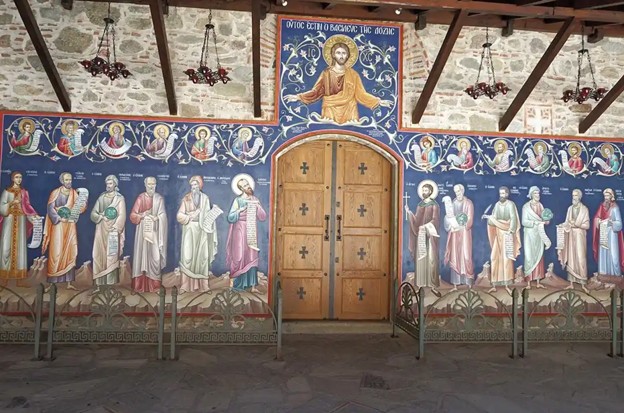
If you were to go to Meteora, Greece, ascend the spire atop of which is the Great Meteora Monastery, and then followed the monks into their katholikon to attend evening vespers, you would walk by a remarkable fresco surrounding the door. It depicts pagan philosophers Solon, Sybil, Socrates, Plutarch, Homer, Thucydides, Plato, and Aristotle (among others) standing next to St. Justin the Philosopher, a Christian who was martyred in the second century.
Today is the feast day of St. Justin Martyr, who wrote some of the earliest and most powerful apologias in the history of the Church. As early as the second century after Christ’s birth he described for the ages the form of Christian worship and contradicted the false claims made by pagans against the followers of Christ. What makes Justin such a powerful voice is that he was a philosopher, an educated man, and so could not, as many early Christians were, be easily dismissed as backward and ignorant (sound familiar?)
He was a student of the philosophical schools and a devotee of Plato, and so could craft the incisive, well-articulated arguments that his opponents found difficult to refute. He could do this, moreover, because he had spent his life pursuing truth, looking for deeper meaning in life, searching for God. Yet, as deeply as he read and understood philosophies of many kinds, they always left him wanting more. Until he met an elderly monk.
The wise old cleric explained to Justin that the knowledge of God cannot fully come through human wisdom. God reveals Himself through prophets, and even directly to us, because God is someone you know, not something you know about. He then showed Justin that the fullest revelation of God was in Jesus.
Suddenly for Justin, everything snapped into place.
The reason the Church honors pagan philosophers is because as seekers of truth, they were seeking Christ, who is Truth incarnated. But because they were relying upon their own wisdom, and Christ had not yet come, they couldn’t fully know the Truth. When Plato wrote in his Symposium about Absolute Beauty, he was inadvertently describing God. He wrote that
He “who has learned to see the beautiful in due order and succession, when he comes toward the end will suddenly perceive a nature of wondrous beauty…which in the first place is everlasting, not growing and decaying, or waxing and waning; secondly, not fair in one point of view and foul in another, or at one time or in one relation or at one place fair, at another time or in another relation or at another place foul, as if fair to some and foul to others…but beauty absolute, separate, simple, and everlasting, which without diminution and without increase, or any change, is imparted to the ever-growing and perishing beauties of all other things.”
God is the source of such beauty, and the realization of these ideas takes work and has a direct effect. According to Plato:
“This is that life above all others which man should live, in the contemplation of beauty absolute; a beauty which if you once beheld, you would see not to be after the measure of gold, and garments…But what if man had eyes to see the true beauty—the divine beauty, I mean, pure and clear and unalloyed, not clogged with the pollutions of mortality and all the colors and vanities of human life—thither looking, and holding converse with the true beauty simple and divine? Remember how in that communion only, beholding beauty with the eye of the mind, he will be enabled to bring forth, not images of beauty, but realities (for he has hold not of an image but of a reality), and bringing forth and nourishing true virtue to become the friend of God and be immortal, if mortal man may.”
Plato had the Truth, but only in part.
Now that Christ is come, all of philosophy is fulfilled in the revelation of God Incarnate. Justin saw this immediately and began to convince even learned men to become Christian, skillfully parrying their assaults on Christian faith and practice. He argued with preeminent philosophers of his day and even with Emperor Marcus Aurelius. He became so effective that a pagan philosopher named Crescentius turned the emperor’s court against Justin and had him arrested and eventually beheaded in 165 AD.
The life of St. Justin reminds us that we must “Trust in the Lord with all [our] heart, and lean not on [our] own understanding.” While Justin was doing that he, like the philosophers before him, missed out. He wasn’t getting the whole truth. But if “In all [our] ways [we] acknowledge Him, He shall direct [our] paths.” St. Justin certainly found this to be true, and so can we.
Always pursue the Truth, follow where it leads, and realize that we are going to need God to give us some hints and nudges now and then. Even Plato needed some help.


thank you, Fr David! I really connected with your article as I always lived philosophy! Happy we got to meet you in SD a while back, our son Stefan just finished his 2nd yr seminary courses at HCHC! Good luck you your sons! Alina
LikeLike