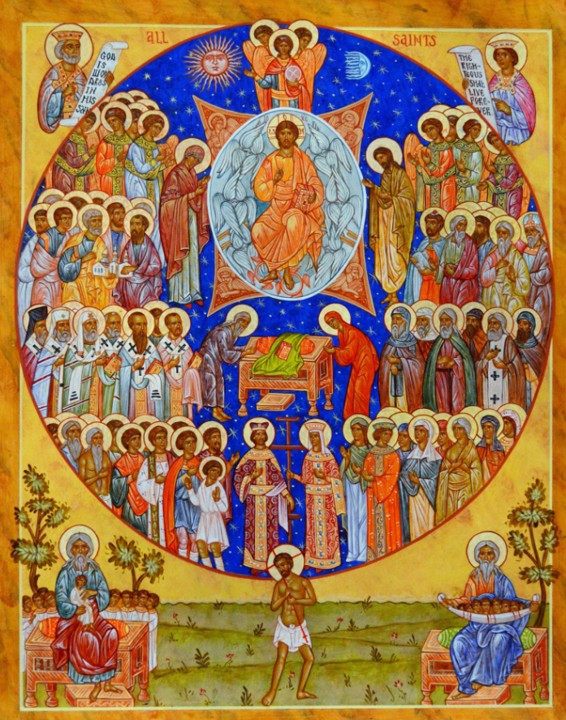
Holiness. Today I would like to talk about holiness. We hear the word all the time, but do we know what it means? Do we know what the implications of holiness are? Of achieving it or not?
Of course, you could look up “holiness” in the dictionary, but then you’d likely find the kind of definition that refers you to another word: the state of “being holy.” But what does “being holy” mean? Because really this is what we need to know, and this knowledge involves more than any dictionary definition.
So, let’s turn to the Church, and to Her saints. This will get a little closer I think, especially since the Greek word that is translated to “saints” is the same word that is used when in English we hear “holy.”
- Holy, holy, holy, Lord of Sabbaoth” is Άγιος, άγιος, άγιος, Κύριος Σαββαοθ.
- When we elevate the gifts at the consecration the priest says, Τα Άγια τοίς αγίοις, the Holy for the Holy.
- And when we commemorate our Most-Holy, pure, blessed, and glorious lady the Theotokos, and ever virgin Mary, with all the saints… μετά πάντων των Αγίων μνημονεύσαντες.
- This is the Sunday of All-Saints, τῶν Ἀγίων Πάντων.
All-Holy. Holiness. When the Church calls us to be saints she is calling us to holiness, to be holy. So, what does the Church, what do the Saints teach us about being Holy? You just heard about it in the scripture readings for the day. Especially in the epistle reading:
“Brethren, all the saints (πάντων των Αγίων), through faith
What did they do? “Conquered kingdoms, enforced justice, received promises, stopped the mouths of lions, quenched raging fire, escaped the edge of the sword, won strength out of weakness, became mighty in war, put foreign armies to flight. Women received their dead by resurrection.”
Can you do that? Maybe not, but we can do some of what’s on this next list:
“Some were tortured, refusing to accept release, that they might rise again to a better life. Others suffered mocking and scourging, and even chains and imprisonment. They were stoned, they were sawn in two, they were tempted, they were killed with the sword; they went about in skins of sheep and goats, destitute, afflicted, ill-treated – of whom the world was not worthy – wandering over deserts and mountains and in dens and caves of the earth.”
Sounds like being holy and being a saint isn’t so easy.
To be “Holy” means to be set apart, consecrated. If we are set apart from the world, then we will be against, opposite, the world. These saints that Paul is talking about to the Hebrews were so set apart that the world was not even worthy for them to be walking in their midst, and this set them at enmity with the world with the resulting devastating consequences. If we want to be holy, then we must be set apart, set at enmity with the world.
But what does it mean to be at enmity with the world? Here Jesus gives us a clue in this morning’s Gospel reading: “Everyone who acknowledges me before men, I also will acknowledge before my Father who is in heaven; but whoever denies me before men, I also will deny him before my Father who is in heaven.”
Ok. I think I can do that. But Jesus doesn’t stop there. He adds “He who loves father or mother more than me is not worthy of me; and he who loves son or daughter more than me is not worthy of me; and he who does not take his cross and follow me is not worthy of me.” He’s repeating a speech he gave the disciples in chapter 10, right before he sent them out to teach in Israel, and there he was much clearer. The Lord said
“Do not think that I came to bring peace on earth. I did not come to bring peace but a sword. For I have come to ‘set a man against his father, a daughter against her mother, and a daughter-in-law against her mother-in-law’; and ‘a man’s enemies will be those of his own household.’ He who loves father or mother more than Me is not worthy of Me. And he who loves son or daughter more than Me is not worthy of Me.
Are you ready for that? I’m not sure I am. But I do know that Christianity, and perhaps Orthodox Christianity in particular, knows that to be holy, to be Christian—Christ-like—means to suffer.
Actually, to live in the world means to suffer. Many of the difficulties I see among young Sailors and Marines result from how surprised they are that life is so difficult, that it’s unfair, and often hurts. They can sense that there’s something wrong about it, that life should not be this way, but it is and the sort of cognitive disconnect causes significant stress.
Every religion since the dawn of man has wrestled with this phenomenon: that life is full of suffering, and that we can sense that it isn’t supposed to be this way. Hinduism used karma to try and explain it, Buddhists say detachment from the world is the only way, modern politicians (today’s most popular religion) will tell you that correct policy will end human suffering. Christianity says that we can’t fix suffering, that it is largely a result of our own making, and—even more shocking—that it can actually be good.
St John Chrysostom explains by saying that in the midst of suffering it is a “truly great consolation” for us to recall the “sufferings of Christ and of the Apostles. For [Jesus] so well knew that this is the better way of virtue, as even to go that way Himself, not having need thereof: He knew so well that tribulation is expedient for us, and that it becomes rather a foundation for repose.” This is why Jesus says, “if a man takes not up his cross and follow after me, he is not worthy of me.” He does this, says St. Chrysostom, because affliction is a great thing “for it accomplishes two great things: it wipes out sins and it makes men strong.”
This is why the psalmist prays to “Make us glad according to the days in which You have afflicted us, the years in which we have seen evil.” Because it makes us stronger in faith. Smooth seas never make great sailors.
But clearly all these champions of the faith, this cloud of witnesses in Hebrews, were ready, were faithful, were triumphant. Yet, says the Apostle:
“And all these, though well attested by their faith, did not receive what was promised, since God had foreseen something better for us, that apart from us they should not be made perfect.”
Even though they succeeded in titanic tasks, even though they triumphed in faith, even before Christ had come, yet they must wait for their crown of victory, for their promise, until we receive ours. And here we, in our comparably meager suffering get so impatient to have what we think we’ve earned.
I pray and don’t get what I ask for, I fast and still can’t control my appetites, I give alms to the poor and yet can’t afford the things I want. And since my neighbor has found out I’m a Christian, he keeps harassing me calling me a hateful bigot. My father won’t speak to me anymore since I became Orthodox. I have to be at Church soooo early on Sunday morning.
We admire holiness, but we don’t really want it. Everybody wants to go to heaven, but nobody wants to die. Everybody wants miracles, but nobody wants to pray.
With all our suffering and all our struggles yet we are still waiting for the victory, just like those saints of old who are still waiting. But the waiting is good. To me it’s like the baseball team waiting at home for the player who just hit the winning home run in the 9th inning to round the bases so they can all celebrate together. The batter must still touch every base, but they win together, they receive the trophy together, they celebrate together.
The word “perfect” here in Hebrews means “complete.” No one gets the crown until we all, the Church, are complete.
This is the encouragement that we have in the midst of our suffering:
“Therefore, since we are surrounded by so great a cloud of witnesses, let us also lay aside every weight, and sin which clings so closely, and let us run with perseverance the race that is set before us, looking to Jesus the author and perfecter of our faith.”
We aren’t running our race alone. Today is ALL saints. Sometimes we think that this is the catch-all celebration for the saints who don’t have their own feast day on the calendar, but it isn’t. It is for all saints, known and unknown. We are surrounded by saints, in this world and the next. And Metropolitan John Zizioulas tells us that when we participate in Holy Communion we also
“draw on our communion with all the saints, and thus we hope and pray and expect that we too can be saved somewhere deep in the body of Christ, in the body of the saints. Woe to us if we believe that we can be saved by our own virtues, that we can be saved by our individual holiness.”
Thank God I don’t have to try and be holy all by myself. I could never do it. But with the saints, in the Church, I can move from earthbound sinfulness to heaven bound holiness through the grace and love of our Lord and God and Savior Jesus Christ. The author and finisher of our faith. Let us run that race together, beginning today with All the saints we celebrate here today.

