Pitchers and catchers have reported to spring training, my MLB.TV subscription has renewed, and I can’t wait for baseball to begin a new season. No matter how the MLBPA and MLB try to ruin it for me, I cannot help but be positive in anticipation of each Major League season. This also seems to me a suitable time to recommit effort to this blog. Not only because I enjoy talking baseball, but also to give my long-forbearing wife a break from my ranting.
I confess that some of the rules changes introduced last season have had a positive effect on the game. It is regrettable that it took a clock to make them do so, but it is wonderful to see the batters remain in their box and pitchers on their mound in between most pitches. The pitch clock has certainly decreased the time it takes to play nine innings and increased the pace of play. That is a good thing.
Another good thing: stealing bases made a comeback last year. The number of stolen bases last season (3503) increased more than 40% from 2022. Interestingly, there was no corresponding increase in the number of runners caught stealing. Though more runners were caught stealing, the increase was a far more modest 7%.
There was much fanfare over the new rule that would ban “the shift,” but, though it has limited how much they do, it hasn’t stopped teams from moving their infielders away from conventional positions to ones shown by analytic data to be the most likely spot the batter will hit the ball. As a result, hitting saw a modest increase in 2023 of only 3% more than 2022’s total hit numbers, but most of those (almost 90%) were extra base hits.
The first two changes were the most exciting ones with the most obvious effects on game play, and there are good things about those changes. But those positives have not come without cost.
While the pitch clock does hold the pitcher and batter in their relative positions during most of an at bat, it also tells a potential base-stealer when the pitcher must throw a pitch. Combined with the new rule that limits pick-off throws to first base to only two before penalizing the pitcher with a balk, and it’s easy to see why bases were so easy to steal last year. It isn’t really so exciting if there isn’t much chance that the runner will be thrown out.
“Banning the shift” also had less than its desired effect, at least the effect we were told they were shooting for. Most pundits agreed with Tom Verducci that “the MLB batting average should increase from .243 last season (the fifth-worst ever, and the worst in 54 years) to .255 (equaling the highest since 2011). Well, the league average did increase, but only to .248, making it the fourth year in a row—and the fifth in the last six seasons—to dip below .250. Before the current stretch, you must go all the way back to 1972 to find another sub-.250 season.
Apparently banning shifts and between-pitch walkabouts has not prompted batters to change their approach at all and they are still looking for one of the three “true outcomes” of every at bat, the approach first implemented by the analytics-driven “Moneyball” Oakland Athletics. Since then, most teams have tried to get the most out of each dollar spent by looking to stats that reveal the ability of the batter independent of other factors like ballpark features and fielders’ defensive capability. To this perspective only walks, strikeouts, and home runs can be determined by a hitter’s ability, and thus are the only “true” outcomes of an at-bat, and thus have become the primary metrics upon which hitters are evaluated and paid, and thus affects their approach at the plate.
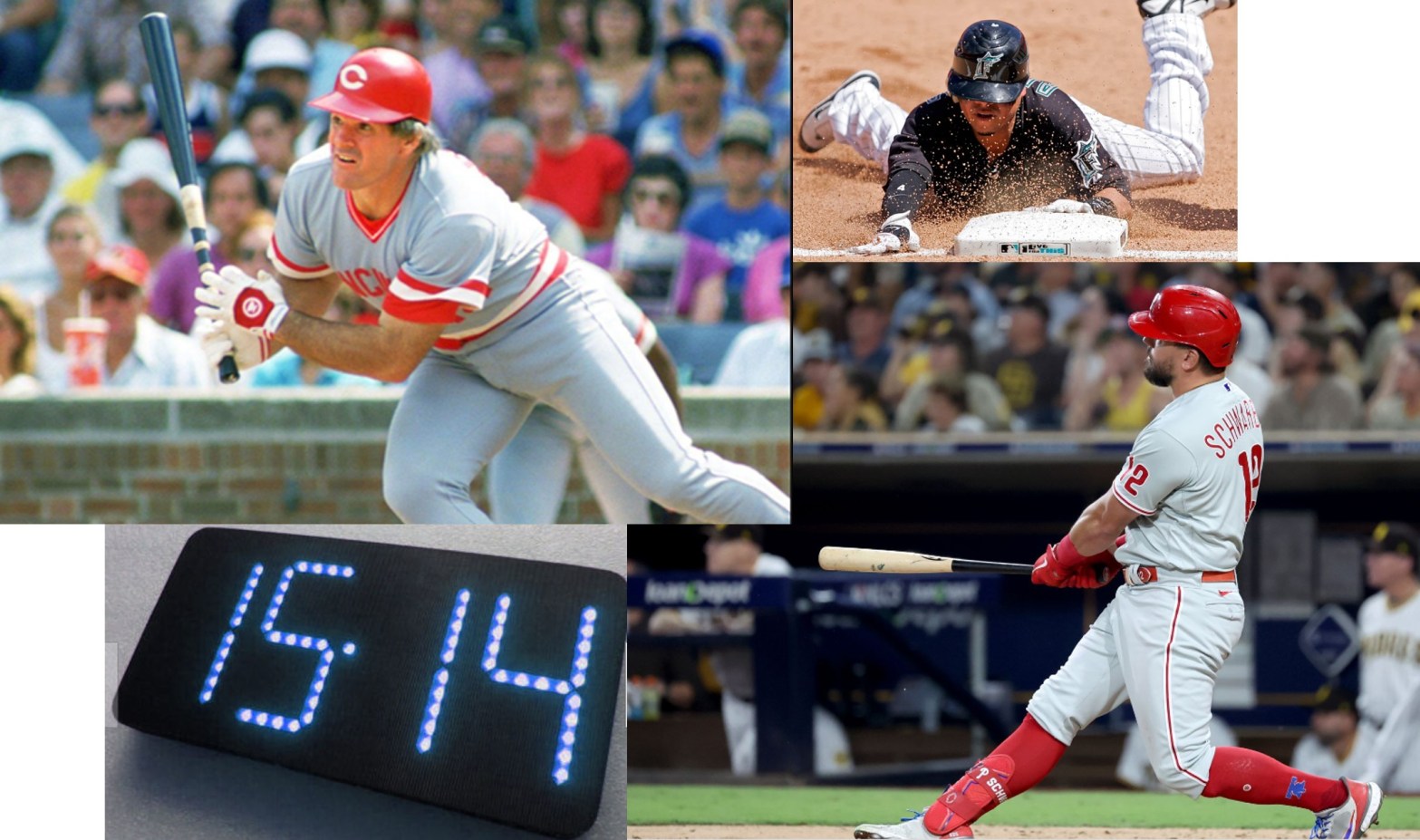
When I was learning to play baseball growing up, we were taught to look for a pitch to hit. Our job was to simply put the ball in play, following Pete Rose’s philosophy of “see the ball, hit the ball.” Considering that he accumulated 4256 hits and a 0.303 lifetime average over his 24-year career, his philosophy merits attention. However, batters are now trained to look, not for a pitch to hit, but for one they can drive, and so batters lay off of close pitches that Rose might have hit safely to the opposite field, waiting for one that is in their wheelhouse that they can hit deep. The result is a lot more pitches thrown, more bases on balls, and a lot more strike outs.
The effects of this new approach to hitting, focused on true outcomes and taking lots of pitches, can be seen in the changes of per game averages over time. For symmetry let’s start with 1977, 23 years before 2000. It was an average year for Rose who hit .311 that year (13th in MLB) with 66 walks and 42 strikeouts. As for the rest of the Majors, the overall batting average was 0.264, with an average of 9.04 hits, 3.27 walks, 5.16 strike outs, and 0.87 home runs per game.
In 2023, by contrast, I already mentioned the astonishingly low MLB batting average 0.248, but what also dropped was the league average of hits per game to 8.4, less than one hit per inning. Yet though there are now fewer hits per game, those hits are more likely to be home runs. There were 1.21 home runs per game last year, so on any given day fans were far less likely to go home without seeing a home run than they were in Rose’s MLB. Taking more pitches did result in more walks per game, but only slightly with 3.34. Where the new approach really reveals itself is in the incredible increase in strikeouts to 8.47 per game, an increase of nearly 65%.
Illustrating my point is the simple fact that the Phillies made Kyle Schwarber their lead-off hitter despite having struck out 215 times, only eight strikeouts away from setting a new single season record. Schwarber gets more at-bats in that position, so though he’s likely to thus get more strikeouts, it also increases his opportunities to jack a long ball. The team is willing to eat the extra, non-productive outs for the benefit of his 47 home runs. If that’s the case, then they certainly aren’t going to ask him to slap a hit to a wide-open left side of the infield just to get on base. He’s waiting for a pitch to drive, not one to simply hit, and so he watches a lot of third strikes go by.
No matter how many rules MLB changes, until teams change their expectations, hitters will not change their approach, and we will be stuck with boring games of strikeouts punctuated by occasional home runs and easy stolen bases. But, hey, at least the clock-governed game will be shorter.
 An Orthodox Priest Abroad
Interesting. I didn’t know that much about baseball! Nice to hear from you!😄
LikeLike